☕ Help us keep WTS free & accessible—buy us a coffee
☕ Help us keep WTS free & accessible—buy us a coffee

Author: Niki Mosier
Last updated: 03/11/2026
Every time someone tells me AI writes bland content, I ask to see the prompt. It’s almost always one sentence long.
“Give me 10 content ideas about fly fishing.”
Eight words. I’d never brief a freelance writer in eight words and then act surprised by what came back, but I’ve watched a lot of smart marketers do exactly that to a language model and conclude the model is the problem.
It isn’t. The model answered the question it was asked. With no information about who you are, who you sell to, or what you sound like, the only safe answer it can give is the consensus answer. Call it the average of everything ever written about fly fishing. That average is, by definition, what everyone else has already published.
So you get “Top 10 Fly Fishing Tips for Beginners.” You get “The Benefits of Fly Fishing.” You get a rod-buying guide that could sit on any of four hundred websites without anyone noticing.
I want to make a case for fixing this upstream, because the fix works. It takes a single afternoon. After that, a prompt that used to return ten forgettable titles returns fifty ideas you can actually put on your editorial calendar.
In nearly every content team I’ve worked with, in-house and agency, the step that stalls isn’t drafting. People can write. What they run out of is things worth writing about.
That shows up in three ways, and you’ve probably felt all of them. The blank page, where you stare at the cursor and every idea you can think of feels already taken. The treadmill, where four channels want more from you, more often, on the hours you already had. And the burnout that follows from scrambling for ideas week after week, shows up in the work long before anyone admits it out loud.
Most teams don’t have a writing problem. They have an ideation problem, and it’s the one nobody schedules time for.
AI is genuinely good at this part. It’s fast, it doesn’t get precious, and it will happily give you fifty options when you would have stopped at six. But it will only do that well if you stop treating it as a brainstorm partner and start treating it as an amplifier, because whatever you feed it is what comes back, multiplied.
Which means the quality of your output is decided before you write the prompt at all. It’s decided by what you tell the model about your brand.
This isn’t fine-tuning and there’s no code involved. It’s a document. You write it once, you save one per brand or client, and you paste it into the top of every ideation prompt from then on.
Six inputs go into it. I want to take each one in turn, because this is where the whole thing succeeds or fails, and because the two most common failure modes are opposite: some companies have none of this documented, and some have all of it documented so generically that it’s worse than nothing. If you feed the model beige, you get beige back with more words.
Throughout, I’m using a composite outdoor-gear brand as the example — call it Tailwater Supply. The details are invented; the pattern is not.
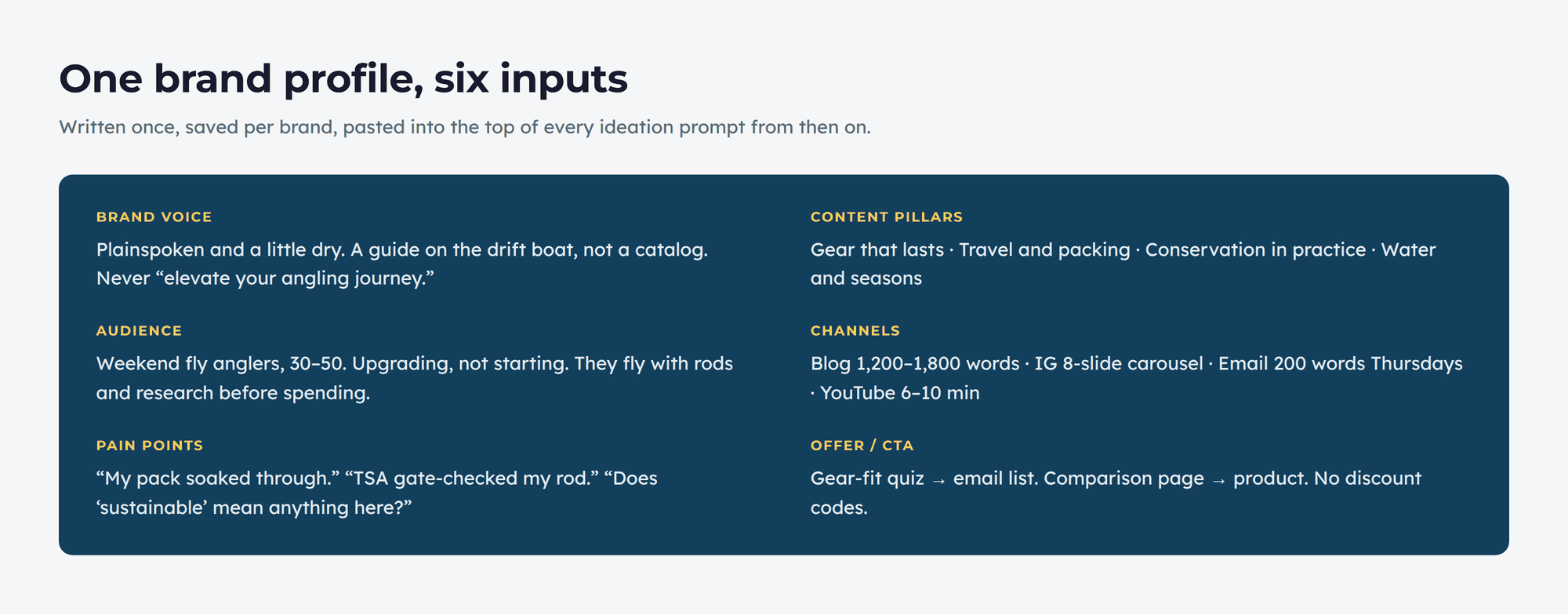
A list of adjectives isn’t a voice. “Professional, friendly, approachable” describes almost every company in almost every category, which means it gives the model nothing to act on and hands you back the same copy as your closest competitor.
Here’s the difference. This is what most voice documents say:
Professional, friendly, approachable. We speak with authority while remaining accessible.
And this is what a voice document should say:
Plainspoken and a little dry. We write like a guide on the drift boat, not a catalog. Short sentences. We name gear failures honestly, including our own. Never say “elevate your angling journey,” “game-changer,” or anything with an exclamation point.
The second one is usable because it contains instructions. Note especially the last line. A “never say” list does more work than any number of adjectives, and it’s the easiest part to build, because it’s just your last round of edits written down.
If you have nothing: paste your three best-performing posts and ask the model to reverse-engineer the voice rules, then edit what it gets wrong. Add the banned words. Name the human you sound like — guide, mechanic, professor, friend. If your voice document could be pasted onto a competitor’s website without anyone noticing, it isn’t a voice. It’s a mood.
An audience of “everyone” produces content for no one. The specificity here is what makes an idea feel written for a reader rather than at them, and demographics don’t get you there. Behavior does.
Outdoor enthusiasts, 25–54, who value quality and care about sustainability.
That’s a media-kit sentence. It has no edges. Compare it with this:
Weekend fly anglers, 30–50. Two to four trips a year, mostly Western tailwaters. They already own decent gear — they’re upgrading, not starting. They fly with rods, drive three hours to water, and research obsessively before spending over $150.
Every clause in the second version generates ideas. “They fly with rods” is worth ten pieces on its own. “Upgrading, not starting” rules out the beginner explainers that would otherwise dominate the list.
If you have nothing: don’t invent a persona. Nobody needs Marketing Mary, age 34, enjoys yoga. Pull real language out of your last twenty support tickets and your sales-call notes. Write down what your audience does, not who they are, and always include what they already know.
This is the most important of the six, and the one I’d spend the most time on. Four of the frameworks I use run directly off this list.
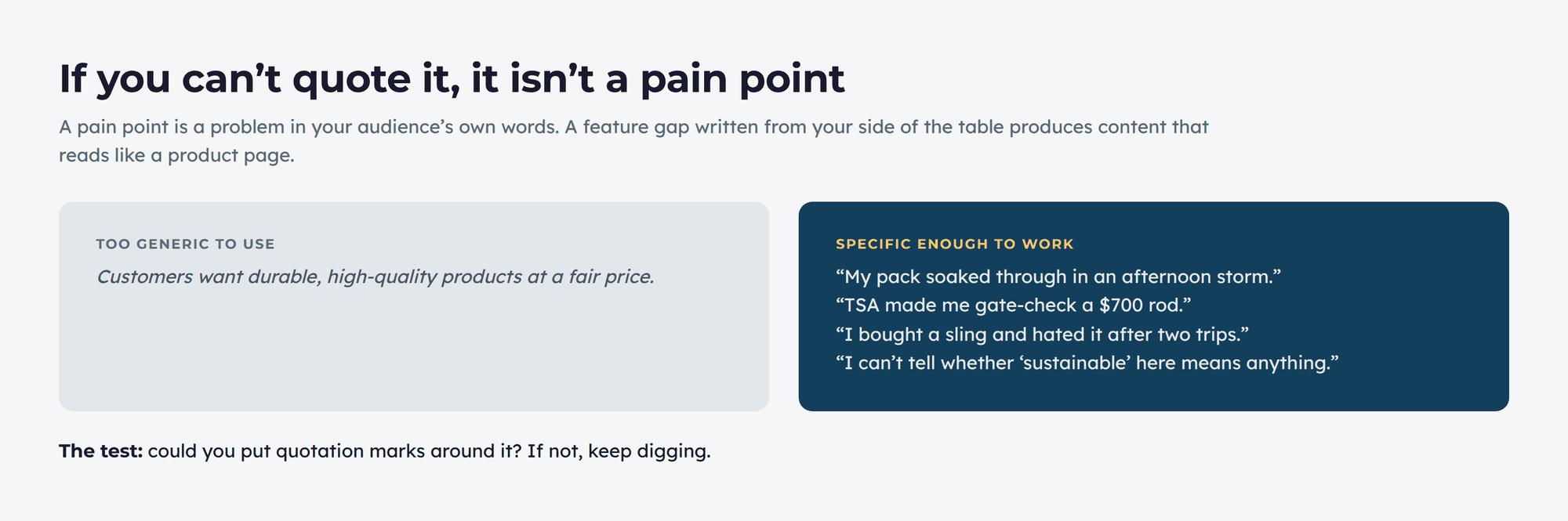
A pain point is a problem in your audience’s own words. A feature gap written from your side of the table is a different thing, and it produces content that reads like a product page:
Customers want durable, high-quality products at a fair price.
Real pain points sound like people:
“My pack soaked through in an afternoon storm.”
“TSA made me gate-check a $700 rod.”
“I bought a sling and hated it after two trips.”
“I can’t tell whether ‘sustainable’ here means anything.”
The test is simple: could you put quotation marks around it? If not, you’ve written a category description, and you need to keep digging.
If you have nothing: read the three-star reviews — yours and your competitors’. A five-star review is a fan. A one-star review is usually a shipping problem. A three-star review is someone telling you exactly what almost worked. Copy the phrasing verbatim, typos included. Check your support tickets and sales objections too.
Pillars stop the model from wandering. Without them you get fifty ideas spread across fifty unrelated topics and no compounding authority anywhere.
These are channels and content types, not pillars:
SEO, social media, industry news, company updates.
Pillars are subject areas:
Gear that lasts — durability, repair, warranty. Travel and packing — flying with rods, carry-on. Conservation in practice — materials, certification, river cleanups. Water and seasons — where to fish, and when.
Three to five is the range. More than five and they stop functioning as constraints. Pillars are also your first prioritization filter: if an idea doesn’t belong to one, it probably doesn’t belong on the calendar.
If you have nothing: derive them. Cluster your top organic landing pages, your product lines, and the three things your sales team repeats most often. And apply the honest test — if a pillar doesn’t map to something you sell, it’s a hobby. Most content teams have one of those, and it usually exists because someone senior finds it interesting.
Channel is a constraint, not a checkbox. It’s what gives an idea a shape. Ask for “a post” without it and you get a formless blob that fits nowhere and has to be rebuilt for every platform.
“Blog, social, email, video” tells the model nothing.
This does:
Blog: 1,200–1,800 words, how-to and comparison, search-led. Instagram: eight-slide carousel, hook on slide one, visual-first. Email: 200 words, one idea, one link, Thursdays. YouTube: six to ten minutes, shot on the water. We don’t publish on X or LinkedIn.
That last sentence matters more than it looks. Naming the channels you’ve deliberately ruled out stops the model from suggesting TikTok every single time, and it saves you from re-explaining the same constraint in every prompt.
If you have nothing: write down what you actually publish and how long it is — not the aspirational version. People often input the channel plan they wish they were executing, then wonder why the calendar the model builds is undeliverable. Include your real cadence, and it will plan a month you can ship.
Everything above decides whether the content is good. This decides whether it does anything.
“Drive brand awareness and increase engagement” isn’t an offer. It’s a shrug. Without a named next step you generate ideas that earn traffic and attach to nothing, and a year later you’re defending a content program on impressions.
Aim for something like this instead:
Primary: get them into the gear-fit quiz, then onto the email list. Secondary: the sling versus lumbar comparison page, then the product. We don’t push discount codes — our margin story is repairability, not price.
If you have nothing: pick one primary and one secondary. Both measurable, both a step a stranger could actually take. Name what you won’t do, too. And carry one question into every idea you generate from here on: and then what? If an idea can’t answer it, it isn’t ready for the calendar.
Six inputs, one document, an afternoon. Mine has been pasted into several hundred prompts since I wrote it. That ratio is the whole argument for doing the work up front.
With the profile written, the prompt itself becomes mechanical. Five parts, every time.
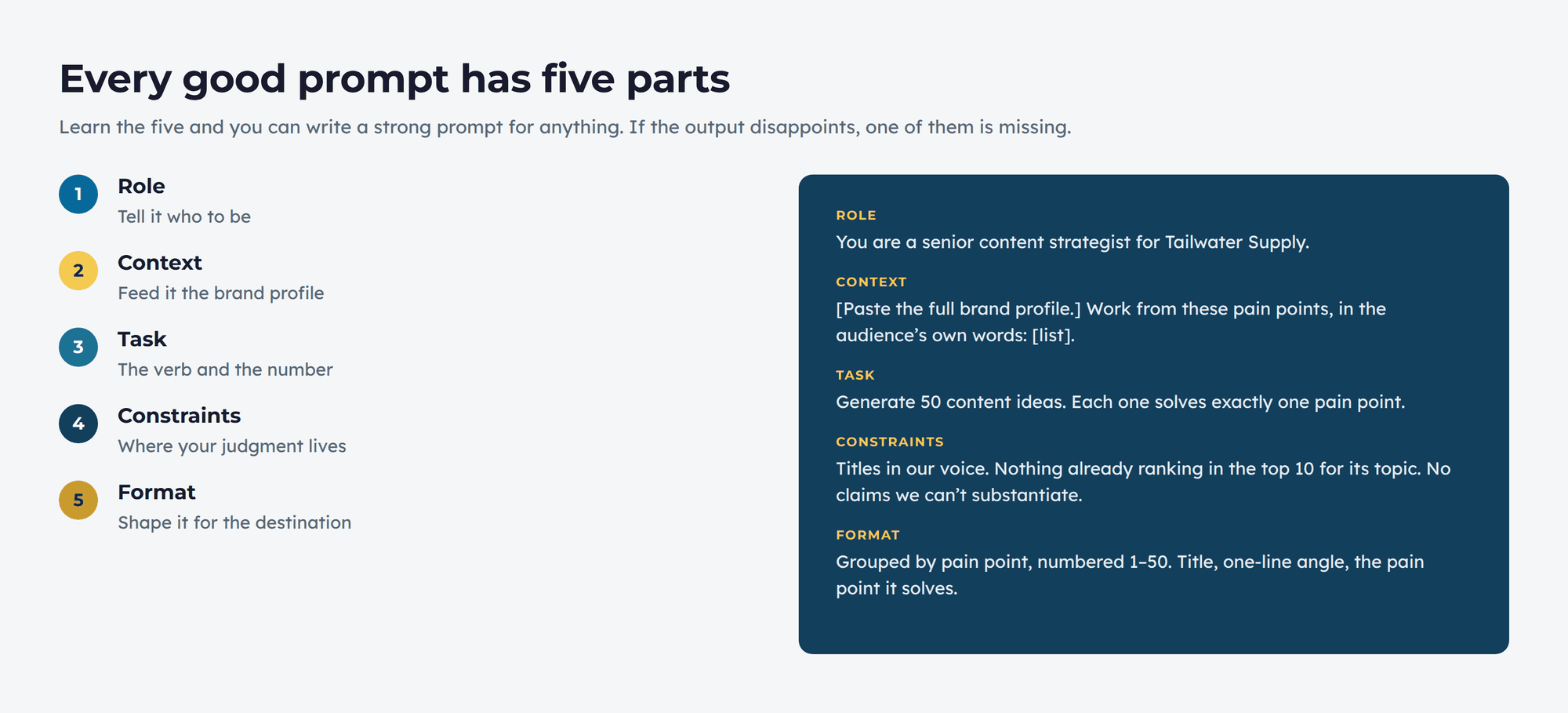
If your output is disappointing, one of these is missing, and you can usually tell which one from the shape of the failure.
Two or three words import an entire way of thinking. “A senior content strategist” brings audience thinking, angles and prioritization with it. Leave it out and the model defaults to a helpful generalist whose instinct is to explain the topic rather than sell against it. You get encyclopedic explainers in a textbook register. Role-play a job, not a celebrity.
This is where the brand profile goes, and it’s the single biggest lever on quality. Drop it and you get ideas that are technically on-topic and completely interchangeable with your competitor’s. That’s the failure people mistake for “AI isn’t good at this yet.” Paste the whole profile every time; don’t summarize it. When output seems to get worse over months, it’s almost never the model. It’s that the context got thinner as you started pasting shorter versions.
The verb and the number. Ask for “some ideas” and you get five, plus an offer to continue. The number isn’t vanity: the first ten ideas on any topic are the consensus ones your competitors already published, and volume is what pushes the model past them. Ideas thirty through fifty are where the interesting ones live. One task per prompt. Don’t ask for ideas and a calendar and headlines in a single breath.
This is where your judgment lives, and it’s the part almost everyone skips before complaining that the output sounds generic. You never told it what generic looks like. Constraints aren’t restrictions on the model; they’re the transfer mechanism for your taste. The best source is free. Every time you fix something by hand, that fix is a constraint you owe your next prompt.
Format decides whether you get something usable or a wall of prose you retype into a spreadsheet. Everything upstream makes the output good; this is the part that makes it fast. Format for the destination: ask for the exact column names your calendar already uses, and the result pastes straight in.
Here’s the prompt I reach for first each quarter, when the calendar is empty and I need ideas.
It’s the five parts, filled in:
Three things in there are doing more work than they look like they are:
The same five parts rebuild into whatever job you have:
In fifteen minutes I get content ideas which I can actually use. Let’s get specific about what happens in those fifteen minutes:
The first two minutes were me pasting in the brand profile. That’s the only part that was already done, and it’s the part that took an afternoon months earlier. Thirty seconds went to pasting the framework prompt above, unedited — I changed the brand name and nothing else.
Fifty ideas came back in under a minute.
The remaining twelve minutes were me reading the ideas, and deciding which to take forward into production.
I cut eleven ideas in total:
That left thirty-nine ideas, (which is roughly a quarter of a year's worth of content from one prompt).
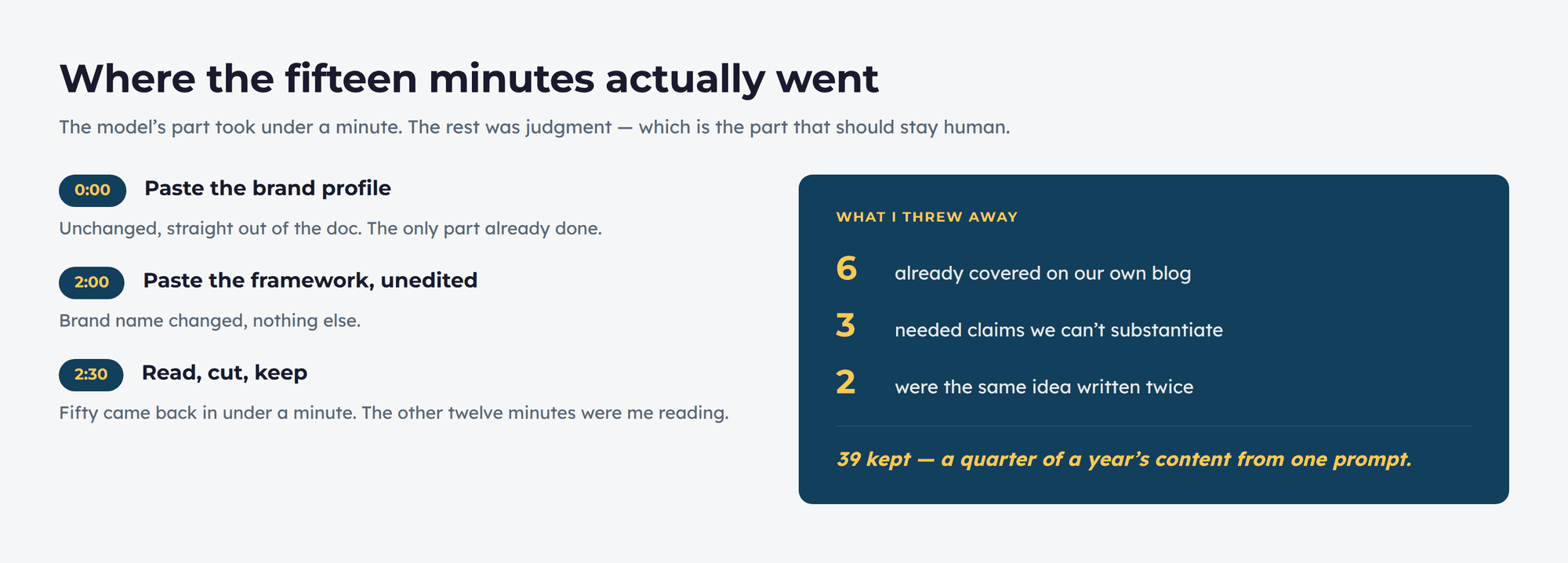
I mention the eleven ideas I discarded deliberately. Fifty perfect ideas would be a better story and a worse claim. What the number actually tells you is where the human belongs in this process: not in generating options, which is the part machines are good at, but in judging them against things the model can’t know: what you’ve already published, what your legal team will accept, what you’ve quietly decided not to be known for.
It also tells you something useful about constraints. Every one of those eleven cuts is a constraint I can add to the next run:
The prompt gets sharper each quarter because I keep feeding my own edits back into it.
The workflow, once it settles, has four steps:
Then repeat.
Only the first step takes real effort, and you only do it once per brand.
What I’d push back on is the framing that any of this makes strategy easier. It does not. It makes ideation faster, which is a different thing, and faster ideation is only useful if someone is still making decisions about what deserves to exist. The model will give you fifty plausible ideas whether or not fifty good ones exist. It has no opinion about your positioning and no memory of the post that flopped in March.
But the version of this job where a smart person spends Thursday afternoon staring at a blank calendar, trying to invent something from nothing — that part is over, and I don’t think anyone should miss it.
Write the profile. Paste it every time. Spend the hours you get back on the judgment, which is the part worth paying for anyway.
If you’d rather not start from a blank page, I’ve built a free tool that does the assembly for you. The Brand-Trained Content Prompt Generator takes your brand, audience and goals and turns them into a full set of ideation prompts, ready to paste. There’s no sign-up. On the same page you can also download the slides from my WTSFest talk, which include the brand profile template and six prompt frameworks you can adapt for your own team.

Niki Mosier - SEO Manager, NASM (National Academy for Sports Medicine)
Niki Mosier is the SEO Manager at NASM, and has 14+ years of experience across agency, freelance, and in-house roles, specializing in technical SEO and data-driven growth. Niki is a Wisconsin native now living in Colorado, balancing digital marketing with outdoor adventures in the Rockies.
We pay our authors, speakers & team to bring you helpful content like this.
We aim to always keep our content and community free and accessible.
If you've found value in WTS, please consider supporting us through our Buy Me a Coffee initiative.