Author: Despina Gavoyannis
Last updated: 01/06/2026
For years, most SEO professionals considered branding to be someone else's job. While marketing teams worried about building and protecting the brand, SEOs focused on technical fixes, on-page optimization, and backlinks.
That division has collapsed.
Google's algorithms now consider brand signals when determining which pages to rank, AI Overviews tend to surface established names, and AI models like ChatGPT connect brands to topics based on how people across the web talk about them.
In this article, you'll learn:
Search engines now understand brands, products, and concepts as distinct entities. They treat them as objects with properties and relationships that exist independently of keywords and search queries.
For most of search engine history, the game was simple: lexical (or keyword-based) information retrieval methods were employed which matched search queries to words featured directly on web pages.
If you searched "running shoes," you’d get pages that contained that exact term. It’s a bit like how Google Scholar still works today:
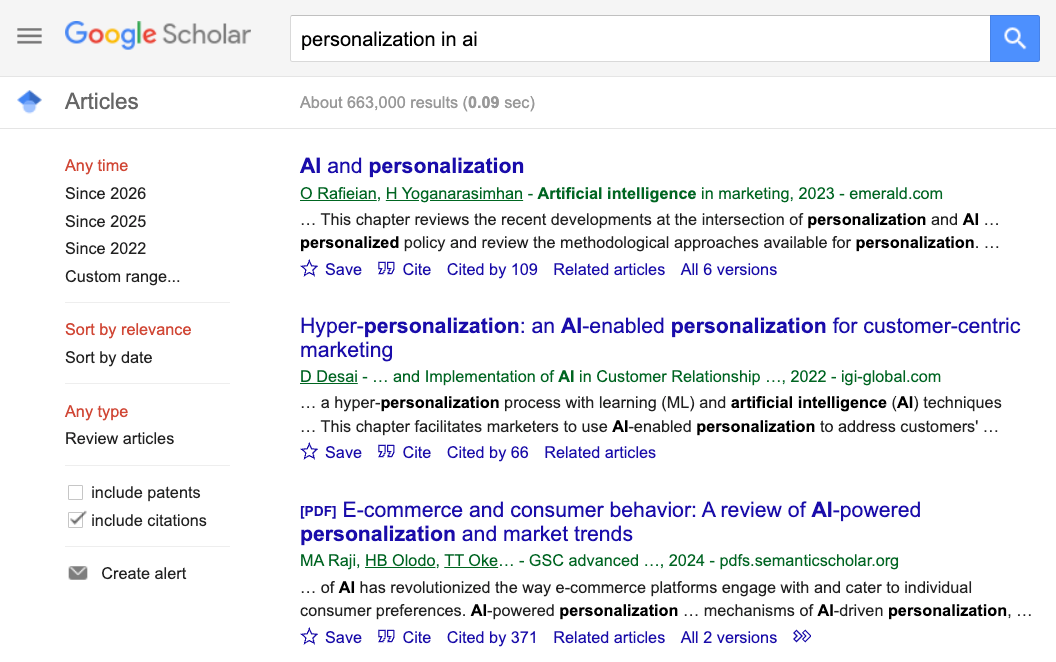
A Google Scholar search result page for “personalization in ai”.
This lexical approach treated search like Ctrl+F – the system was unable to determine what the search query meant, it just returned answers based on matching the query.
Modern search engines understand entities: organizations, people, places, and concepts with documented properties and relationships.
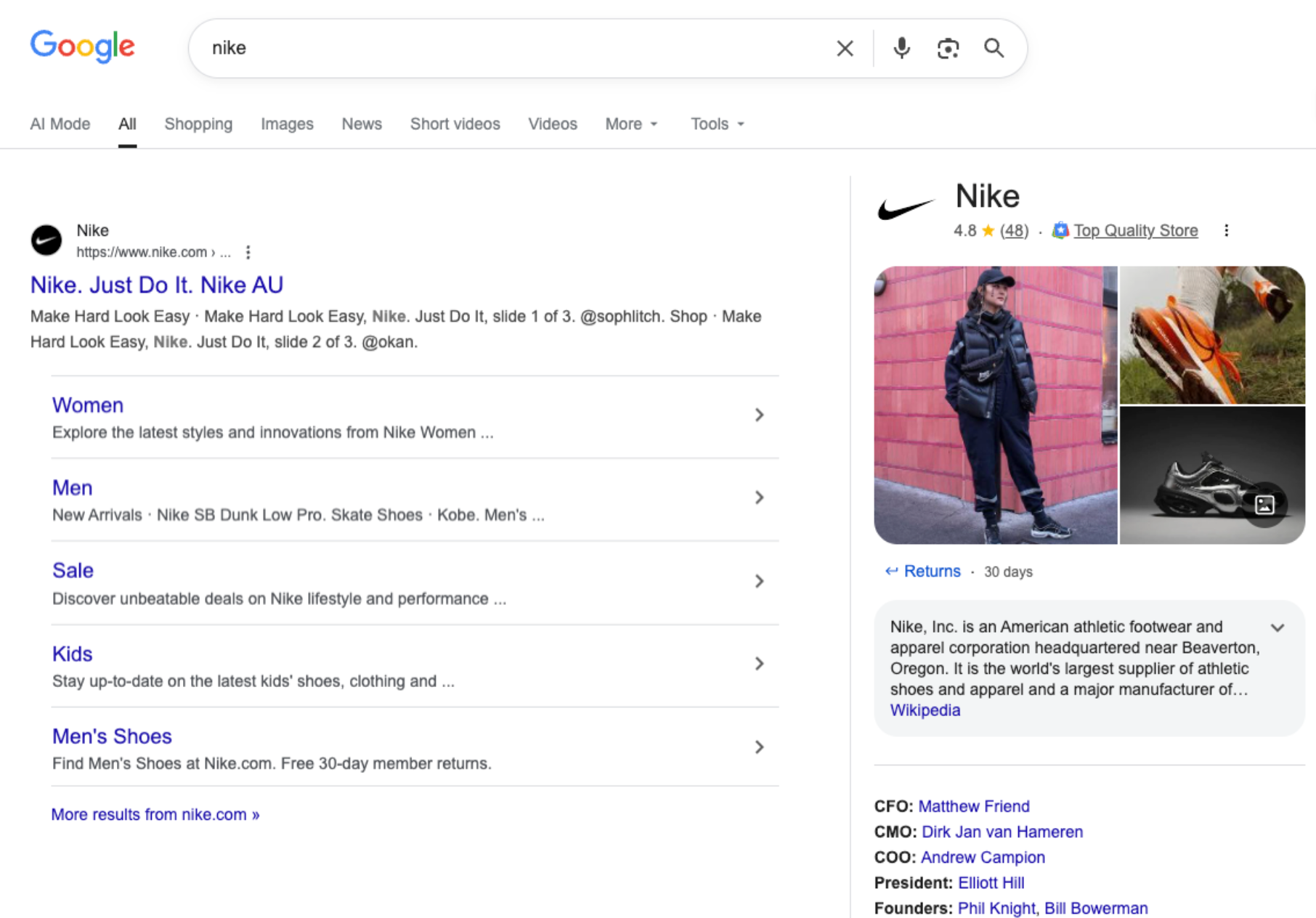
Take Nike as an example. To a semantic search system, "Nike" could refer to the performance footwear brand:
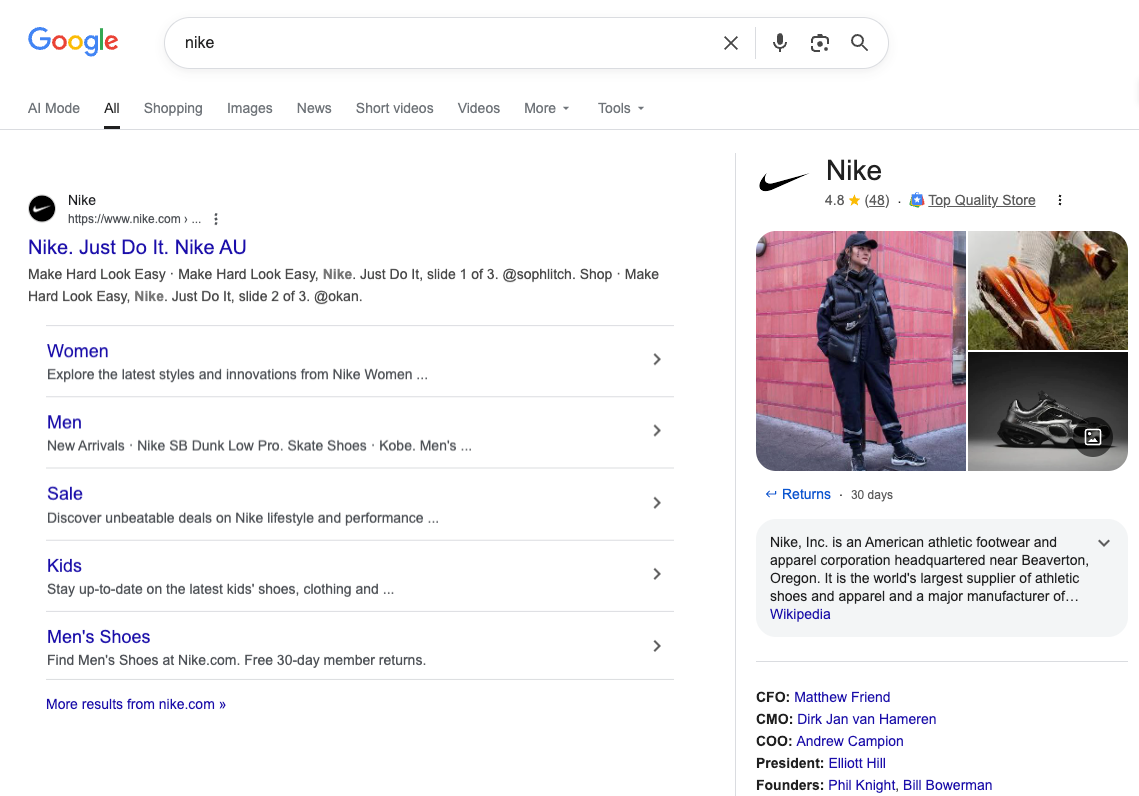
Google search results for the query “nike”.
Or the Greek goddess of victory:
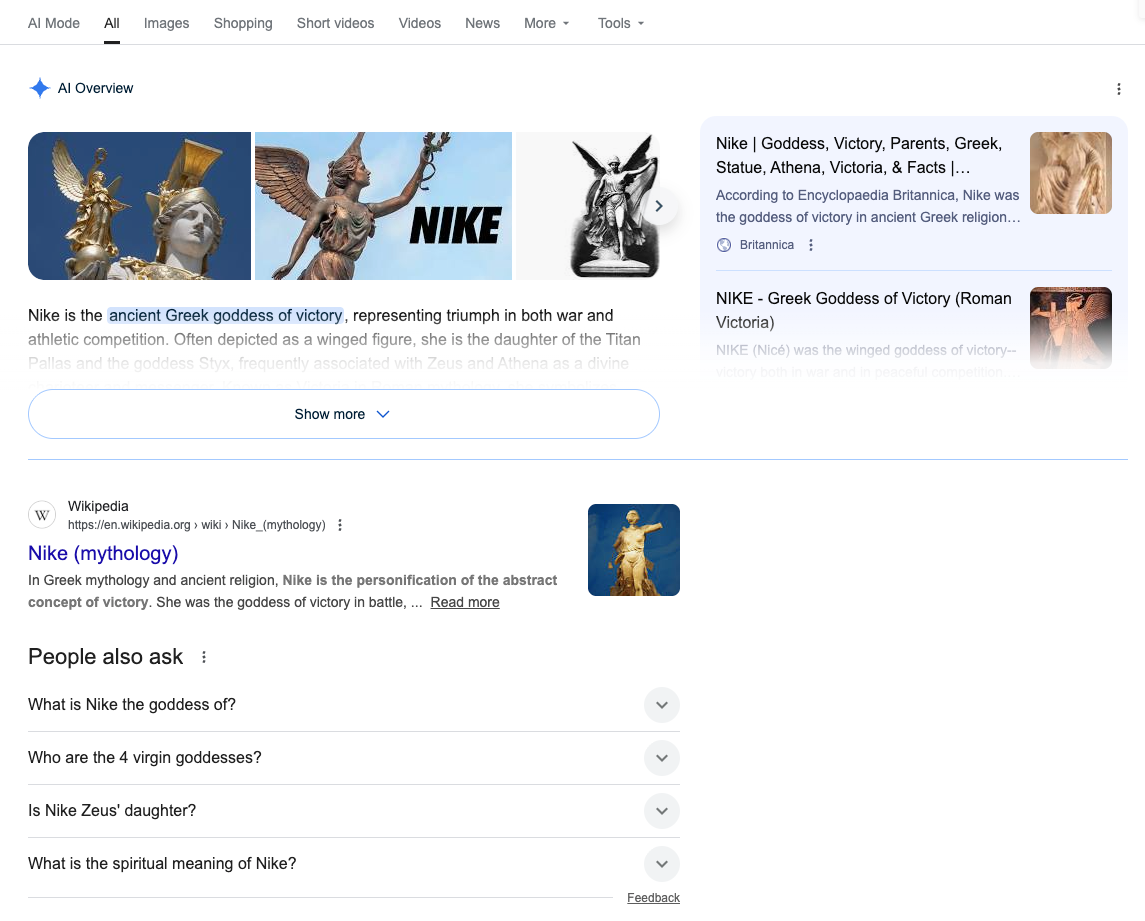
Google search results for the goddess Nike.
Google distinguishes between the sportswear brand and the goddess by examining context. When Nike appears alongside:
… The system understands that in these instances, Nike refers to the sportswear brand.
These connections are built from patterns across millions of data points, including branded searches, mentions in authoritative publications, co-occurrence with specific topics, and surrounding context.
For years, Google used hybrid methods of information retrieval: lexical matching for most queries, semantic understanding for ambiguous ones.
AI has disrupted that balance.
Now, whether someone searches on Google, ChatGPT, or Perplexity, queries run through predominantly semantic processes that prioritize meaning over matching.
When someone searches for "best running shoes for marathons," they get brands with strong semantic connections to "marathon running," "performance," and "distance running" rather than pages stuffed with those keywords. Brands with weak or inconsistent entity signals simply don't appear.
If your brand isn't recognized as a distinct entity, you're invisible to the systems that increasingly control search visibility.
Understanding that search engines and AI systems treat your brand as an entity is one thing. Understanding how they build that entity (what data they use, how they process it, and why they get it wrong) gives you strategic leverage.
Modern search systems aggregate information from multiple sources, weighted by trustworthiness. These sources include:
Inconsistency across these layers can create confusion around your brand and its trustworthiness. If your website, authoritative sources, and user reviews contradict each other, AI systems can't build a coherent entity profile.
Google’s systems, in particular, are likely to default to what independent, trusted sources say about you over what you say about yourself.
Search systems don't just catalog your brand. They also map which topics, attributes, and concepts you're associated with.
For example, when searching for the best SUVs, search systems can connect specific brands to the product categories and features they are best known for. For example, in this AI Overview response, Google highlights Honda as the best choice SUV for reliability and value, Kia as the best family SUV, and so on:
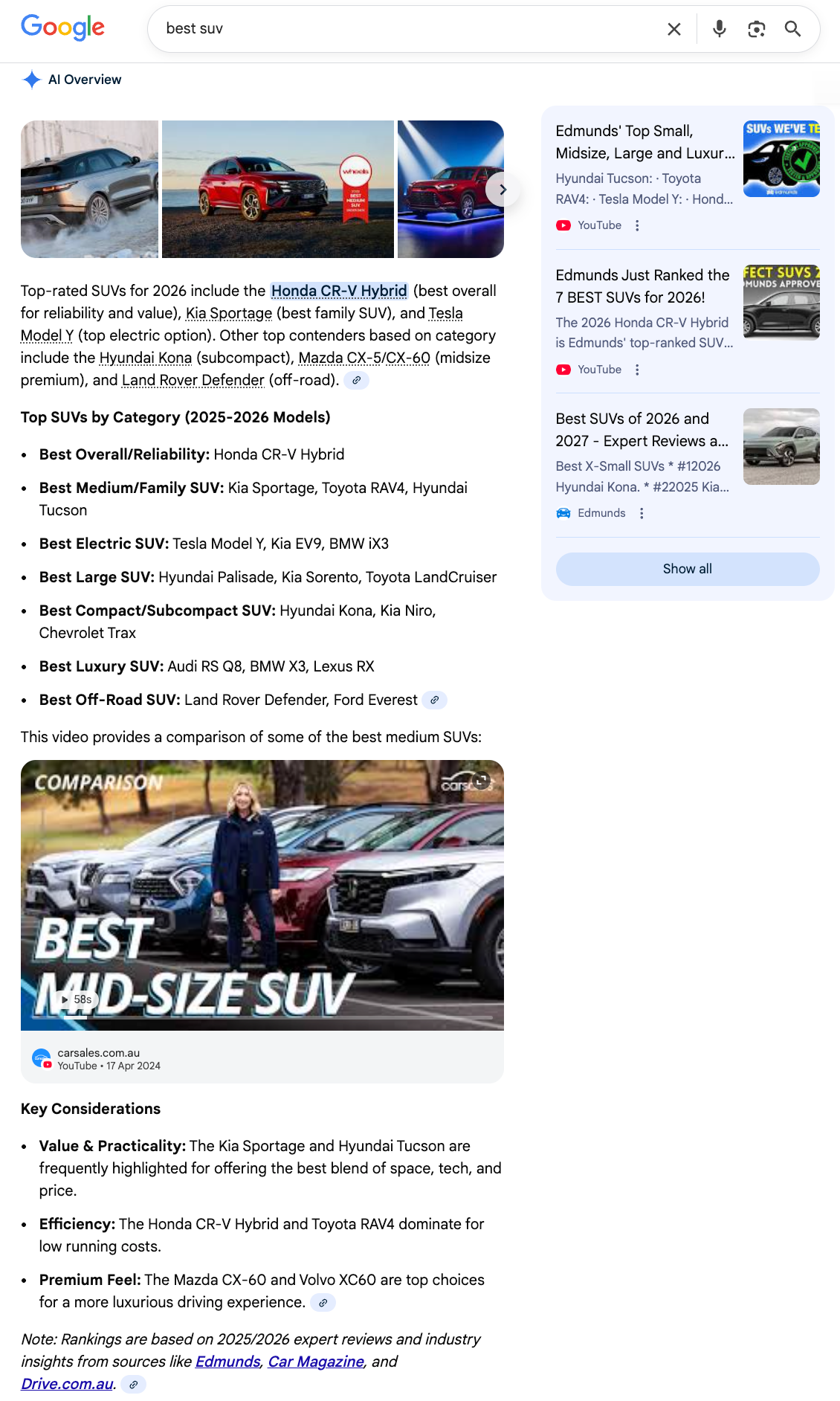
Google AI Overview for the query “best SUV”.
This happens through vectorization, a process where AI converts text into mathematical patterns that reveal relationships.
Think of it like plotting points on a map.
Brands appearing in similar contexts sit closer together. Topics frequently mentioned alongside your brand cluster around you. The more often your brand appears with qualities like "performance" or "eco-friendly," the stronger that connection becomes.
This is why we can no longer rely on keyword optimization. You can't force these systems to make connections simply by repeating "eco-friendly" 50 times on your website. Associations are built through consistent patterns across millions of documents, including your content, third-party mentions, and user reviews, everything that shows what your brand genuinely represents.
Despite all the data used to inform them, AI systems confidently state incorrect information about brands reasonably frequently. The most common causes include:
The solution? Build consistent, authoritative information across all the data sources AI uses like owned properties (your website and social profiles), third-party mentions on authoritative sites, and user-generated content.
The following brand signals work together to determine whether or not your brand appears in AI-generated responses, qualifies for enhanced search features, and ranks organically in search for competitive queries.
Branded search volume measures how often people search for your brand name, or branded variations. To search engines, this is direct evidence of demand and awareness.
For instance, people searching for local businesses typically search for reviews, locations, or general company information:
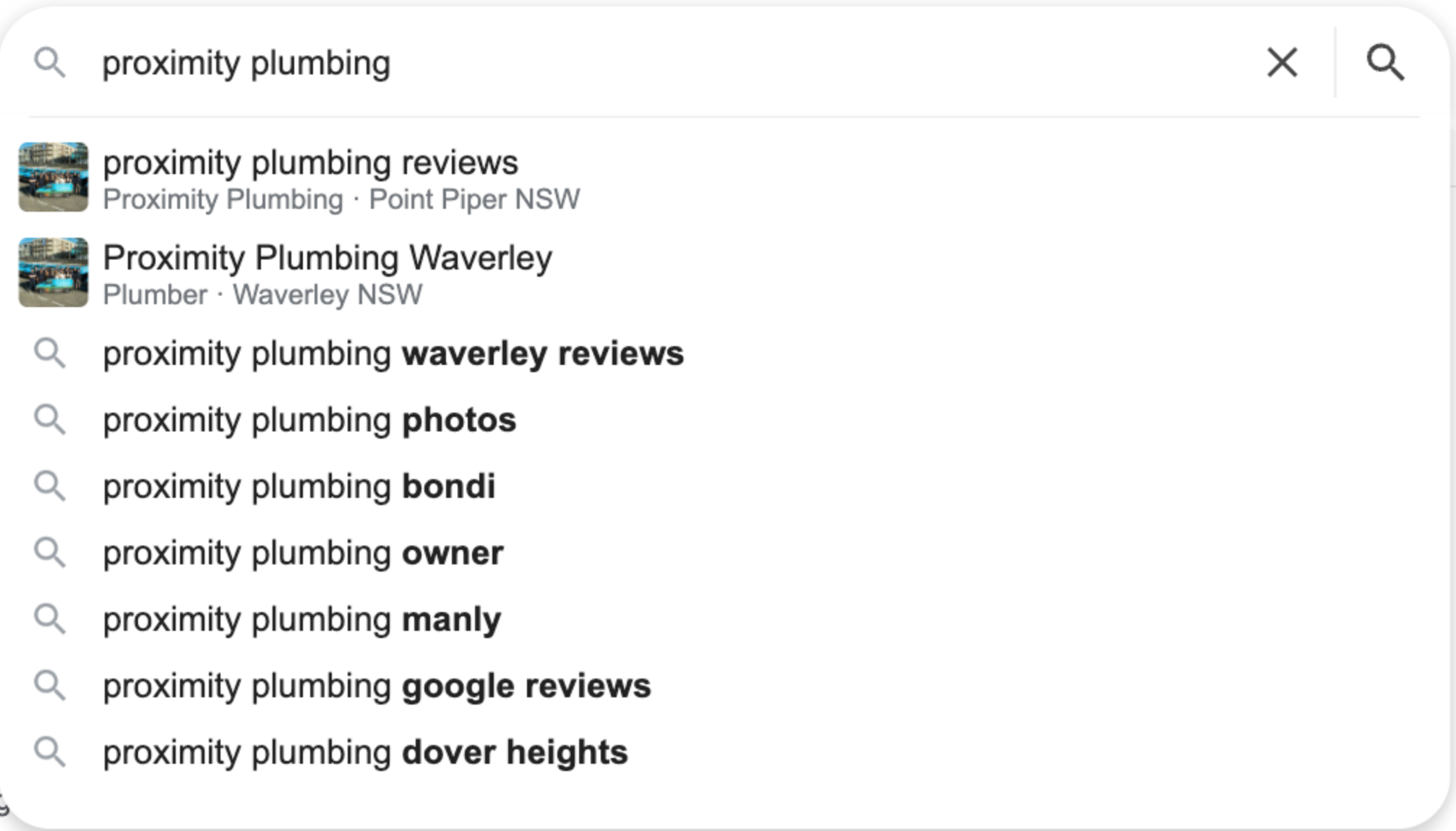
Suggested searches for the company “Proximity Plumbing”.
Consumer brands see searches for product categories, audience segments, or specific product lines:
Suggested searches for L’Oreal.
High branded search volume signals that real people know your brand and actively seek it. It’s a powerful indicator you're a legitimate entity worth surfacing in search results.
Every time your brand gets mentioned online (news articles, blog posts, reviews, forums), search systems note the context.
These mentions create the semantic connections that define your brand entity. ClickUp, for example, has thousands of backlinks mentioning "project management", one of its core product categories:
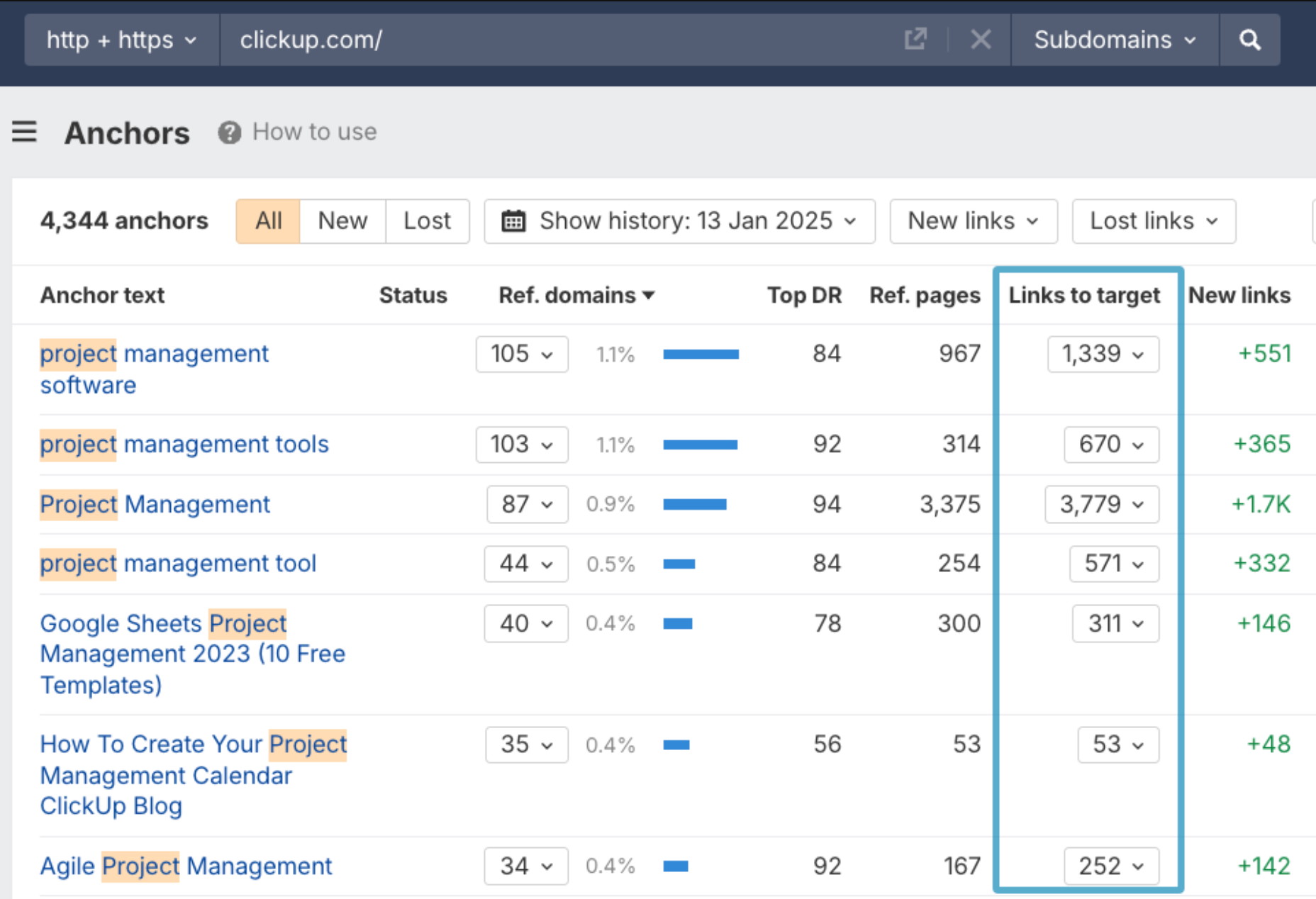
ClickUp’s anchor text profile.
The more that people connect ClickUp to project management, the more search systems make that same connection. You need similar connections, so search and AI systems understand which keywords and topics should trigger your brand as a recommendation.
Not all mentions carry equal weight. Search engines and AI systems evaluate sentiment and context like whether mentions are positive, negative, or neutral.
Consistently positive sentiment across review sites, social platforms, and media coverage strengthen trust signals, positively influencing both traditional rankings and AI recommendations.
Of course, the reverse is also true – negative sentiment across review sites, social platforms, and media coverage can negatively impact your visibility across search engines and AI surfaces.
These three brand signals don't just influence rankings; in some instances, they also determine whether you qualify for visibility at all.
Research by Mark Williams-Cook revealed that Google assigns sites a quality score which functions as a ranking threshold for certain types of search features. Sites above the benchmark qualify for rich snippets in search results. Those below the benchmark do not qualify, regardless of content optimization.
This quality score is based on:
At the page level, Google's Quality Rater Guidelines explicitly instruct evaluators to consider brand and author reputation when assessing trustworthiness (the foundation of E-E-A-T).
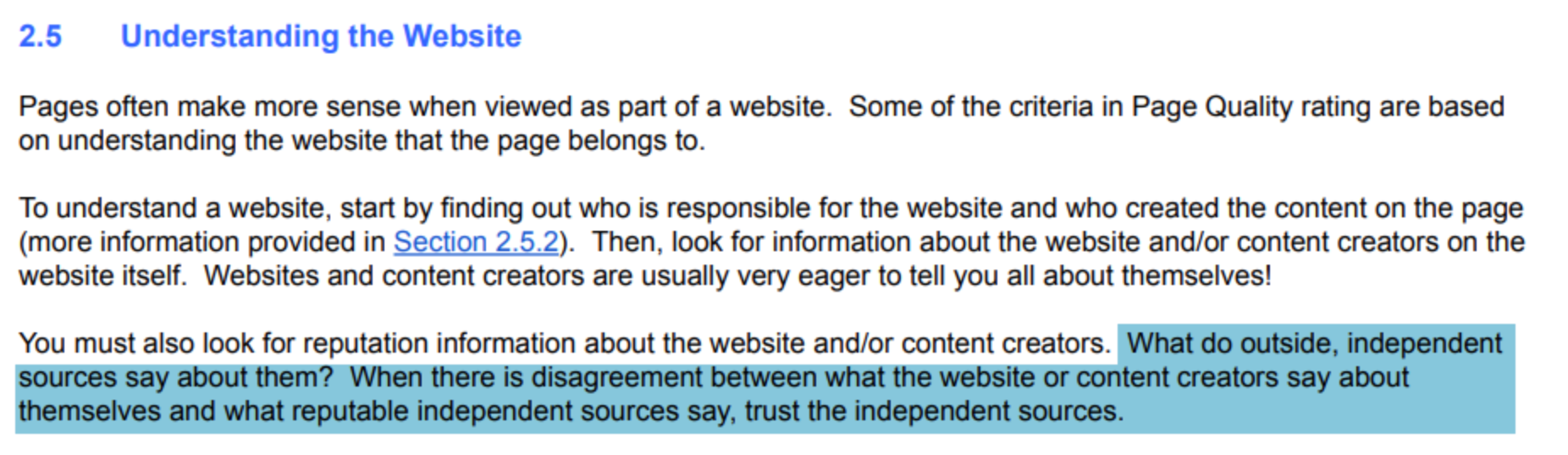
Google’s Quality Rater Guidelines.
Raters research the website's reputation and check what authoritative sources say about the brand. These manual evaluations are then used to train the algorithm to recognize site quality signals at scale.
The result: well-established brands with positive reputation signals get a trust boost. Unknown brands or those with reputation issues face an uphill battle, regardless of content quality.
To paraphrase Google’s John Mueller, you can't “SEO your way” past weak brand signals. For smaller brands, this creates a chicken-and-egg problem: you need visibility to build brand signals, but you need brand signals for visibility.
Here’s what you can do to improve your brand’s authority and visibility in search if you find yourself stuck.
You don't need years of big-budget brand building to improve your brand signals.
Small, consistent actions compound over time; and even modest improvements can move you above the search visibility threshold. Consider starting with these steps:
Start with the basics that search and AI systems need to understand who you are:
Generic claims like "we're the best" or "high quality service" don't create semantic connections. You need to tie your brand to specific, verifiable attributes that people actually search for.
For example, 24/7 emergency availability is one attribute that people search for when looking for plumbers:
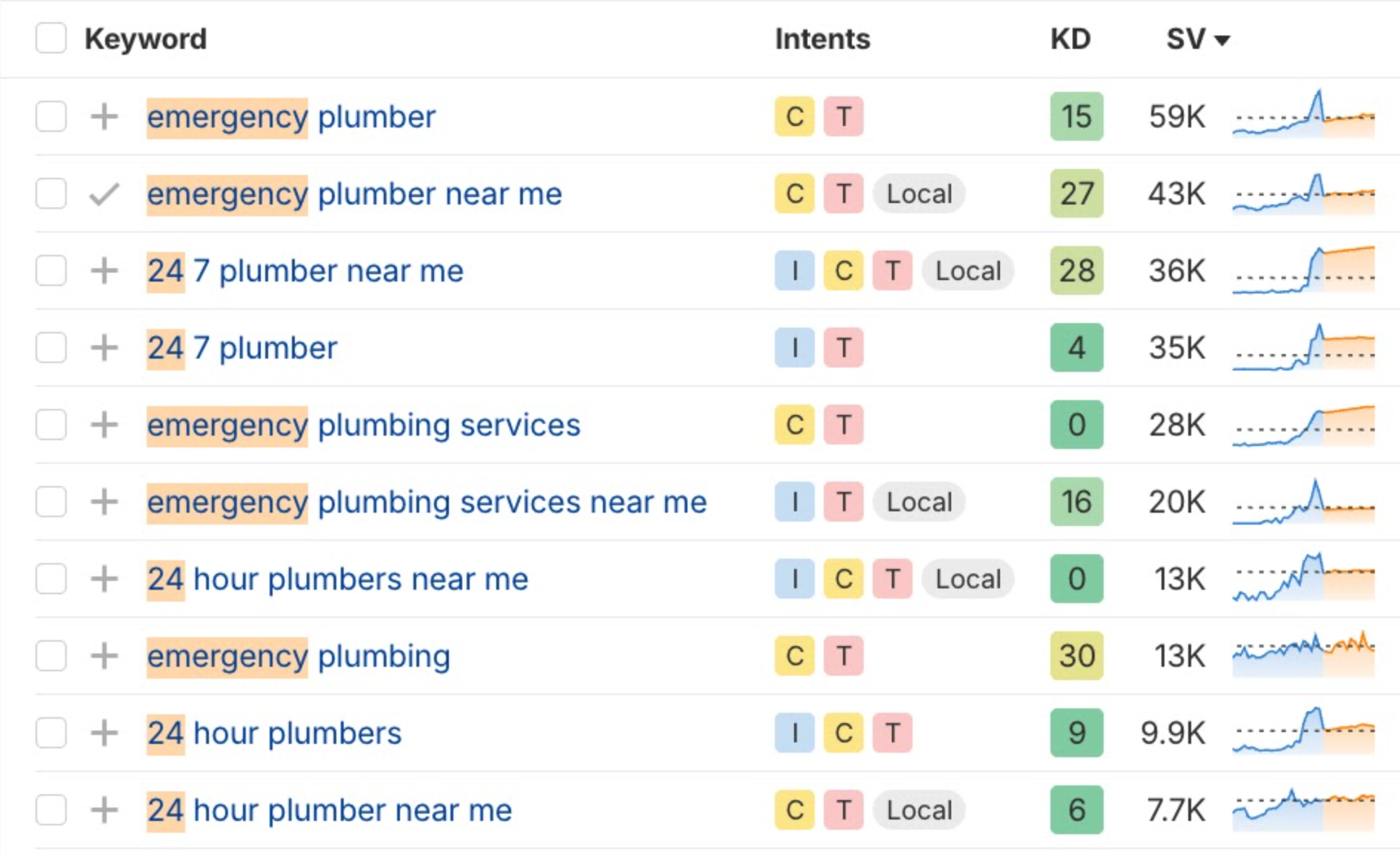
Examples of attributes in keywords related to plumbing services.
In a similar vein, “no win, no fee” services are often searched for in relation to legal services:
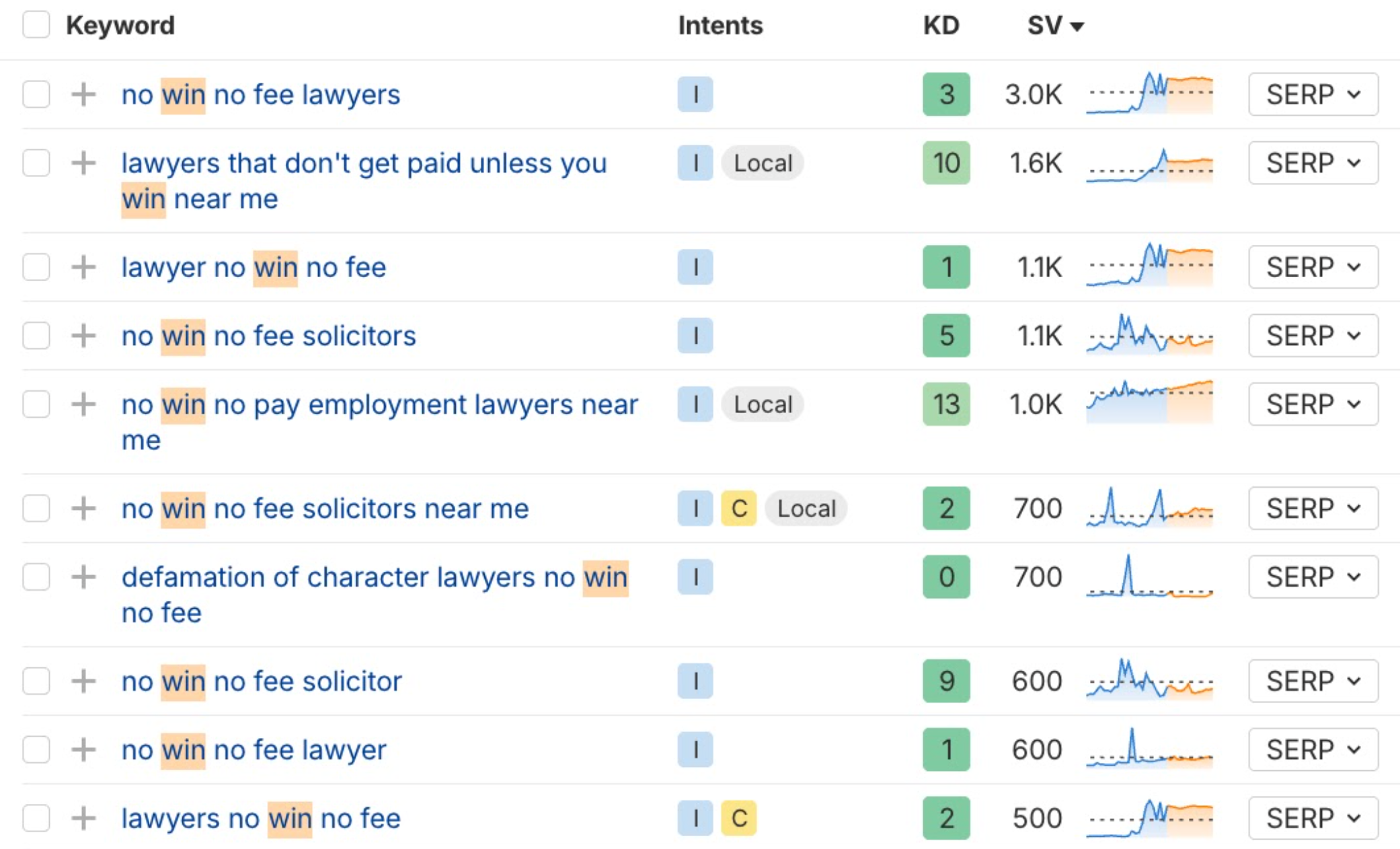
Examples of attributes in keywords related to legal services.
You need to find the features and attributes people search for in your industry that you can connect to your brand.
Instead of creating random blog posts about anything tangentially related to your industry, map out 3-5 core topics where you want to be recognized as an authority.
Create comprehensive pillar content for each topic, supported by detailed articles covering specific aspects. Link these pieces together strategically to show semantic relationships.
For example, a local HVAC company doesn't need to write a "What is air conditioning?" article – leave that to Wikipedia. Instead, create content addressing the specific problems your customers face like:
Set up alerts to track when your brand gets mentioned online. Use tools like Google Alerts, Ahrefs or Semrush for tracking your brand mentions in the news or across the web.
Pay attention to sentiment. A negative review on a trusted platform, if left unaddressed, can outweigh dozens of positive mentions. Respond professionally to criticism, correct misinformation when you find it, and build positive mentions through strategic PR and community engagement.
Every little action you take counts. Over time, these actions will help you build your online brand profile, and enable search and AI systems to recommend you to the right audience.
As AI-powered search becomes the default, semantic systems determine visibility based on their understanding of your brand as an entity.
Traditional SEO still matters, but you can't rank with weak brand signals anymore.
The best path forward is to layer brand strategy on top of SEO fundamentals. Fix naming inconsistencies. Implement organization schema. Connect your brand to verifiable attributes people search for.
Focus on one action at a time and eventually you’ll turn brand strength into your competitive advantage.

Despina Gavoyannis - Senior SEO, Ahrefs
Despina Gavoyannis is a Senior SEO Specialist at Ahrefs, a leading marketing platform for search, AI, and beyond.
She has worked in SEO for over 10 years, specializing in revenue-driven strategies and collaborating closely with cross-functional teams, including UX designers, developers, and marketers.
Before joining Ahrefs, Despina worked as an SEO consultant, providing strategic guidance and education to in-house and agency teams. Her work has helped generate more than $125 million in additional annual organic revenue for the brands she’s partnered with.
Despina is the author of one book, two SEO courses, and has been featured in publications such as Search Engine Journal, Wix, Crazy Egg, and Learning SEO.
ZipSprout connects brands with local nonprofits and events to build sponsorship links that drive local SEO and community impact.
Since 2016, they’ve facilitated 25,381 placements with community organizations across the US, raising over $9.2M in sponsorships.

The same WTSFest experience you love - welcoming, kind, connecting, & helpful - with a few more voices & insights 💜
15 brilliant experts on stage (instead of our usual 10) & 2 wonderful hosts!
We're launching our Connect Session - 2 panels of experts talking about the latest industry trends.
See you at the Barbican on Friday, March 19th 2027!