☕ Help us keep WTS free & accessible—buy us a coffee
☕ Help us keep WTS free & accessible—buy us a coffee

Author: Hannah Smith
Last updated: 09/06/2026
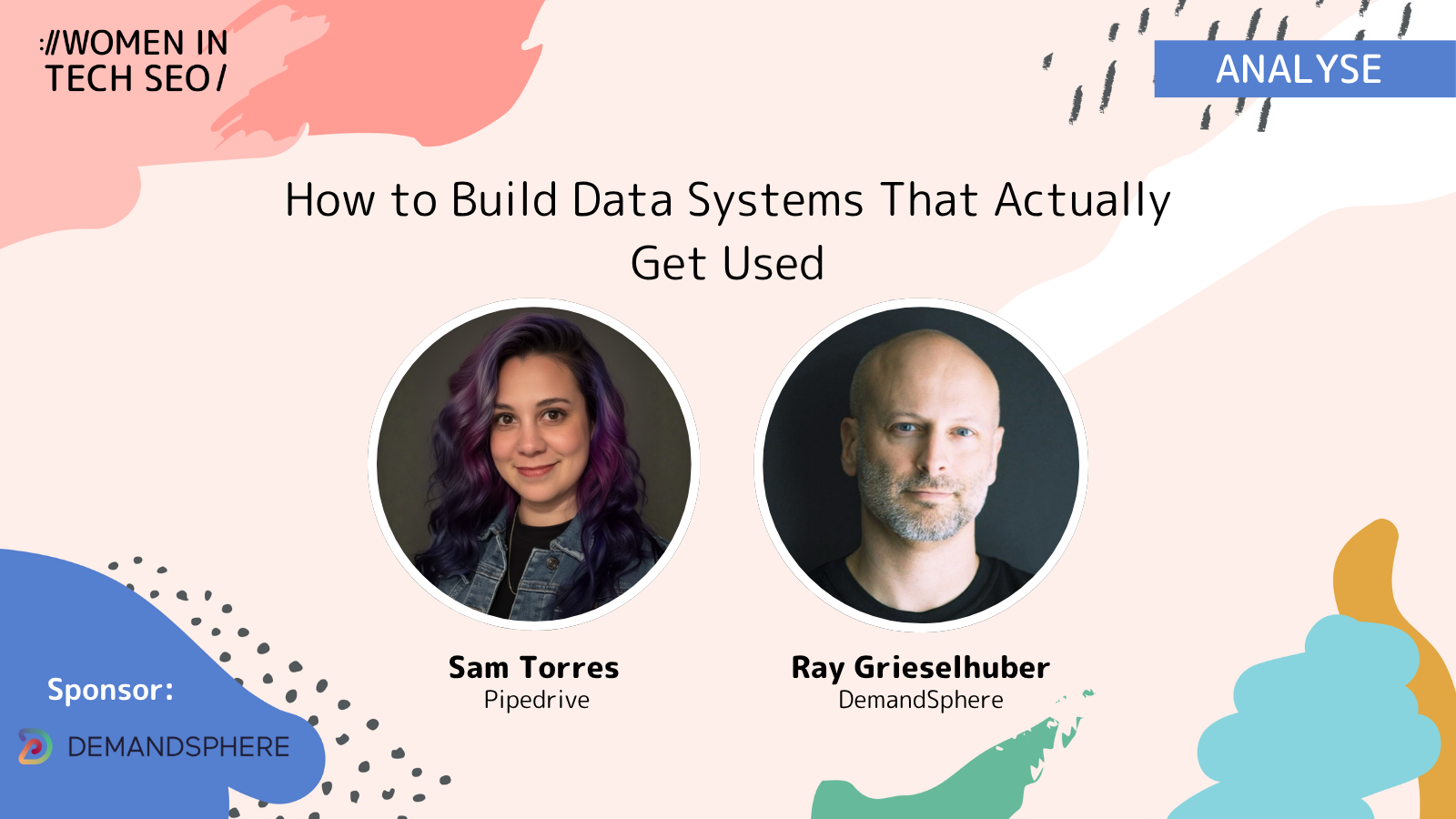
We recently had the pleasure of hosting Sam Torres and Ray Grieselhuber for an Ask Me Anything (AMA) in our Slack #path-inhouse channel.
Sam is the Tech SEO Senior Manager at Pipedrive. She uses her multidisciplinary background as a developer and data architect to solve complex problems at the intersection of marketing and technology. Sam is known for blurring the lines between disciplines to deliver creative, high-impact technical strategies with a transparent and honest approach.
She loves to share her expertise with the wider marketing community: she’s spoken at numerous conferences including WTSFest, SEOWeek, PubCon, and brightonSEO, and is one of the most active members of the Women in Tech SEO Slack community.
Ray is the CEO and Founder of DemandSphere. DemandSphere is a unified AI search visibility platform that combines traditional SERP analytics, AI search visibility tracking, log analytics, and a BigQuery data warehouse, giving enterprise teams a complete picture of their search presence across every surface – Google SERPs, ChatGPT, Perplexity, Gemini, Copilot, and every AI engine that matters. He also created FOUND Conference, a global event series, hosted in Tokyo, New York, San Francisco, London, and Columbus; and has spoken at various conferences including SMX Advanced, Pubcon, ad:tech, and brightonSEO. Ray comes from an engineering, data science, and machine learning background, and has over 20 years of experience in enterprise and technical search marketing.
Sam and Ray answered questions from our community on a range of topics, including metrics, reporting, building AI workflows, communicating with the C-Suite, and more! You can read the highlights from their session below.
Our live AMA sessions take place on the WTS Slack Workspace, a safe, private space for community members to ask questions and share their knowledge. Out of respect for our members and their privacy, rather than publishing full transcripts of these sessions, we curate edited recaps which capture a selection of the questions and answers from each session.
Want to take part in our next Slack AMA? Join the WTS community!
Sam: I think the ratio shifts depending on whether you have a team, or you're a department of one or two.
If you've got a team that can support execution, you're likely heavily leaning on write-ups and strategy. I'm fortunately in that situation, and spend a lot more time on strategy documentation (and defending the work with higher-ups), than on execution. I do this because I see that as my job: shielding my team from the corporate rigamarole and getting them the resources and tools they need.
If you're solo or spread across many initiatives, I'd plan for something like 20-30% of your time on communication, strategy docs, decks, the defense. I know that feels high when you're buried in execution, but given how volatile search has been, that's not overhead. That's the part of the job that keeps the job. We're seeing a ton of layoffs and a brutal market, and the people who can show senior leadership a vision, and who can make the case for why search matters, are the ones who keep getting the resources. Time spent proving you're essential is time well spent.
One way I keep the write-ups from eating the hours I'd rather spend executing is by using NotebookLM. I throw in stream-of-consciousness notes, rough drafts, performance reports, industry case studies that inspire me to get it all synthesized into starter decks and points of view. I say starter because I absolutely still edit, and I've got to get everything into the company-branded assets anyway. But it gets me past the blank page fast.
Ray: This is one of the things I've always struggled with, and I don’t think I’m alone. Our discipline involves both the ability to see the bigger picture, and the expertise to make it all work. And it feels like a huge time sink to spend time on write ups versus just getting it done.
I didn’t have a great answer for this until some of these new tools came online. It's now much easier than before to record a 20 minute video, paste the transcript into an LLM, and spend a little time in formatting for the various audiences you need to communicate with.
Even decks can be built out quite nicely, assuming the right skills are in place. I always have to make some final edits but a huge weight has been removed so this is easier to deal with than it used to be.
I really like Sam’s framing of spending 20-30% of time on strategy and communication. NotebookLM is great, we're using it more and more to build custom knowledge bases based on inputs from a lot of different sources.
Sam: First I want to make sure I'm tackling the different ways "enterprise site" could be interpreted.
This could mean:
If I'm in a situation where it's millions of URLs and crawl budget is a consideration (for myself, I keep a general rule of 100k+ URLs), then that does become my first tier. I want to understand exactly how crawlers are getting across my site, and are my URLs findable. Am I prioritizing internal linking to priority pages? Do I have pagination set up correctly, filters and facets, etc? For me, the game really becomes making it as easy as possible for Googlebot and agents to access and understand the priority of my content.
More generally, across all site types:
Must-haves
Should-haves
Nice-to-haves
Ray:
For enterprise sites, the focus should be on what is going to have the maximum amount of impact for the least amount of work, ranked by business impact. Easier said than done.
Indexation is a great example. Is it something easy that can be managed at the CMS / web server level? Is it a deeper product decision? A lot of times in these environments, you can file the issue and know that it will take the product team 6 months to actually fix. There is only so much you can do but I do recommend escalating these types of issues higher IF the actual business impact is there. That can speed things up a little.
Basically though, the site should be serving content that is relevant to the audience it's trying to attract in a way that is rewarded with visibility (and ideally traffic) from the engines. It largely comes down to how to maximize the surface impact of that mission with the resources you have.
The more time you can spend getting the C-Suite to look at things from that perspective and build trust with them in your ability to communicate these things in the right business context, the more sanction you'll get for your initiatives. Again, that’s easier said than done, of course :)
Sam: I still report on both, and try to find the themes within them. I think you can start to prioritize impression reporting, but personally, I’m not ready to abandon click performance right now.
Ray: Agreed! I think it’s still really useful to measure clicks because this will be a leading indicator of rankings, which are still relevant in AIOs and are also a reflection of the index / grounding data for citations in LLMs.
Impressions are where the insights around new and current opportunities exist and can help you catch things, both good and bad, before they become a problem with conversions, UX in the SERPs, etc.
Sam: I've just come out and said the measurement for AI is not a science, so we should just pick one tool whose approach we like, and look at trends. These numbers are not exact, we're looking for directional performance.
This is also why we signed DemandSphere, as I like Ray’s approach to tracking LLM mentions and citations, (where we’re looking at how we’re trending directionally, not at hard numbers).
Ray: It's so tempting to treat these as concrete metrics in a performance marketing context but that's just not the world we live in right now. I think it makes sense to benchmark these directional insights compared with both competitors and the landscape as a whole. There is a TON of stuff happening offsite (that you can’t control) and will be having an impact – YouTube and Reddit are the canonical examples but there are many more.
Sam: I explain that if we have multiple tools, they're likely to have wildly different data because this is not a science, and a bit like measuring the wind with your finger. We should pick one platform or tool and grow with them, and also look just for directionality, not hard numbers.
I also like to supplement this data with logfile analysis because that IS hard data we can reference in terms of what content agents and crawlers are interacting with.
Ray: I really like this question because it forces folks to think through what these metrics really mean in the context of their business. There is so much noise right now so it's easy to get swept up in it all but it really comes down to a couple of core talking points:
The web is being measured and sorted on the basis of semantic information architecture, brand strength, content quality, and offsite perception of all of the above. Each of the AI search experiences have their own slightly different but similar retrieval methods to surface the most relevant answers to user queries.
How much does the C-Suite care about winning in that context? And, if they care about winning, what does winning look like?
Does a metric like mentions or citations make sense, or are those just clues into understanding how the business is perceived by the engines? Do we want to use those clues to predict our audiences’ responses based on how we appear on AI search surfaces?
Sam: Well, for my current role, my director established these
But I think it always comes back to what are the overall company goals, and how or where does SEO/GEO activity impact them. What I usually see is visibility scoring on target terms, share of voice in both traditional search and AI search, and conversion rate.
Ray: Share of voice, mentions, visibility, and citations in the LLM context. Also presence versus competitors in AI Overviews (these are the new SERP basically). Citations are undervalued in my opinion because these represent the grounding in the search index that all of the LLMs use. This can be a useful thing to explain to the stakeholders as well.
Sentiment is interesting, but it’s an ongoing challenge to measure properly so I always provide caveats around it. I also think that explaining that the LLM data in particular is going to be directional and a sample (i.e. it’s not concrete) is helpful for context. There are so many factors changing all the time on this.
Ray: It's easy to over-engineer this in the beginning. I've seen teams waste so much time building out the perfect data warehouse, data inputs, dashboards, etc. In general, I think it makes sense to keep things simple at first and expand from there. GSC is the obvious place to start, just get all of the data into a tool like SEOGets or, ideally and/or later, BigQuery using the built-in bulk export mechanism.
There are so many insights just from that data and it will quickly lead to the next set of questions you need to answer like, why exactly are CTRs dropping, what are competitors doing, when do AI Overviews appear, etc. Focusing on a few key things to report on that answer the "so what" question ASAP can build a lot of credibility for future projects.
Sam: Agree on this one, start with GSC - and I will always promote SEOGets as I think their platform is fantastic!
I also would recommend reviewing what existed prior to you joining, as that will give you insight into what your execs may ask about, because they're used to seeing it.
Related to this – this is a great time to re-educate them on what you think they should care about as the SEO expert. The number of exec teams that want reporting on pagespeed never ceases to amaze me – they got got by fear-mongering articles back in the day, and haven't been able to move off of that since.
A change in team is the perfect time to shift the focus and get back to what matters, likely conversions and revenue and how SEO contributes to that. And like Ray said, start small! You don't need all the data immediately because you won't be able to action anything that quickly anyway. Start with low hanging fruit, like GSC, then maybe rank tracking and SERP changes, and then build from there.
Ray: Surprisingly, the big companies aren't always as sophisticated as one might imagine. They are usually big companies because they have been big companies for a long time and they are also still just trying to get organized, especially as AI search continues to accelerate. They tend to have a ton of traffic and strong brands (in most cases) so it becomes more a matter of ROI on new activities, making sure the next 12-18 months aren't wasted, making sure attribution is properly handled, etc.
On the SMB side, it seems to be somewhat segment defined. Startups will tend to be very focused on growth metrics like customer acquisition cost (CAC), lifetime value (LTV), retention / churn rate, revenue, etc. And tying the metrics we tend to deal with in AI search / SEO back to those is always a challenge because of the questions around attribution.
Other SMBs that aren't in the startup world tend to be even more focused on what’s driving revenue, sometimes to their detriment as it can cause missed opportunities.
Sam: 100% agree with what Ray said about big/enterprise companies. The data is often siloed and gatekept, so you practically need a congressional hearing to get access to the same datasets you get when working with medium to small businesses.
And attribution is a challenge with companies of all sizes – always question, always validate.
Ray: Obviously it depends on the audience, the company, etc, but I try to think about the specific titles of the people who will be reading the report, and the main KPIs that they are responsible for.
For example:
The challenge from a search perspective is understanding how the various search activities impact these things.
The other thing that gets clouded in SEO is that unlike other marketing channels, not all spend is operational expenditure (OpEx). A lot of what we would consider to be technical SEO will be capital expenditure (CapEx). As such when running return on spend models, it can help, (if the organization's mindset supports it), to focus on the right category of spend when comparing performance across channels. This is more challenging now as CTRs decline and measuring performance on LLM visibility is more difficult.
One question I always ask is, if you're deciding on investment based purely on traffic, conversion, and revenue metrics and if your perception of that performance is not where you think it should be, does that mean you're going to abandon that channel and let your competitors move in? This can reframe the conversation pretty quickly away from purely transactional metrics.
Sam: Yep, trying to understand what the audience or various stakeholders care about usually frames the conversation for me. And don't be afraid just to ask a new stakeholder what their goals and priorities are – it’s a great way to build goodwill and rapport.
I also like to ask upfront how familiar the folks are with SEO and the metrics we're discussing. I explain that I don't want to make them listen to things they already know, but equally I don't want to be speaking in acronyms the whole time like a jerk! :)
Sam: As a rule, my dashboards allow me to see the 13-month trend (sometimes 16-month since that's what we get from GSC) AND month-on-month.
Quarter-on-quarter can also make sense, it depends on the business and their sales cycle. For example, for anything education-based, I’d want to compare Fall 2026 to Fall 2025, But if I try to compare Summer 2026 to Spring 2026, I'm inviting horrible numbers.
Plus, if I know the sales cycle is ~4 months for example, I may build those out too. And I’ll also try to understand cohorts with my whole SEO funnel.
Ray: 13 months is great for the year-on-year view it brings, and I also use 16 months where possible. I also like to have day-on-day and week-on-week for active campaigns or initiatives, like if you're trying to break into new segments with content, internal link optimization, etc.
Sam: I think exploration dashboards are for when other teams come to you and you need to investigate to get an answer. Maybe traffic to a content section is down 20% month over month and you don't yet know why. You use an exploration dashboard to find out. You filter to the section, then split by device, is it mobile or desktop? By country, is it one market or all of them? By query type, branded vs non-branded? By landing page, is it spread across the section or concentrated on a handful of URLs?
Action dashboards are for answering a specific question or tracking a scenario. These are the ones that tend to be shared outside of the SEO team. They answer questions like "Did the migration hurt us?"; "Are our priority pages performing well?"; "What topics are we losing to competitors?"; etc. With these, I also like to add the actual question or business case, and further context since I know they are going to be shared with non-SEOs.
Ray: I view exploration dashboards as being focused on generating (and/or validating) hypotheses and action dashboards as those that should drive decisions.
The exploration dashboard should be more open-ended, have options for filtering, slicing the data, and would typically be used by analysts. A successful outcome of this dashboard use case would be "this helped us surface a question we didn't know to ask."
The action dashboard should be clear and should answer one question: should I do this or not? It should already have a point of view built into it, which means it's going to be opinionated based on the strategy of the company. This can be good or bad, so it takes a lot of time to really get these right.
How you know which one you need comes down to whether you can name the decision that needs to be made and who will make it. If you can't answer that question, it's not (yet) an action dashboard, it’s an exploration one.
Smaller teams should focus more on the dashboards that will drive decisions and you can use things like data warehouses and SQL (or SQL with the help of an LLM) to handle a lot of the exploration without building and maintaining a whole UI. The nice thing is, you can now have LLMs generate quite sophisticated exploratory dashboards as artifacts from their analysis of the data.
Sam: Oh how I wish there was, and that I could give you a better answer than "it depends on your audience"!
Here’s how I like to think about it: the numbers are what earn trust, the story tells people what needs to happen.
A report that's all numbers and no narrative leaves your audience to interpret everything themselves, and busy people won't. A report that's all narrative and no numbers makes your audience ask a bunch of questions like "but how do you know that?".
So I don't really think about it as a ratio. I think about the "so what?". For example:
"Organic traffic dropped 12%." is a dead end.
"Organic traffic dropped 12% and it's as a result of a page template change. We can roll back the change this week." contextualizes the data for the reader, and offers a solution to the issue.
Ray: I don't think there is a perfect ratio, but I think that for every number you include you need to be able to answer "so what" and "what next?"
If you only have narrative then it's just an opinion piece, but if you have too many numbers with no context, that obviously doesn't help anybody. It's a trap that is easy to fall into too because it's easy to make numbers look beautiful and informative when they really aren't.
I like to find ways to connect the numbers too with things like metric trees, because a lot of the numbers that we know matter upstream are harder to explain downstream, so if you can connect those via visualization and/or narrative, it can help on both sides.
Most importantly, in my opinion, is understanding the audience, and what they actually need versus what they think they need.
Sam: My approach generally is to automate anything boring or tedious. What do I mean by that? Anything that looks like "pull this data, refresh this number, flag when something crosses a threshold" is a job for automation. The second it becomes "why did this happen and what do we do about it," that's a human job.
So in practice, I automate things which are both boring and error-prone: pulling from the GSC and GA4 APIs, classifying URLs at scale, topic modeling across a big content set, flagging when rankings or traffic move past a threshold I care about. That's not where my judgment adds anything, and honestly the machine does it more consistently than I would at 4pm on a Friday. (I do want to flag that this is also where I recommend blending some machine learning models for things like URL classification - because those are consistent while LLMs are black boxes and come up with different answers every time.)
What I don't automate is the "so what?". Two pages can both drop 15% for completely different reasons, one's a cannibalization issue, one's a SERP layout change I can't control, and the recommended actions to remedy the issues are totally different.
Automation is great at telling me something happened. It's still pretty bad at telling me whether I should care and what to do about it. The interpretation, the prioritization, the "here's what this means for the business," that's the part I'm actually paid for.
Another thing I'd like to add here: err on the side of adding too many human checkpoints. You can always remove those, but if you have one big workflow that doesn't invite feedback at any point, then you are more likely to end up with bad output.
For example, if you're automating identifying decaying content and making a new content brief to update it, add a check where you make the agent tell you why each piece of content needs to be updated. Then add a human-in-the-loop step to approve individual URLs and keyword and topic targeting. Only once this step is complete, can the agent kick off the next steps, like pulling SERP competition research and synthesizing that into the content brief.
Ray: The things that are good to automate would be related to the data collection, normalization, detection of anomalies, alerts based on ranges, etc.
I don't think you can ever fully automate away proper decision making, understanding causation, strategy, etc. It's one of the reasons I've never been a huge fan of rule-based recommendation engines.
Obviously there is a new layer now with LLMs and agents and this is a new territory because it's enabling more middle ground than there used to be.
I still think all the steps around collection, normalization, should be completely automated, but you can now do a first pass analysis of the data with these tools. Just don't let them do your thinking and decision-making for you.
Sam: I try to take a modular or atomic approach to building workflows and automations. Any time a judgment or prioritization is involved, I like to add a check - and I make the agent tell me why it picked what it did, as part of the check. This makes it easier to find flaws in its approach, so I can improve the workflow and instructions if necessary.
As for QA, I also do a lot of vetting datasets while I'm building, and have even built workflows that basically check and flag any dataset disagreements. This allows me to then review any workflows those datasets touch.I also have workflows that monitor the content changes on the documentation of all the APIs I use. It can get noisy for sure, and I'm working on how to automate determining what API documentation changes actually matter, but for now, I'm sifting through the noise!
Ray: Agreed on vetting the data sources and understanding the boundaries from one step to the next.
A lot of data workflows don't spend enough time on validating each step along the way and if the lower-level steps aren't QA'd properly in the beginning, then the data at the end of the pipeline will be wrong.
I also like to think in terms of exploratory versus regression testing / QA. Exploratory is manually going through and making sure things make sense. Any issue found should be filed as a bug or task to follow-up on. When it's resolved, these feed into regression test cases.
Regression tests are there to ensure that previous data issues don't arise again (harder than it sounds sometimes). Any issue found and fixed in the exploratory phase should be added to a growing list of regression test cases. Ideally, all of the regression tests will be completely automated since you know the pattern and errors will alert the right people.
Sam: Log files have absolutely entered the chat because they offer the most concrete data available on how agents and LLM crawlers interact with a website. And my executive leadership team is obsessed with AI and LLMs!
I use log file analysis to illustrate how our site presents itself, to identify where AI crawlers spend most of their time, and to determine the extent to which AI systems understand who we are and what we offer. This analysis also allows me to prioritize and understand the impact of any activity. In short, it helps me figure out the gap in how we want to be perceived vs how LLMs perceive us – which starts venturing into product marketing, brand, communications, content, etc. Which also makes it easier to get tech SEO buy-in.
When it comes to SEO metrics, my C-Suite doesn't care if we're 70% indexed or 7% indexed. They care if our top pages are indexed, or if they're not, what are we doing to change that? They care about our visibility metrics and share of voice. How do we compare to our competitors?
As such, I generally don't report on pure tech SEO metrics. I do reference conversions, and give thoughts on how we can improve for specific regions, content topics etc, and I'll even outline specific things we're doing – but I always link it back to how we expect it will impact visibility, conversions, or understanding of who we are (for users and AI).
Ray: 100% on log files!
In general, the more technical the metric is, the less the C-Suite tends to care about it. I have had success in reframing these types of metrics as product and UX issues versus pure search. The context just isn't there from a search perspective, but if you can connect how things like indexing, page speed, etc. affect potential customers’ impression of your brand or product, you have their attention.
I once cold emailed the CEO of a F500 nationwide pharmacy chain about UX issues once and got a response within 3 minutes from them directly because I was offering a solution.
AI search is presenting a really good opportunity to reframe a lot of the things we understand on the technical SEO side into priorities around AI search visibility. Share of Voice and competitor metrics are definitely worth addressing, as Sam mentioned above.
Sam: I honestly don't often report on tech SEO metrics to my executive team because they really only care about traffic, conversions and revenue.
What IS easy to communicate are things like: "Conversions are down in the LatAm region. It's likely because of cannibalization with regional language variants that haven't been localised enough to be differentiated". That's a content and hreflang implementation issue, but rather than leading with that, I’m leading with the impact (conversions are down) because what I'm really trying to do is get buy-in for the dev and content resources I need to fix it.
Or another example: “We’ve invested significantly in video production, but right now we’re missing out on XX,XXX potential video views per month. This is because there’s an issue with our video page template, and as a result our videos are not being indexed, or watched.” Rather than leading with the tech SEO problem (video indexation), again here I’m leading with what the impact is.
I guess what I'm saying is by leading with the impact (rather than the technical SEO issue) you’re able to make a far more compelling case for whatever resources you need to fix the problem.
Ray: Urgency comes from impact, threats, and risks. That’s what motivates the C-Suite.
For example, you could make the case for risks of de-indexation, loss in visibility, etc. and the first question they will ask is, what is the impact? What did we have before and what will we be losing? If the answer is "not much" then it won't motivate them. But if it's a key line of business that is going to suffer as a result, that's the place to focus.
The other thing I always recommend in any technical communication is that it's never about "you have to do this or that." Everything is about tradeoffs and multiple options. This builds a lot of credibility. They are used to engineers and technical people saying "we have to do this now!" and they will just filter that out.
But if you can come in and say, here is the situation, here is how it impacts users and customers, here are the the risks (losing potential customers, causing bad reviews, competitor takes share, etc.), and then:
It's important to be honest about the trade-offs and make them objective, not based on the narrative you’re trying to promote. The C-Suite is always going to have a broader business context that we might not always understand.
Sam: I'll try to find examples where tech SEO issues are causing bad UX, and/or try to find where an LLM answers something totally wrong about who we are. I find highlighting where competitors are beating us can be really compelling for the C-Suite.
Ray: I think it makes the most sense to frame these as product, UX, and competitive issues. "Do you want our competitors to take advantage of this opportunity?".
Sam: I guess I have a counter question: do they need to understand it?
If I'm trying to use data to justify resource requests, then I let the C-Suite know the likely outcome of each decision they could make in a given scenario. (NB this does mean I’m taking on the responsibility of painting the outcomes appropriately and reasonably.)
Then I have to step back and let the C-Suite make and own that decision.
It may not be the decision I would have made, and I certainly document the decisions alongside the corresponding impacts that were felt (I find having an audit trail is super-helpful for navigating future situations).
Ray: Everything that Sam said.
Also, is there a way to reframe the data in the context of:
DemandSphere is a unified AI search visibility platform that helps brands understand and improve their presence across traditional search engines, AI-powered search experiences, and emerging agentic platforms. It combines SERP analytics, AI visibility tracking, log file analysis, and data warehousing to provide a complete view of search performance. With insights into rankings, citations, mentions, sentiment, competitor visibility, and AI-generated responses, DemandSphere enables in-house and agency teams to measure, monitor, and scale their visibility across Google, ChatGPT, Gemini, Perplexity, Copilot, and beyond.

We pay our authors, speakers & team to bring you helpful content like this.
We aim to always keep our content and community free and accessible.
If you've found value in WTS, please consider supporting us through our Buy Me a Coffee initiative.