LAST DAY to save £200 on WTSFest London 💙 £399 until midnight, £599 after
LAST DAY to save £200 on WTSFest London 💙 £399 until midnight, £599 after

Author: Heather Hamilton
Last updated: 05/10/2026
I have a pretty detailed patchwork American Traditional leg sleeve. Meaning, my right leg is covered in American Traditional style tattoos.
When I started getting tattooed by my artist, Brad, I told him there were two things I would never get. "I will never get a skull," I said. "And I will never get an eagle." If you know anything about this style of tattoo, you know that skulls and eagles are two pretty common staples within the traditional style.
Now, six years later, I have seven skulls and what Brad refers to as a "bitchin eagle" on my leg.
When I told him I didn't want these two tattoos, I meant it. I wasn't lying. At the time, I had a very clear picture of the image I thought I wanted to portray as a tattooed woman. It mostly contained flowers. But six years later, I love my traditional leg sleeve.
The reality is, we don't really know what future versions of ourselves will actually want. This also applies to our career. The act of showing up and learning changes us as humans, which changes our desires and ultimately, our path.
So, this is not an article about how to plan your career better. The plan you'd write today is a plan for a person who won't exist in five years. What I want to offer instead is a different question to bring to your decision-making process, and a set of tools for when you decide to ask yourself that question.
More people are building something of their own than at almost any point on record. Americans filed over three million new business applications in the first six months of 2026, up 17% over the previous year. According to Upwork, 58% of full-time employees surveyed said they are considering freelancing, which is up from 36% in 2025.
I don't share this data to encourage you to quit your job. I share it because there is evidence that shows that many people are either making a move or interested in making a change soon. So if you're feeling restless, know that you're not alone.
As children, we are often asked what we want to be when we grow up. As soon as we can start talking and thinking for ourselves, we are asked to plan our career path. It's expected that we pick one thing and work toward it. Find a passion, folks say, and you'll never work a day in your life.
To me, this sounds a lot like you're telling me to commit to being underpaid and overworked because I really care about something.
It turns out I'm not just being cynical. Erin Cech is a Sociologist who studies inequity in the workforce and her book "The Trouble with Passion" describes exactly this. Erin's research into passionate people in the workforce identified the down sides of following your passion as a career path.
Passion-seekers tend to tolerate less ideal work conditions, lower pay, and longer hours.
Erin found in her research that employers prefer hiring passionate applicants and perceive them as harder workers, but they don't pay them more or compensate them for extra time.
The people who actually succeed at following passion pursuits are disproportionately the ones with family connections and a financial cushion behind them. Working-class or first-generation graduates who try to follow their passion without a safety net are more likely to end up trapped in low-paying or unstable roles.
Roughly 40% of Americans lose a job at some point in their career. If your job is your passion, losing it feels much heavier. Tying your career into your self-worth can make a layoff or career setback feel like a devastating personal crisis.
As a quick example, I have experienced some of this personally. Passion pointed me in a single direction and I followed it for ten years, into jobs I genuinely loved that paid me very little, on top of student loan debt I had no way out of.
Both of my degrees are in kinesiology. For the first ten years of my professional career after my Master's Degree, I was stuck in a cycle of overworking with very low pay. I worked my way up the ladder in Higher Education and Fitness and Wellness, moving from Coordinator to Director at five universities, resulting in an increase of a whopping $12,000 annual salary over the course of ten years.
Because the pay was so low, I worked on the side as a Personal Trainer and Fitness Instructor at various gyms. About five years into this, I created a business that I still own today, a decade later. That business included a website where I wrote about fitness and strength training.
After some time, the business began receiving more and more leads. This caused me to get curious about one very specific question: where are the leads on our website even coming from?
Nobody assigned me that question. It wasn't in a job description. I didn't take a career aptitude test that came back as "search engine optimization specialist." But I just could not stop pulling on the thread. Why is this page showing up in Google and not that one? What happens if we try adjusting this header? How does Search Engine Optimization work?
I chased that question at night, for fun, for months. Until it turned into a company.
When I first started diving into SEO, I taught myself the fundamentals, learned some code, sold a few inexpensive audits to friends so I could test, and once I realized I was onto something, I built a portfolio in six months. Then I applied for SEO jobs. I happened to land an SEO Specialist position at an agency for Higher Education SEO. I secured this position over candidates with far more experience than me, because I walked in with six months of case studies, a decade of management experience, and a business of my own in exactly the vertical that agency was selling into. But above all, I was scrappy, confident, and brave enough to apply to that role. And someone who would become one of my mentors recognized it and brought me on board.
I made that pivot in my mid-thirties. Once I decided I was moving in that direction, I leaped into mentorship. I joined the WTS mentorship program, attended five SEO conferences in my first year, sitting in the back row at the first WTSFest in Philadelphia and soaking up the knowledge. Two years later I was speaking on that stage.
During my time working at an agency, I kept both side hustles (the fitness business, and the marketing company) and grew them both to over six figures in income before leaving my full time role. I now have a team, including a full time salary employee, and a meaningful job that I not only love, but it also pays me well. I have also finally paid off that $94,000 of student loan debt.
Trainer. Founder. Director. SEO Specialist. Founder again. My titles accumulated exactly like my tattoos did, one curious yes at a time. No grand design. No five-year plan. Just a, "Huh, I wonder why that happens," that turned into something I could not have mapped out in advance.
When I look back now, I realize I have always done things that aren't typical in a career trajectory. I've always turned something around and surprised folks with an outcome. I didn't graduate high school, but I have a master's degree. I never played a sport growing up, but I once broke a national record in powerlifting. The milestones I hit and the successful things I've done could never have been predicted or planned. They happened because I wasn't afraid to follow my curiosity.
If you're wondering if you're ready to try something new, I'll let you in on a fact: I have never once felt ready. I have only ever felt curious enough to spend real energy on something new.
Curiosity is a question. And for me, it turned into freedom, because it built diversification into my working life. Following a passion kept me in one lane. Following my curiosity opened doors.
But I want to be honest about two things.
First, this is a privilege. Following curiosity requires time or money, and not everyone has the same amount of those. If your basic needs aren't being met, "go explore" is not neutral advice. I recognize this and the fact that everyone has a different starting point. I hope that something in this article still inspires you to listen to your own curiosity while having grace and understanding for your current situation.
Second, I am not telling you to throw everything away and chase something new. That's just another narrow decision pointed in the opposite direction. I'm a planner. When I finally left my full-time job for my side hustle, I had set very specific milestones I needed to hit first, and I did not leap until I hit them. Open the door, look inside, and play around. If it doesn't work out, you've almost certainly learned something valuable. If it does look viable, then you can start planning the next move.
So here's the reframe. You don't need a career map. You need a compass, and that compass is your curiosity. A map shows you the whole route before you leave the house. A compass points you in a direction. It doesn't promise a destination. It keeps you oriented while you explore.
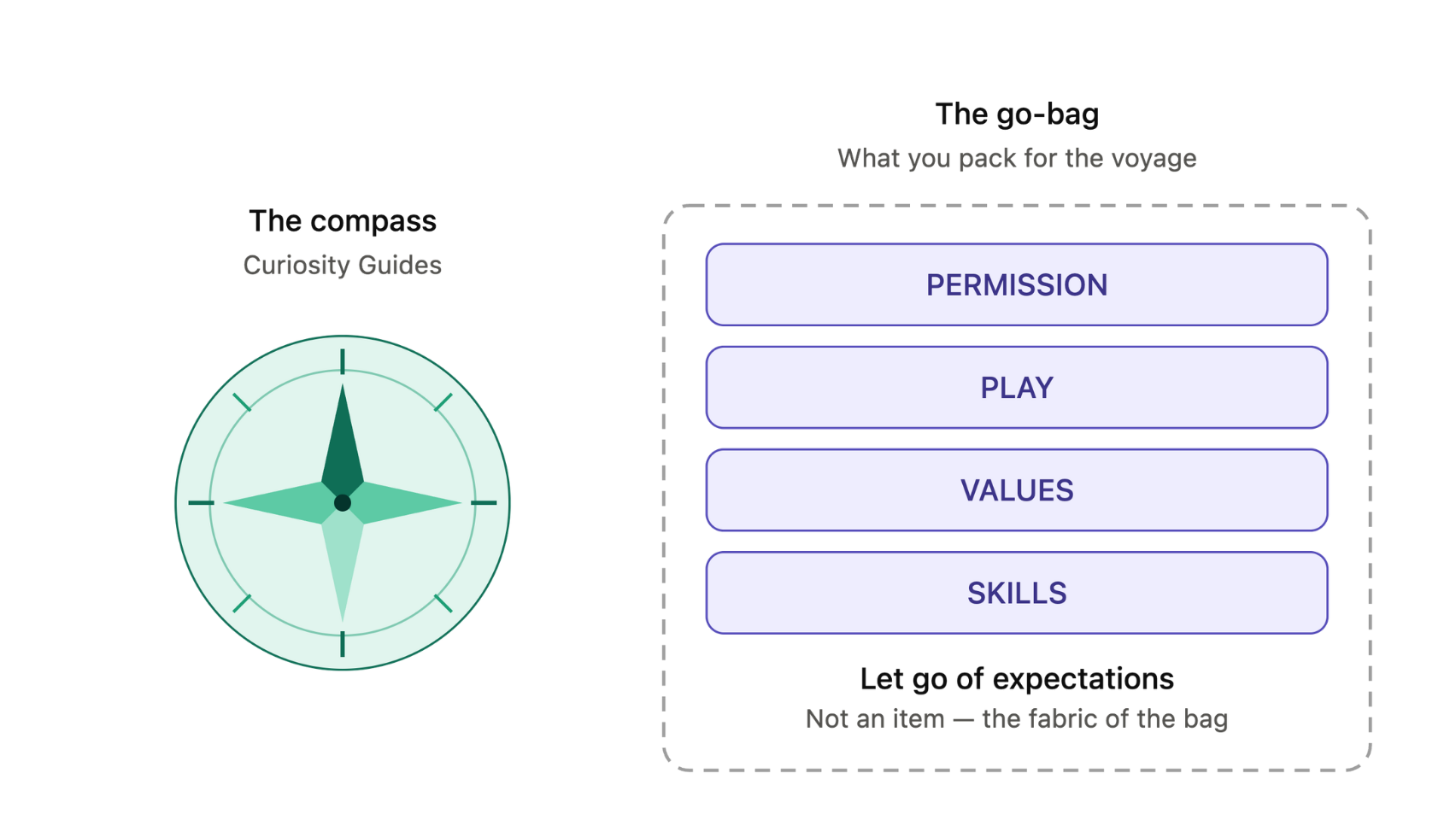
In order to ensure you're set for your journey, you need to pack a go-bag. The bag I'm recommending has four things within it:
"Playing big—following our callings and dreams—puts us all in a vulnerable place, but for women the stakes are especially high." - Tara Mohr, Playing Big
When setting out on this plan to follow your curiosity, you'll first need to give yourself permission to take this journey. While this sounds simple, it can be an exceptionally tough thing to do.
Tara Mohr wrote a book called Playing Big, where she talks about your inner critic. She says your inner critic isn't scanning for probable danger. It's scanning for any possible danger. It's not asking 'will this go badly?' but it's asking 'could this conceivably go badly?' - to which the answer is always yes. That's why it's so hard to take the leap.
Her suggestion isn't to defeat the inner critic but to notice it, name it, separate yourself from it (give it a character, even), and ask with some compassion what it thinks it's protecting you from. Identifying the inner critic and learning how to deal with it compassionately is the first step to giving yourself permission to make a risky or scary move.
In the book Big Magic, Elizabeth Gilbert devotes an entire section to permission, and her answer is blunt: there is no committee granting this for you. No letter arrives in the mail. You are the only person who is able to give yourself permission.
She then reclaims the word entitlement as a fierce belief that you're allowed to be here, doing this, and taking up space to do it. Many people were not raised with that kind of belief or encouragement. It can be difficult to give ourselves permission, but it is ultimately only ours to give.
In the book The Art of Asking, the author Amanda Palmer names an imaginary being (similar to the inner critic) as the fraud police. This is an imaginary force that will kick down the door in the middle of your big presentation and announce that you have no business standing up there. Once you say it out loud, you can hear how ridiculous it is. There are no fraud police. No one is coming to call you out for taking a leap.
So if the inner critic will never clear you, the permission committee doesn't exist, and the fraud police aren't coming, that only leaves you to sign that permission slip. Take the time to truly give yourself permission to explore your curiosity.
Developed by Dr. Stuart Brown and the play science team at the National Institute for Play, Play Styles is the product of thousands of play history assessments and decades of research into how people naturally play.
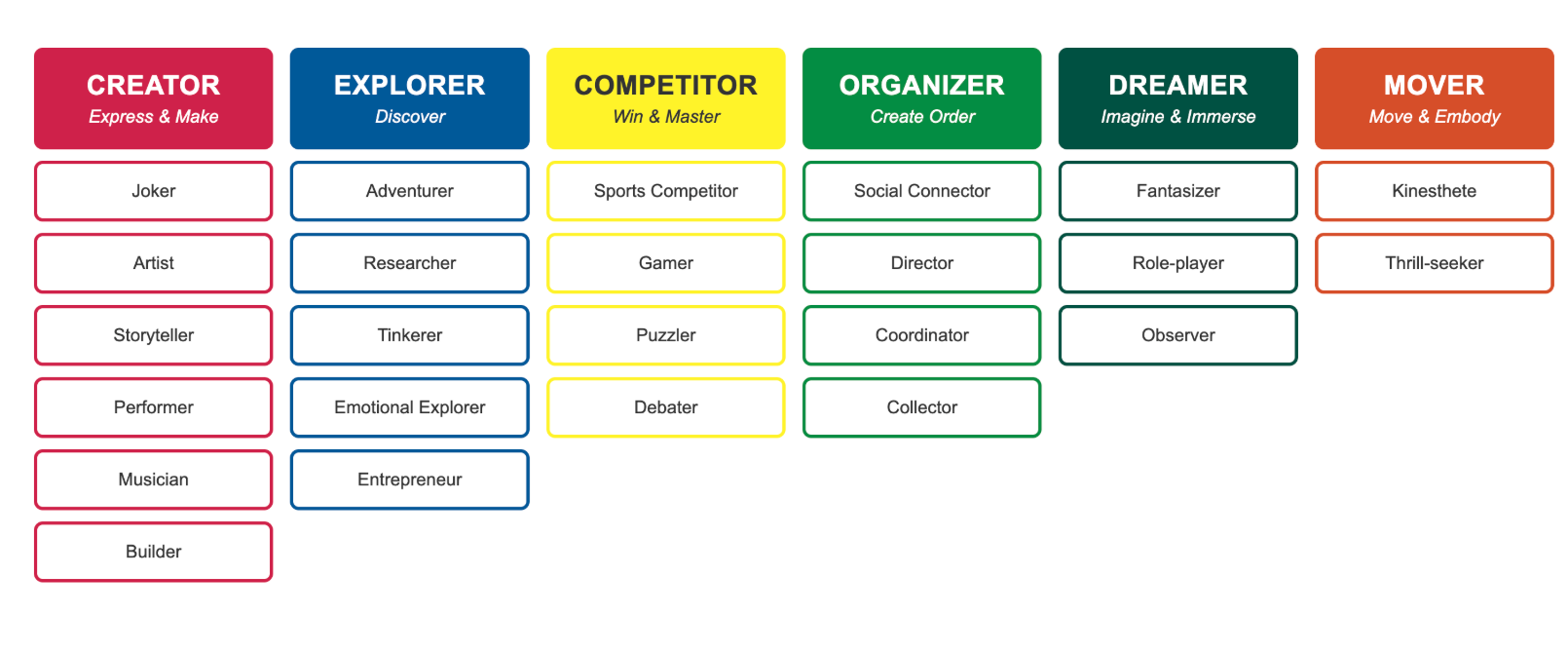
The National Institute for Play's six play styles: Creator, Explorer, Competitor, Organizer, Dreamer, and Mover.
NIFPlay recognizes 6 distinct play styles: the Creator, Explorer, Competitor, Organizer, Dreamer, and Mover. Each reflects a unique way people naturally engage with the world through play. Keep in mind that you're likely a blend of these various play styles and they shift and change throughout your life.
Creators bring something new into the world through art, music, stories, or humor. Explorers are driven by curiosity and the quest for new knowledge or experience. Competitors are energized by acquiring new skills, and fair contests. Organizers play by bringing order to things, leading people, and shaping social dynamics. Dreamers play through fantasy, observation, and immersion. Movers find play in physical engagement with the world.
For my play styles, I'm primarily a Creator, Explorer, and Organizer, and that explains why much of my work doesn't drain me. Spreadsheets, planning, coordinating a team, tinkering with websites, and pulling a story out of data are all things I do for fun.
My partner, on the other hand, is a Dreamer, Competitor, and Creator. He cannot fathom organizing a spreadsheet for enjoyment, he never plans a trip, and he recently pivoted from Engineer to professional Chef. Watching him enjoy working in a kitchen more than he ever enjoyed working a desk job makes complete sense once you see his play styles.
Knowing your play styles can be a surprisingly practical filter. While we do need to be careful of over-committing to work we are passionate about, that doesn't mean you can't enjoy working. Understanding your play styles can inform you on potential next steps and help you understand which doors are worth opening.
Many times in our career, we try to make decisions by predicting outcomes:
These are great questions to consider. But a lot of the time, we can't actually know the answers. We can run the numbers, we can ask all the questions in interviews, we can talk to folks who have worked there, and we might be able to get an idea of whether or not this role fits into our big picture.
But how many of us have taken a job that turned out to be nothing like what we were sold? We can't always know how the next position is going to play out.
If we can't know the future, we can look at the present. And a tool we have access to in this present moment is our set of values.
Mine are transparency, inclusion, autonomy, learning, and working with people I respect and actually want to build something with. Every one of those is observable during a hiring process or a client consultation:
When meeting with potential employers or clients, I stopped asking "how does this end?" and started asking "how does this align?"
Your values are an extremely powerful tool for knowing when to move in a certain direction and when to pass on that particular path.
What can you use that you already have? What are you good at? Where do you shine? These can be hard or "soft" skills. In fact, many folks are discussing the fact that "soft skills" are going to become increasingly important in an AI world.
Make a list of your skills. Hard skills, soft skills, and especially transferable ones. With this list, you're building an inventory of your own awesomeness so that when curiosity points somewhere, you can already see which dots connect.
Importantly, remember that you do not need to qualify for every single line in a job description. If you see a line item that you don't have, look over your list and see where your experiences or expertise translate. You may be surprised at just how transferable your experience is.
Now that we've discussed the four tools within your go-bag for this journey, let's hit on one more important element. This is not just a tool, but the fabric of the bag that holds it all together. It's non-attachment.
One of my many side quests was going through a 200 hour yoga teacher training. I didn't do it in order to teach yoga, though. I prefer not to teach for money; I wanted one pursuit with no monetization attached to it. It may have been the most useful side quest I've ever taken.
Two thousand years ago, Patanjali (who may have been one person or a collection of people) gathered existing oral traditions, philosophies, and practices into what is known as the Yoga Sutras: 196 short verses, or "threads" of wisdom. (As an aside worth mentioning, only three of those 196 sutras have anything to do with the physical postures that we see so much of in Western yoga today).
Sutra 1.12 reads: abhyāsa-vairāgyābhyāṁ tan-nirodhaḥ. This translates to, "The modifications of the mind are stilled through practice and non-attachment."
Abhyasa is practice: steady, dedicated, effort over a period of time. In other words, it's showing up and doing imperfect, messy work. Vairagya is non-attachment: engaging fully in the effort while releasing your grip on the result. Letting go of the end result.
While this applies to meditation practice, this also applies to how we live our lives. Being willing to show up with courage and put in messy repetitions while releasing expectations about the end result can take you further than perfectly following any life or career map.
If we can take the journey without a required destination, we're no longer blocked by the pressure of the outcome.
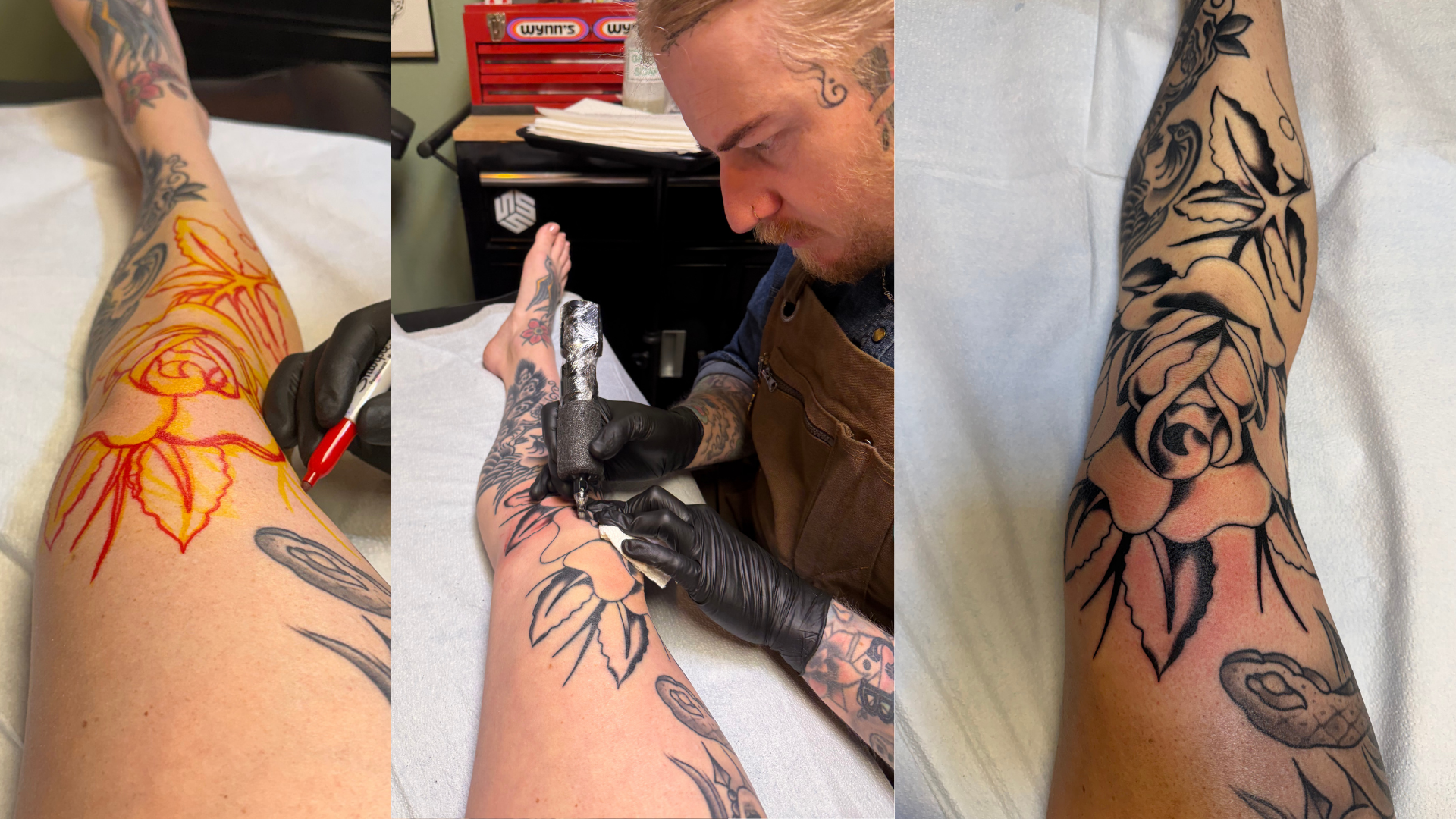
Of all my tattoos, my favorite is the giant rose on my knee. The day I got it, I went into the shop knowing we would probably work on my leg but having no idea what we'd actually do. Brad asked what I wanted and I said "let's do a big one today, I'm feeling good," and he pointed at my kneecap. Then he pulled out a Sharpie and freehanded a giant rose directly onto it. No pre-drawing, no stencil.
It's stunning. It's the one I get compliments on. It changes my entire vibe. And it was completely unplanned.
This isn't a road map, it is a tool kit. Hopefully you'll find something that sparks your creativity and guides you to a new discovery. Maybe it will enhance your career or place you on a brand new path:
A freehand rose, seven skulls, and a bitchin' eagle. Every single one of them was a "never" at one point. This sleeve could not have been designed on the first day I walked into a tattoo shop. Not by me, and not by Brad. It was built one session at a time, by a person who kept changing because she kept showing up.
Maybe you don't need to plan the whole sleeve either. Maybe you just need to show up for the next session with a little curiosity.

Heather Hamilton - Founder/Principal, Well Optimized SEO
Heather is the founder of Well Optimized, a growing digital marketing agency in Denver, CO. After over a decade in higher education and fitness, she side-hustled her way into a career pivot, building multiple businesses rooted in strong values, and sustainable growth.
Instead of our usual 10 speakers, we'll be inviting 15 brilliant experts to join us on stage this time!
We received so many amazing pitches this year & we can't wait for you to see them take the stage.
We'll be sharing our speaker agenda on October 5th - that's also when early bird tickets close (£399 now → £599)
If you've been thinking about joining us in London - now is the time to save £200!
See you at the Barbican on Friday, March 19th 2027!