The agenda is live: WTSFest London is 114 days away 🇬🇧
The agenda is live: WTSFest London is 114 days away 🇬🇧

Author: Laura Iancu
Last updated: 25/11/2026
I love AI.
However, I am increasingly worried about how quickly we have become reliant on the answers these systems provide, and our tendency to ignore the problematic nature of those answers.
Like many of you reading this, I build, configure and test AI agents.
We all know these AI systems have limitations in terms of how slow or fast the models “learn”. However, the bigger issue is where these systems retrieve their information from – our own biased human knowledge that exists on the web.
As a person who works in search, I believe strongly that my work carries a heavy weight of responsibility. So much so, I began referring to myself as a search activist because ultimately the work I do can impact not just whose questions are understood and answered, but whose experiences are visible.
With the rise of AI platforms, that means asking whose language, knowledge, and needs these systems recognise, and also whose they do not.
I believe that everyone working in search has a part to play in this. In this article I’ll explore what the issues are, and what we can do to help remedy the situation, whether we work in SEO, content, product, research, engineering, or other related fields.
People working in SEO have been aware of the bias in search engine results for years.
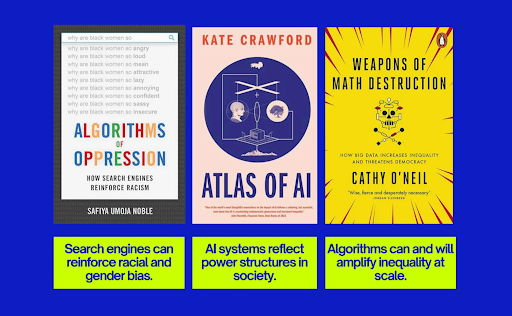
In 2018, Safiya Umoja Noble published Algorithms of Oppression, examining how search engines could reinforce racist and sexist ideas. Even though the book was written 8 years ago, it is far from being a period piece.
Fast forward to 2026, and we’re now dealing with another type of monster, our LLM friends ChatGPT, and co. Today, instead of a list of links, users searching via these platforms get a conversational response synthesised from whatever information these systems consider relevant.
The problem is that the information retrieved comes from the same biased sources that caused the issues in traditional search. As such, it’s fair to assume that the AI answers generated by these platforms are incomplete, biased and non-inclusive. (Unless these systems are prompted in very specific ways, but we’ll get to that in a bit).
When people say an LLM is "good at language", I want to ask: whose language? Formal written English? A dialect, a minority language? The way someone jokes with their family?
How well does the model handle regional expressions, code-switching or cultural references that have no tidy translation?
I am Romanian and I live in the UK, so I know how much of a person gets lost when everything has to be translated into a version of English that is appropriate for different contexts.
Yes, AI can help people communicate across languages, but if we treat one way of speaking as the standard, and everything else as a variation to be corrected, we're asking the technology to make the world sound way smaller than it is.
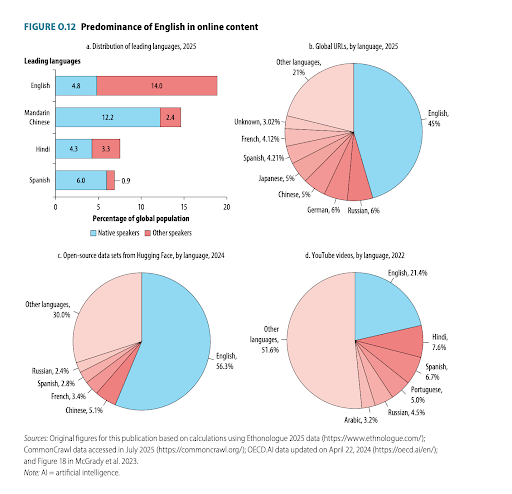
The World Bank's 2025 Digital Progress and Trends Report estimated that English accounted for roughly 45% of the URLs in its language analysis. Just to be clear, that is a measure of online content, not a measure of the world's English speakers: “Spoken by roughly 19 percent of the global population, English dominates high-quality text data—accounting for 45 percent of global URLs”
It’s a bit of a no-brainer when we look at this data that there is a significant imbalance that leaves models with barely any relevant material for the majority of languages.
And so, English language becomes the default.
To help illustrate this issue, here’s a quick experiment to try out with a group of friends or colleagues:
For example, one of the common expressions I picked up as a Romanian living in the UK is referring to my evening meal as “tea” instead of “dinner”. This throws a lot of people, so I tested Google and Chat GPT to see how the AI models responded:
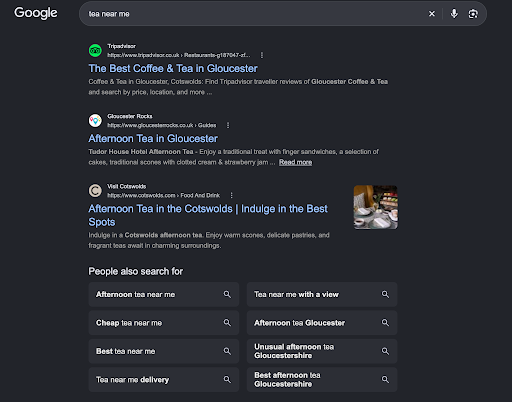
First I searched Google for “tea near me”. Google automatically assumed I’m either looking for a beverage, or afternoon tea. It does not consider that “tea” could mean an evening meal:
I then entered “I want some tea” into ChatGPT. I used the free model with no previous data collection. It assumed I wanted a beverage and recommended English Breakfast tea with milk:

I then entered “Recommend me something for tea” into my paid version of ChatGPT (with previous data collection). Here the model performed a little better. It asked if I meant a cup of tea, or my evening meal; and it went on to suggest that if I’m hungry I could make myself a jacket potato.

When people say they’re “training an agent”, they’re usually configuring instructions, selecting documents, connecting tools, building workflows, and evaluating outputs.
I think we need to do more. In the past I’ve spoken about mindful prompting, and whilst I acknowledge that well thought-out prompt can’t rewrite the internet or repair a model’s entire training history (the people who build and procure AI systems also have a more direct responsibility for dataset provenance, evaluation, and governance); it can, however, shape the assumptions we bring to a task, determine which source material the model retrieves, and what we accept before an answer goes live.
We need to look beyond the polished prompts we write at work. Think about someone typing in a minority language; using a screen reader or speech input; a teenager asking an awkward question; a migrant asking about local rules; or a person who doesn’t know the official word for their problem. Their questions may be vague, emotional, use mixed-language, be misspelled, but they are nevertheless entirely reasonable – they’re just in a context we don’t share.
If we test only the queries we would write, these systems may look excellent. But it’s important to remember that when we do this, we’ve tested only how well the system serves us.
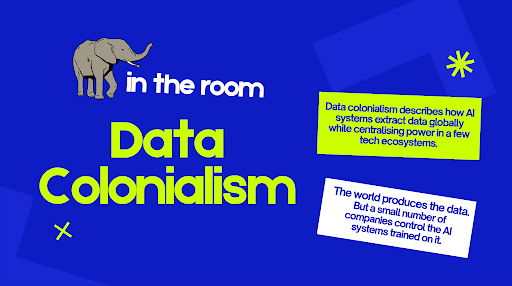
There is a larger issue here that researchers including Shakir Mohamed, Marie-Therese Png and William Isaac have explored through decolonial approaches to AI: whose knowledge and values shape the technology, who has power over it, and who bears the consequences. The term data colonialism points towards extraction and unequal control over data and the value it creates. Adding a few international examples to a prompt does not dismantle that structure.
Still, our everyday publishing choices matter. We can make locally relevant information retrievable without forcing it into one supposedly universal voice. We can attribute cultural knowledge and expertise. We can keep original-language names and meanings where they matter, provide genuinely useful translations, and avoid converting every cultural reference into a tourist-friendly stereotype.
We can also stop treating English-language, highly ranked content as the only possible authority. Search visibility and truth are not synonyms.
If the available material is incomplete, an agent should be able to say so and ask for context rather than invent a tidy consensus.
UNESCO's Recommendation on the Ethics of Artificial Intelligence explicitly addresses multilingualism, cultural diversity, fairness, and the environmental impact of AI.
This isn't an obscure concern dreamed up by somebody who has spent too long testing chatbots. Although I have also done that 🙂
There is another piece of cultural infrastructure that is easy to forget: the planet we live on.
Data centres need electricity, cooling, materials and land. AI also offers useful possibilities, including more efficient systems, but those benefits don't erase its footprint.
The International Energy Agency's 2026 update projects global data-centre electricity demand rising from about 485 TWh in 2025 to about 950 TWh by 2030, and the IEA identifies AI usage as an important driver of the increase.
As a result, I’m a strong advocate for thinking about resource use in agent design. If you build AI agents and workflows, I’d encourage you to consider the energy impact of what you're building.
When you’re designing an agent or workflow, ask yourself these questions:
And while you’re doing your part, go big and prompt the organisations you work with or depend on to do their bit too. Go all “search activist” on them 🙂
There isn’t one checklist that will magically remove bias from AI.
But teams working in search, content, product, research and engineering can take the following practical steps:
Build a small set of realistic prompts that vary by language, dialect, spelling, context and level of detail. Include the kinds of questions your audience might ask when they don’t know the official wording. Record the system, settings and date, because results can change.
Does the system ask for clarification when a request is ambiguous? Does it infer someone’s location, identity, or needs without evidence? Whose perspective is present, and whose is missing? Keep a record of outputs and sources rather than drawing a broad conclusion from one surprising answer.
Make information findable without forcing it into one supposedly universal voice. Preserve original-language names and meanings where they matter, provide useful translations, and attribute cultural knowledge and expertise. Search and AI visibility, and truth are not synonyms; highly ranked English-language content is not automatically the only authority.
Document what a system is for, its limitations, who reviews its output and how people can report problems. Teams that build or procure AI systems have a more direct role in asking about data provenance, evaluation and governance. Guidance such as NIST’s Generative AI Profile can help teams think through risks and evaluation, but no single score will capture what every user experiences.
I’ve also written about building practical AI governance into SEO. Responsible use needs more than a thoughtful prompt: it needs clear guardrails, accountability and human review.
Data centres need electricity, cooling, materials, and land. Benefits gained from creating AI systems don’t erase the resources this technology demands.
Ask whether repeated rounds of self-critique are necessary for simple factual tasks. Could retrieval be more precise? Could a safe cached answer be reused? Could a person make the decision faster and better?
Look, a better prompt can’t undo historical bias, but we can question assumptions, test with people whose experiences differ from ours, publish with care and make room for language that doesn’t arrive neatly formatted for a machine.
For those of us in the search industry, this connects directly to our work: whose expertise becomes visible, whose needs are understood, and who can access information. We can all play a part in turning our concerns into actions across search, content, product and AI governance.
And ultimately, before accepting an answer, ask: whose worldview does this answer assume? If the answer is “mine”, that’s a starting point, but it shouldn’t be your endgame.

Laura Iancu - Searchpedia Founder & International Search Consultant
Laura Iancu is a UK-based, independent search consultant, mentor, and educator known for her work in international SEO and ethical use of search. She is the founder of Searchpedia, the online glossary for all things search, and SEO at Octopus Energy. Her work is a blend of technical SEO, advocacy around representation, culture, and human-centred search experiences.
15 speakers, a thoughtfully planned agenda & a room filled with brilliant people from across SEO and digital marketing.
Take a day away from the everyday to learn, reflect, connect & feel inspired about what comes next.