Author: WTS Team
Last updated: 15/10/2026
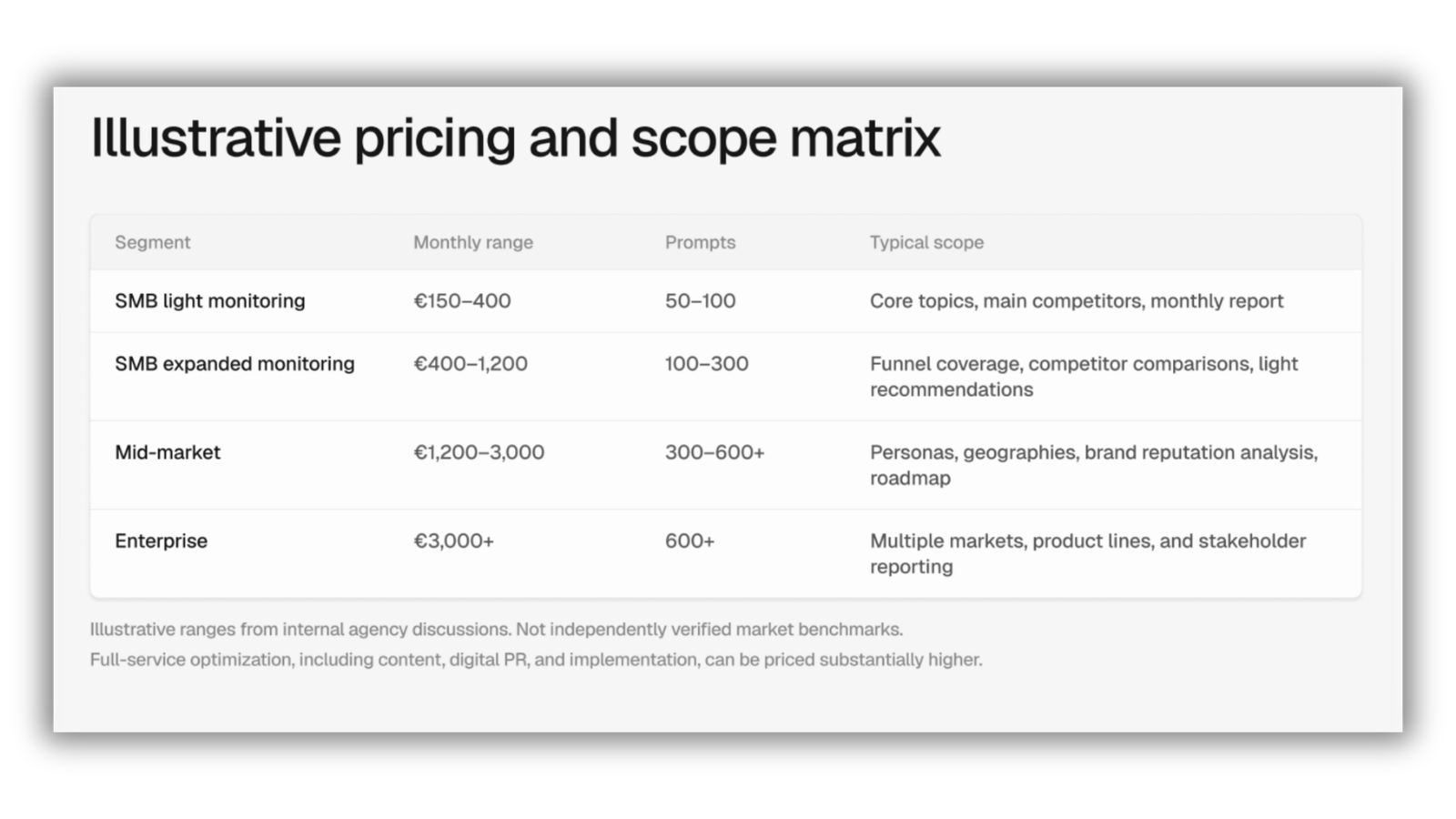
The pricing matrix was one of the most compelling moments for attendees during this WTSTalk.
It put indicative monthly ranges, prompt volumes and levels of service side by side, from light monitoring for an SMB through to multi-market enterprise work.
But Leon Sentker made an important distinction: the numbers on the slide were not a client rate card.
They were illustrative ranges drawn from internal agency discussions, showing how the underlying scope can grow. They were not independently verified market benchmarks—and they were not intended to represent the full fee an agency should charge.
That distinction gets to the heart of the session. Clients are not simply buying access to an AI visibility platform. They are paying for research, commercial judgement, strategy, implementation, reporting and the expertise required to turn data into useful action.
In this WTSTalk, Antonia Breitenfellner, AI Agency Search Strategist at Peec AI, and Leon Sentker, Agency GTM Lead at Peec AI, shared a practical framework for defining, pitching, packaging and pricing that work.
You can read a quick summary below as well.
Antonia encouraged agencies and freelancers to step back from claims such as “we’ll get you ranked first in ChatGPT” or “we’ll own every AI answer in your category”.
Those promises ignore how variable AI-generated responses can be and set up expectations that no provider can reliably control.
A credible service starts with outcomes you can support, such as:
This changes the pitch from “AI search is changing everything” to “here is the business problem we can help you understand and solve”.
It also means adjusting the language to the person buying the service.
An SEO lead may see the work as an extension of SEO.
A senior leader may be more interested in brand perception, market position, revenue or how the organisation is represented across AI interfaces.
The underlying work does not need to change every time, but its commercial framing might.
Not every client is ready to buy the same AI search service.
Antonia and Leon grouped the opportunity into three broad stages.
The client needs clarity and evidence.
This could begin as an intelligence project covering research, prompt development, benchmarking and an initial view of visibility, sources or brand perception.
Success at this stage is not an instant improvement in rankings. It is helping the client make better decisions.
The client has identified a problem and wants a focused strategy.
The scope becomes narrower and more targeted. It might involve a particular product line, audience, market or reputational issue, followed by the first layer of execution.
Success is measured against defined objectives rather than a broad visibility score.
The client wants sustained progress.
This is where the work becomes cross-functional and recurring. Research, optimisation, implementation and measurement operate as an ongoing cycle rather than a one-time snapshot.
The pitch can then be made more relevant through four useful lenses:
These approaches make the analysis specific to what the client is trying to achieve instead of offering the same generic dashboard to everyone.
A standalone audit can be a practical starting point, especially for a client that needs evidence before making a larger commitment.
It should not be presented as the complete solution.
AI-generated answers, cited sources and competitor activity continue to change. A one-off audit can show what is happening now, but it cannot reveal what changed three months later or whether the actions taken had the intended effect.
Antonia described a more useful progression:
This creates a reason for the next conversation.
An initial diagnostic can become a strategic audit.
↓
The audit can become a focused engagement.
↓
That engagement can become an ongoing partnership covering research, implementation and business measurement.
The goal is not to force every client into a retainer. It is to define each stage clearly enough that the client understands what it delivers and what remains to be done afterwards.
The session outlined 3 practical packaging models.
For an existing SEO client, AI search can be introduced through regular reporting, a quarterly business review or a renewal conversation.
This is often the most natural route because much of the work overlaps with established SEO, content and digital PR activity. The agency adds new data, analysis and reporting while building on an existing understanding of the client.
Some agencies begin by introducing a small amount of AI visibility reporting before proposing a formal expansion of scope.
A standalone service can work when the client has a dedicated budget or when the buyer sits outside the SEO team.
Corporate communications, brand, digital PR, social and other teams may be interested in questions around AI visibility and brand perception even when the existing SEO budget is already committed.
The service still needs to connect monitoring to decisions and delivery. A dashboard alone is unlikely to sustain the relationship.
A paid audit can help a cautious client understand the opportunity before committing to a longer engagement.
This should be a meaningful piece of work with defined outputs: prompt research, benchmarking, competitive or reputation analysis, strategic priorities and clear recommendations.
If the audit identifies useful opportunities, the next engagement can focus on implementation and continued measurement.
A platform is one input into the work. Its subscription cost should not determine the entire client fee any more than the cost of an SEO tool determines the value of an SEO retainer.
The service may include:
Leon recommended a value-based approach: what expertise, deliverables and business value is the agency providing?
The pricing matrix followed the same principle. Moving from light SMB monitoring to enterprise work meant more prompts, more markets, more personas, more complex reporting and a larger strategic workload.
The useful question is not “What does the platform cost us?”
It is: “What expertise, deliverables and business value are we providing?”
Clients may know AI visibility matters while still asking how it contributes to revenue.
There is not yet one metric that answers that question completely.
Antonia suggested starting with the client’s business goals, identifying the priority topics attached to those goals, then building a prompt set with enough depth to cover them. From there, the agency can examine visibility, sources and opportunities before recommending actions.
Leon described measurement as a combination of signals:
Referral traffic alone will not capture the whole impact in a zero-click environment. At the same time, visibility alone does not prove commercial value.
A credible reporting approach brings the available signals together, explains their limitations and avoids claiming more certainty than the evidence supports.
Antonia closed the presentation with 5 pitfalls that can undermine an agency’s credibility:
The agencies and freelancers best placed to sell this work are not necessarily the ones making the biggest promises.
They are the ones that can explain what is happening, connect it to the client’s business and create a realistic plan for what to do next.
The full WTSTalk includes Antonia and Leon’s complete positioning framework, examples of competitor, geographic and persona-based pitches, the illustrative pricing and scope matrix, and audience Q&A covering tools, freelancers, suitable industries and C-suite language.
Watch How to Package & Price Your AI Search Services on YouTube.
Stay to the end for a speed round that somehow produces a hypothetical horse-scuba diving consultancy.
Note: No horses were asked to actual scuba dive before, during, or after this webinar.
Peec AI is a WTSPartner. Their support helps keep The WTS Community free and sustainable for members while making practical learning opportunities like this WTSTalk possible.
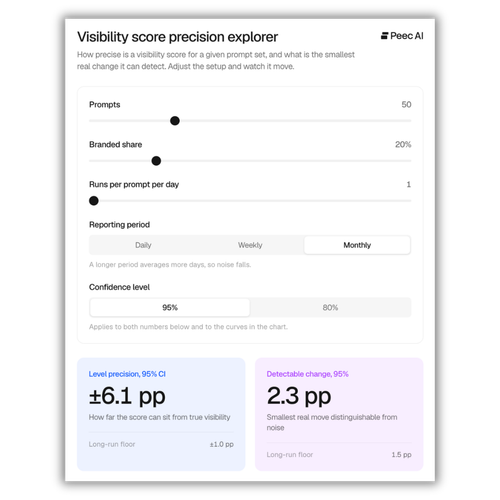
AI visibility scores can move even when nothing meaningful has changed.
Peec AI analysed seven months of data across roughly 120 million chats to show how prompt coverage and tracking time affect the reliability of visibility scores.
The research explains why agencies should track a broader, stable portfolio of relevant prompts over time—and includes a tool for estimating how many prompts are needed across different business lines and focus areas.
Thank you to Peec AI for supporting WTS as a WTSPartner 💜