Author: Katie Mishner
Last updated: 20/04/2026
When I was an intern in 2014, "omnichannel" was the marketing buzzword of the moment – everyone was talking about how to create a seamless and consistent customer experience across all channels, both online and offline. But more than a decade later, the promise of delivering true omnichannel experiences remains unfulfilled because we've continued to operate our various marketing channels in silos.
As consumers shift to AI-powered search, I believe that SEO can no longer continue to operate as a separate function – it needs to be the glue that holds these seamless experiences together.
In this article, I’ll explore how SEO teams can lead the way.
I have elected to use running shoes as the primary use case throughout the article. It’s a space which is heavily brand-led, and highly competitive on paid and organic search. However, it is also a market with a wide range of potential customers, with different levels of engagement and knowledge. In addition to this, because I started running last year, I’ve spent a lot of time on both sides of this use case!
It’s also worth noting that I am an eCommerce expert, an SEO Manager in a UK agency, and as such, my experience, perspective, and points of reference are largely sector-specific. There are of course nuances to SEO, GEO and the shift in search as it applies to SaaS, fintech, B2B and other sectors; however, I believe that the tactics I’ll be sharing here can be broadly applied to a variety of markets and sectors.
The rise of AI search means that marketing teams need to work together to understand new patterns of search behaviour.
According to SEMRush, the term “running shoes” has 60.5k monthly searches in the UK. Plus, it appears that interest in running is growing – The Great Run company found in 2024 that running uptake for their races spiked by 39%; and according to Google Trends search demand is increasing:
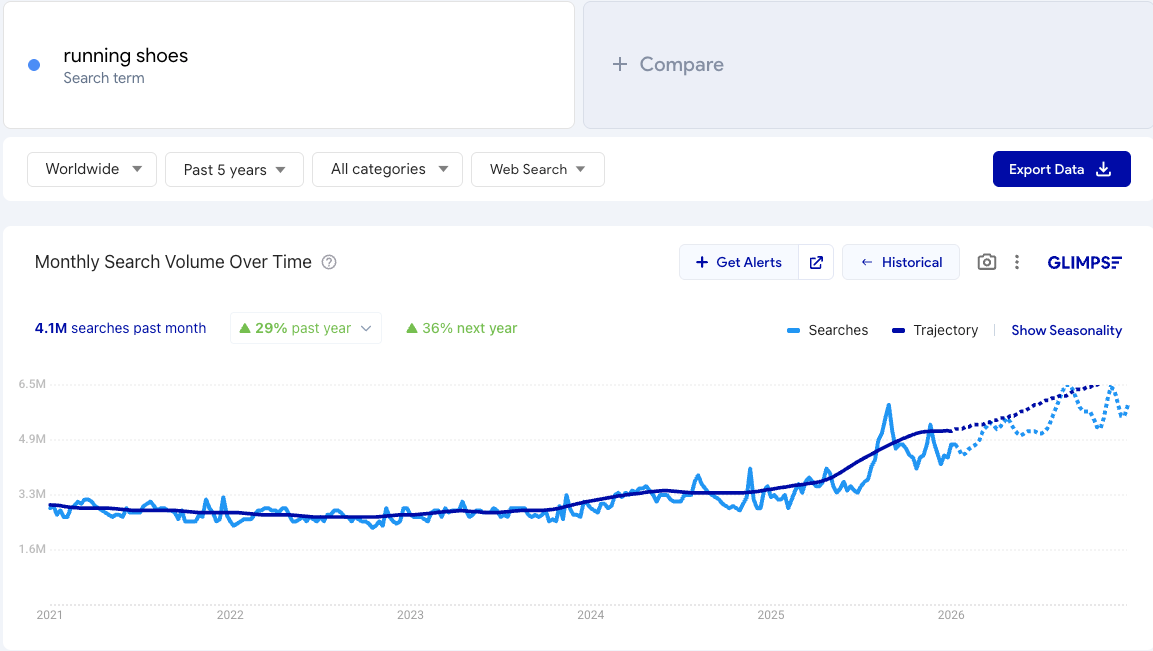
Google Trends graph for the term “Running Shoes” which shows an increase in search volume of 29% versus last year.
But of course, people don’t just use search engines to find answers – the way that users search is continually expanding. A user might perform both a simple search for ‘women’s running shoes’ or something more specific. In between this, they might watch a TikTok video, speak to a friend, go into a running shoe store, or look through Google shopping’s listings of products. They might run a search on an AI engine like ChatGPT.
What’s perhaps most noteworthy is the difference between the types of queries people use on search engines, versus LLMs.
For example on a search engine someone might enter a query like “women’s running shoes”; however on an AI platform we’re seeing significantly more detailed queries e.g.:
Increased information demand is not just fuelled by LLMs, but also by the ways in which people use them to search for answers.
I suspect that economic factors are playing a part here too. According to EY brand loyalty is declining, and UK consumers are prioritising value for money which likely means we’ll continue to see an increased demand for information, product/service comparisons, and shopping around for the best deals.
Query fan out is the method of mapping a single topic to a full spectrum of queries. It is the technology that is used by AI Mode and AI systems to answer multifaceted questions, such as the ones outlined above.
SEO would usually take responsibility for keyword research, but query fan out gives non-SEO teams a framework they can understand and use too.
PR teams can see which angles drive visibility and use their expertise to determine what is newsworthy. Paid teams can align messaging across their campaigns. Social teams can feed the ecosystem that query fan-out taps into, as it can be very trend or campaign orientated.
There are several ways that you can approach simulating a query fan out, using the Gemini AI in Screaming Frog or utilising an LLM to analyse and provide query fan-out. This is up to preference, personally I have found the latter to work effectively as the prompts can be amended easily.
However, what I have found to be most effective is setting up a process that allows for the collaboration and engagement of multiple departments.
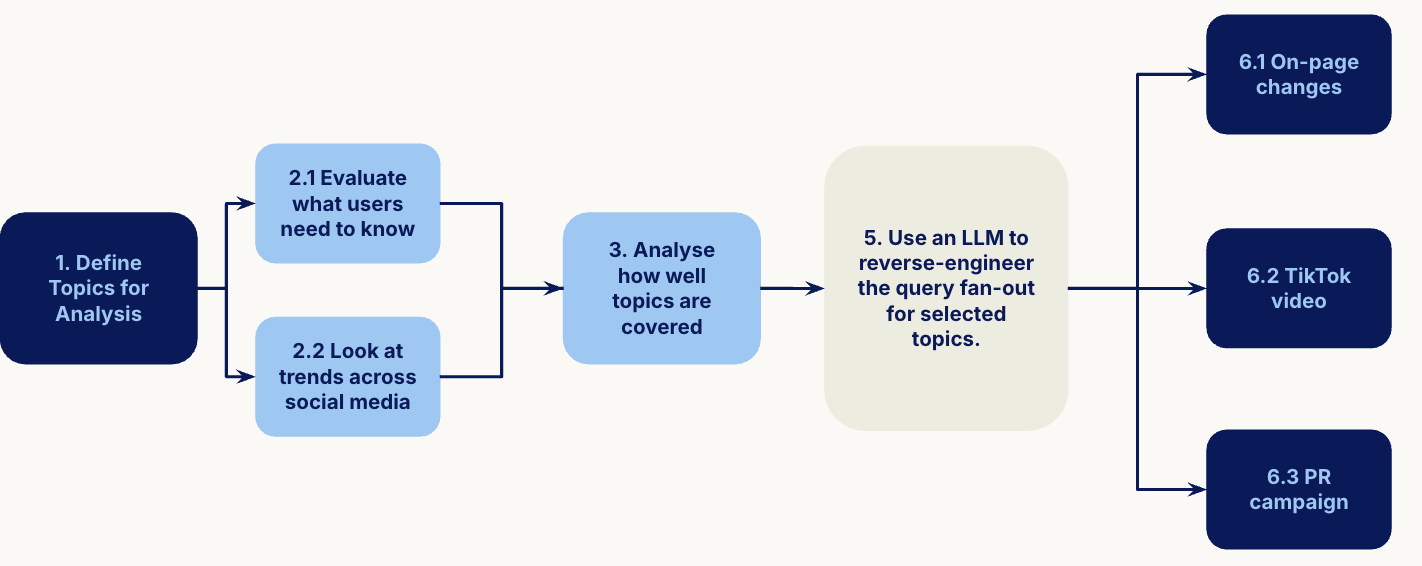
How to approach query fan out analysis (Source: NOVOS & Katie Mishner)
Broadly speaking, SEO targets increased visibility on search engine results pages (essentially we’re trying to ensure pages on a website rank well for relevant queries), whereas GEO (Generative Engine Optimisation) targets AI answer inclusion i.e. we’re trying to ensure our brand, products, and/or services appear in the answers for relevant searches on LLMs like ChatGPT, within Google’s AI Mode, etc.
Search engines rank pages, whereas AI surfaces assemble answers. Because of this, AI relies on structured data and infrastructure to understand context. (For further information on how AI surfaces assemble answers, you might like to check out Aimee Jurenka’s article, How AI Chooses Content.)
As such, there are some core technical differences between how we should approach GEO, versus SEO:
In my opinion, the difference is subtle but significant – SEO is about optimising content for search engines; but GEO isn’t optimising content for AI systems, it’s about enabling AI systems to better understand our content.
Comparative information, attributes, and simple question-answer structures all help LLMs gain an understanding of your content, which, in turn increases the chances of your brand, products, and/or services being mentioned and cited in AI answers.
For many, this approach may be a slight shift in strategy but these concepts are not alien. Think of it as a re-prioritisation.
Schema implementation may not have been that high up on your list before, but knowing that it will benefit both traditional SERP visibility, and the chance of being surfaced by LLMs, it makes sense to prioritise it now.
Context is required when it comes to joining up channels, and structured data is a really effective way to do this. ‘Product’ schema is absolutely essential for most channels and therefore, expanding your structured data here will provide search engines and AI systems more context about your brand, products, and/or services.
Schema gives specific information that users want to know about products or services, while also leaning into validation and trust signals, which will always be important from an SEO perspective.
If I was to recommend a tactic for a website optimising for the comeback of omnichannel, Audience, Usageinfo and Review would be my go to schema because of the way that they give context through structured data.
Audience and Usageinfo isn’t (yet) supported for rich snippets or merchant centers, but it is highly useful for AI-generated answers for platforms such as LLMs, AI mode, and AI overviews.
Audience is a subjective way to mark up a product, but in my experience it’s best to avoid using terms that are too demographic, and instead focus on who the actual customer will be. (i.e. it’s about the intent of the customer, not necessarily their age, gender or location.)
Here’s an example of how this would be used situationally, leaning into our example of running shoes.
A website is selling a pair of running shoes for road races, with carbon plates. Things that we know to be true about this product:
This means that the core audience is advanced runners, so we’d mark this up
"audienceType": "Advanced Runners"
}
We can pair Audience with Usageinfo schema to further enrich AI systems’ understanding of our products. In this case, the key differentiating factor of the product is that it includes carbon plates, which could make marked up in this way:
"usageInfo": {
"@type": "UsageInfo",
"usageType": "Race day",
"usageDescription": "Designed for road running races using a carbon-fiber plate to improve running efficiency at faster paces."
}
Sitting adjacent but serving a different purpose is ‘review’ schema. Daisy Burrell wrote a fantastic piece about the rise of reviews. I particularly resonated with the quote “I trust reviews more than your website. So does AI”.
Reviews have always been important - they act as validation and signals of trust. They’re essential across the marketing mix, from browsing TikTok, to encountering a paid ad, to a good old Google search. However, Daisy argues that for AI systems, reviews carry more weight because of the way that they prioritise and synthesize real life experiences, consensus and repeated sentiment.
SEO is the glue for these channels in this case. Reviews are important to all of us, but this is a case for making a particular effort to ensure that these signals are across the website (arguably the role of SEO), and that it is marked up accordingly (arguably the role of SEO).
With the rise of AI, SEO offers infrastructure that lays a solid foundation for other channels, and as we’ve seen with schema, can be the key to gaining alignment across the relevant marketing teams.
Schema improves the quality, consistency, and reliability of the data that paid media platforms depend on. As automation, Shopping, and Performance Max rely heavily on machine understanding, schema helps reduce ambiguity around products, pricing and stock availability. In theory, stronger schema should lead to fewer disapprovals, and more predictable performance across paid channels.
Feeds are another form of structured data that LLMs and AI agents rely upon for understanding topics. AI doesn’t care if the source of data is organic or paid, just that the information is true. Therefore, information on Merchant Centres needs to be aligned with schema on-site.
Key information should be aligned to avoid any confusion between traditional SEO, paid and AI search results:
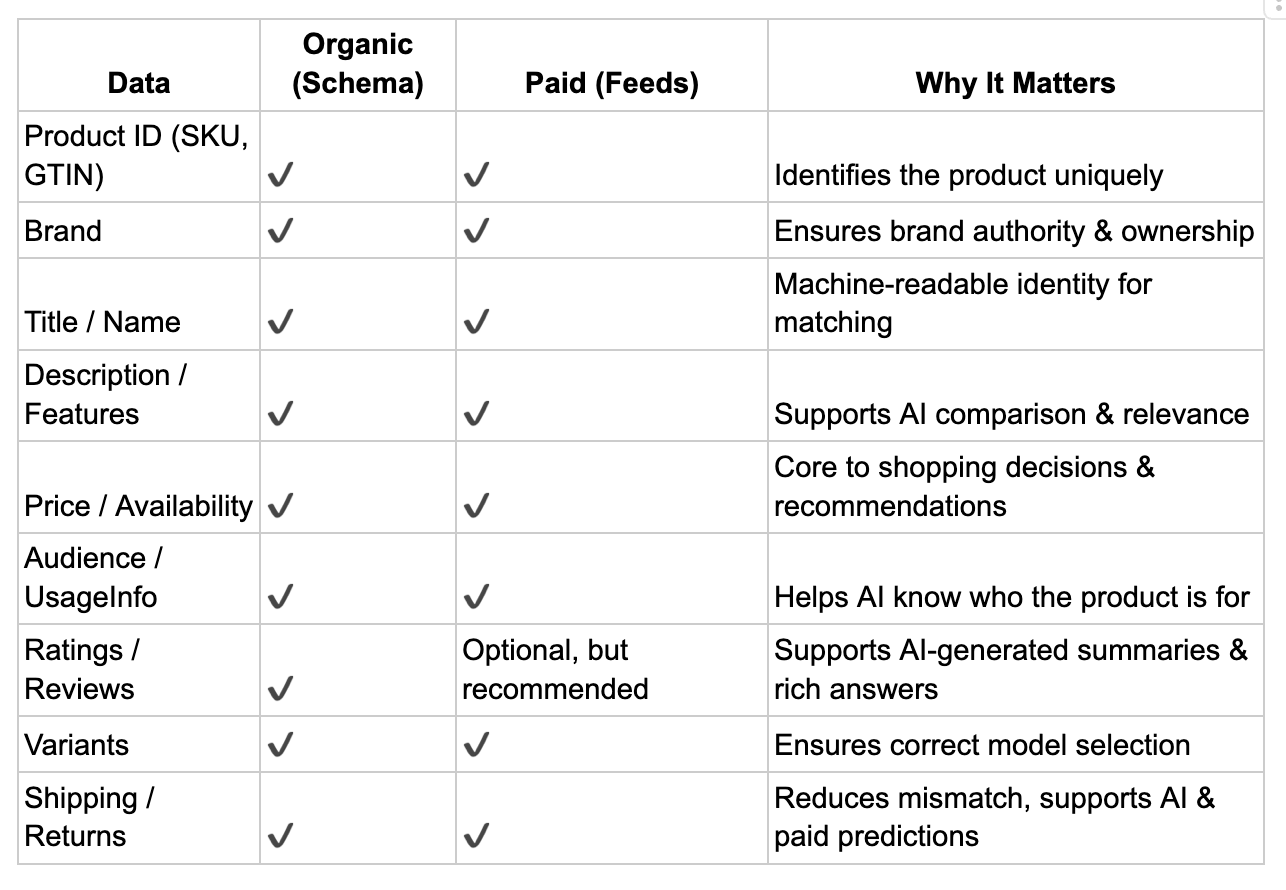
Schema types and why they matter
Paid teams can work closer with SEO strategies to enhance attributes, schema and improve overall results.
As search evolves toward AI-generated summaries and comparative experiences, brand representation is increasingly shaped by how machines interpret and combine information from multiple sources. Schema provides brand teams with a structured way to define brand identity, product relationships, and key attributes in a machine-readable format, reducing ambiguity in how brands are presented across search engine results pages and LLM-generated answers.
LLMs and AI agents do not distinguish between “brand messaging” and “search data”, they prioritise consistent information. When schema is aligned with brand positioning, it increases the likelihood that AI-driven experiences reflect brand messaging, rather than inferred or third-party interpretations. This is especially important in comparative queries, where there may be competition with third-party resellers.
Closer collaboration between SEO and brand teams ensures schema reinforces brand strategy, protects brand safety in AI-driven environments, and reduces the risk of misrepresentation at scale.
Schema requires product information to be explicit, structured, and consistently defined. Data cannot be marked up if it does not exist.
This creates a natural alignment between SEO and product teams, as schema forces clarity around what a product is, who it is for, and how it should be understood by machines across channels.
AI systems and LLMs summarise, compare, and recommend products without relying on a single page or channel. When product attributes, specifications, and usage context are not clearly defined, AI systems can be more likely to hallucinate and provide incorrect information.
Schema allows product teams to encode intended product definitions directly, ensuring products are interpreted as designed. Key product information should be aligned across on-page content and schema to support accurate AI understanding:
By working with SEO teams, product teams can ensure that product definitions are reusable across organic search, paid media, and AI-driven discovery. Consistency is key.
AI search often falls into the remit of SEO, and rightly so, I feel we’re best placed to make recommendations there. Maybe this is my bias showing, but this feels like a good thing, because it should give SEO as a channel a chance to be in the driver's seat, it is also the perfect opportunity for increased collaboration between channels.
For example, at NOVOS, I’ve been working hard with the Digital PR team to build cohesive strategies that are designed to drive visibility across traditional search and AI. We’ve always overlapped with goals and our strategy, but the need for citations has driven this to a new level of closeness.
However, this type of common goal and the new user experience can muddy the attribution waters. There will always be a place for traditional SEO reporting, but when budgets begin to tighten and ROI is harder to prove, it is important to look at how SEO can be demonstrated as the glue of the marketing mix.
Some of the ways you can do this, beyond traditional clicks, impressions, rankings, and revenue:
Omnichannel never went away and while it still isn’t a very fashionable term, the sentiment of cohesion and consistency does resonate in an otherwise turbulent search landscape.
If we return to the running shoes example, a runner does not move neatly from awareness to purchase in a straight line. They might ask an LLM which shoes reduce shin splints, watch a TikTok review of carbon-plated racers, compare prices in Google Shopping, read reviews on a brand’s website, and finally purchase in-store or via a paid ad. To the user, this is one continuous experience. To machines, it is a fragmented web of signals that must be reconciled.
In an AI-driven search landscape, SEO is no longer about “ranking for running shoes”. It is about ensuring that the truth about a product (who it’s for, how it’s used, why it exists) is consistently understood across every channel. Structured data, information architecture and content clarity are what allow that carbon-plated race shoe to be understood as a specialist product for advanced runners, rather than a generic option surfaced to the wrong audience.
This is where SEO shows its true value. Not as a traffic channel, but as the infrastructure that allows paid media to scale more efficiently, brand messaging to remain intact, reviews to carry weight, and AI systems to summarise products accurately. These are not “SEO tasks”; they are the foundations of a functioning omnichannel experience.
The opportunity for SEO teams is not to chase new acronyms or attempt to “optimise for AI”, but to lead collaboration across product, brand, PR, and paid teams. In the age of AI, the best omnichannel experiences are built by getting the basics right, and SEOs are ideally placed to deliver this.
We pay our authors, speakers & team to bring you helpful content like this.
We aim to always keep our content and community free and accessible.
If you've found value in WTS, please consider supporting us through our Buy Me a Coffee initiative.