1 day left to save £200 on WTSFest London 💙 £399 now → £599
1 day left to save £200 on WTSFest London 💙 £399 now → £599

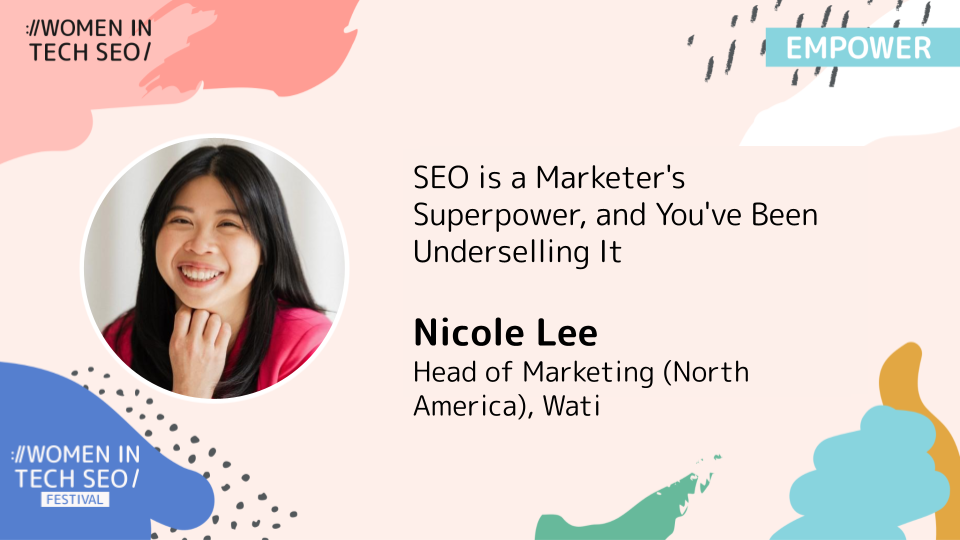
Author: Nicole Lee
Last updated: 06/07/2026
Many marketers know SEO matters, but they treat it like a utility. Something to hand off to a specialist, an agency, or whoever is willing to deal with it. Then they go back to their work.
I think this is a mistake.
I started out as an SEO before switching to product marketing. Then I worked in content, and most recently I’ve moved across to growth. From the outside, each transition looked like a pivot. But actually, what made each leap possible was my background in SEO.
Not the mechanics of keyword research, or crawl budgets, but the underlying way of thinking about your position in the market, about your customers, and what it takes to get your product or service in front of a person who needs it.
That's what most people miss when they dismiss SEO as a tactical channel. The tactics are almost beside the point.
Search data is customer research
Search data offers deep insights you just can’t get from anywhere else. It’s not what customers say in interviews or click on in surveys, it’s what they type into a search bar or LLM when nobody's watching. There's no performance at that moment. It's just a person and a real problem, described in their own words.
Search data tells you how customers describe the problems they’re trying to solve. Many companies don't use it that way, because they've decided keyword research is the SEO team's job, which often means those insights remain stuck in a silo rather than being shared with the whole marketing function.
Another thing SEO trains you to do is to connect actions to outcomes. Organic traffic, rankings, click-through rates, and attributed pipeline… SEO practitioners have never had the luxury of vague brand metrics.
You learn to build a performance story that compounds over time, or you don't have a story. That skill is rarer than it should be, and it transfers everywhere. Growth, demand generation, you name it.
Systems thinking is about understanding how changes to one variable can create non-obvious effects elsewhere, and using reasoning about the whole system to predict outcomes. Not just optimizing the part directly in front of you.
SEO forces that. Constantly.
Take internal linking. Adding a link from page A to page B passes authority, but it also changes the crawl priority of B, which affects how often search engines revisit it and how quickly content updates get indexed. Changing one link is never just changing one link. It's an intervention in a system, and the system responds in ways that aren't always visible at the point of intervention.
Site architecture affects which pages get crawled. Crawl budget affects which pages rank. Which pages rank affects which content investments actually pay off, and which content is considered bloat. A decision that looks like an information architecture decision is also a resource allocation decision, and a growth decision, all at once.
And content cannibalization? You know that publishing two pages targeting similar intent doesn't double your chances of ranking. It splits authority between them and creates a signal conflict about which page to serve. Both underperform. The whole behaves differently from the sum of its parts, which is exactly what systems do.
The SEO practitioner who does this work for a few years develops an instinct for second and third-order effects. They learn to ask: if I change this, what else moves? That instinct transfers.
I’ve worked across product marketing, content, and growth. Time and time again, I’ve found my background in SEO has served me well. Here’s how:
When I was in product marketing, working across four products at Upland Software, one of the first things I did was keyword research. Not as a box to check, as actual research. I was repositioning four products and needed to do the real work.
The question I was trying to answer was: how do real people describe the problem these products solve? Not how we describe it internally, not how the products were originally built and intended to be positioned, but what language existed in the market for the category we were competing in.
What keyword research gives you in that context is a reality check on internal assumptions. It tells you whether the category language you're planning to commit to is correct. The words that will go on the website, in the pitch deck, and in the sales scripts are mapped to real demand rather than introducing terminology into a market that already speaks a different dialect.
Repositioning is expensive. Doing the search validation first is better.
The research changed how we talked about these four products in ways that the internal team hadn't seen coming, because they were too close to it. Positioning and repositioning are product marketing moves that require knowing what only search data can tell you.
On the content side, my SEO background shaped how I thought about editorial intent from the start. It took me years to realize this wasn't universal.
The distinction between informational and navigational intent isn't just taxonomy. It determines what kind of content actually serves the reader at a given moment, and what business outcome the content can realistically drive.
When we were building top-of-funnel educational content (the kind of content designed to reach someone who doesn't know yet that they have a problem worth solving), the keyword strategy was intentionally informational. Broad terms, how-to framing, explainer formats. This isn’t just about SEO best practices. It’s about the content needed at that stage of the funnel. Trying to close someone who's still in discovery mode is an error. The content fails not because it's badly written but because it's trying to do a job the reader isn't ready for.
When we shifted toward more bottom-of-funnel content (comparison pages, use-case-specific landing pages, content for someone who's already named the problem and is evaluating solutions), the intent profile changed entirely. Navigational and commercial keywords: terms that include product names, competitor names, and "best X for Y" listicles. Different job, different content type, different metrics for what success looks like.
Many content teams don't make this distinction. They understand it abstractly, but don't have a systematic way to enforce it. Intent mapping gives you that. It's a framework for making editorial decisions that are actually tied to where the reader is in their decision-making process, and what job the content you create needs to do.
When you can see where you're winning in organic search, and where you're not, you have a map.
The gaps in organic coverage are almost always the right places to run paid. If a competitor is dominating a high-intent query you can't displace organically, because they've built too much authority there, that's exactly where paid makes sense. You're buying visibility in a place where organic isn't delivering it, rather than pushing paid budget towards terms where you're already winning.
The inverse is equally important. Running paid on terms where you're already ranking well can be wasteful. You're paying for clicks you were going to get anyway, and (potentially) cannibalizing your own organic performance in the process.
Most growth teams don't see this clearly because the organic and paid pictures live in separate dashboards, and each is owned by a different person. SEO practitioners see both by default. The integrated view changes which decisions are made.
I believe that many of the skills that make someone excellent at SEO, also make them excellent leaders.
Understanding how changes to one part of a complex system create effects elsewhere, how to prioritize interventions, and how to explain the logic to people who don't share your mental model of the system – these same skills apply when you're building growth infrastructure, designing a product launch process, or trying to understand why a funnel is leaking.
Keyword research, done properly, aids positioning. Probably one of the most important things you’ll need to do for your company.
It's figuring out what language your category actually speaks, which problems your ICP is searching to solve, and whether the words you're about to put in your messaging resonate with real demand or internal consensus.
This is exactly the same question product marketers ask when they're building a positioning framework. They just usually do it with customer interviews and competitive analysis rather than search data. Adding search data to that process improves the answer.
Cross-functional collaboration is not optional in any SEO program. You cannot ship technical SEO without engineering. You cannot build a content program without the content team. Anyone who has worked on SEO at a company of any size has already done more cross-functional stakeholder management than most PMs. They just didn't call it that.
Measurement rigor, and connecting actions to outcomes in terms that matter to the business, is something SEO practitioners have had to develop because nobody ever let them hide behind vague metrics. That discipline carries over to every role that involves explaining marketing impact to people who don't necessarily believe in marketing.
SEO compounds. Many channels don't
The evergreen content you published two years ago (if it was built around real search intent) can still be driving qualified traffic today. The organic base you build this year reduces your customer acquisition cost (CAC) next year. The authority you accumulate in a category makes it harder for competitors to displace you, even when they outspend you.
The same logic applies to SEO as a career skill. The understanding you develop early (about how customers describe problems, how to connect actions to outcomes, and systems thinking) compounds as you move into more senior roles. It doesn't become less useful as you move up. It becomes the thing that distinguishes you from peers who've only ever worked in one function, because you can see across the stack in a way they can't.
This is why I believe the ceiling on an SEO career is artificially low. The skills you learn in SEO are genuinely leadership-level skills. The problem is that many practitioners find themselves pigeonholed and struggle to progress.
"You're too technical.”
"This is more of an SEO thing."
"Stay in your lane."
I believe that the reason many SEO practitioners find themselves pigeonholed and struggle to progress is the way in which they've allowed their roles, (and indeed themselves), to be positioned.
This is worth sitting with, because it's the same dynamic that shows up when any functional specialist tries to move into strategy conversations.
Your job title does the work before you even get a chance. "SEO specialist" suggests: technical, tactical, channel-specific. Not strategic, not cross-functional, not the person you bring into strategy conversations.
The language you use to describe yourself determines which conversations you get invited into.
If you describe yourself as an SEO specialist, that's the category you're in. If you describe yourself as a marketer who uses search intelligence to make smarter decisions? The conversation is different. Positioning yourself as a marketer who understands search can make a massive difference.
This framing isn't just cosmetic. In my experience, it has changed what I’ve been asked to work on. It might sound small, but it isn't.
Of course, it’s not just about the language you use to describe yourself; the ways you report the impact of your work really matter too.
Everything changed for me when I stopped ranking-based reporting. Why?
Search rankings are not a business story. The business story is organic versus paid acquisition cost, and what it actually costs to acquire someone through the compounding channel versus the renting channel. It's about the attributed pipeline from organic content. It's the ratio of organic to paid CAC over time, and how that ratio shifts as the organic base matures.
That's the language that got me into strategy conversations. I was no longer the SEO person explaining a dashboard. I became a marketer explaining business economics.
Your career is yours to shape. Don't let your job title stop you.

Nicole Lee - Head of Marketing (North America), Wati
Nicole Lee is Head of Marketing (North America) at Wati. She writes a weekly newsletter about marketing, career navigation, and more. She is based in San Francisco.
Instead of our usual 10 speakers, we'll be inviting 15 brilliant experts to join us on stage this time!
We received so many amazing pitches this year & we can't wait for you to see them take the stage.
We'll be sharing our speaker agenda on October 5th - that's also when early bird tickets close (£399 now → £599)
If you've been thinking about joining us in London - now is the time to save £200!
See you at the Barbican on Friday, March 19th 2027!