🦅 15 days until WTSFest Philly
⏳ & London early bird tickets close end of month
🦅 15 days until WTSFest Philly
⏳ & London early bird tickets close end of month

Author: Chioma Anunobi
Last updated: 04/05/2026
A few years ago, publishing content followed a familiar pattern: you conducted keyword research, wrote your article, hit publish, waited for your article to rank organically, and then the traffic came rolling in.
Fast-forward to today, you can publish a well-researched article, see it rank on page one, but the traffic you were expecting may not materialize.
Google has placed an AI Overview above your organic listing. A large language model (LLM) like ChatGPT rewrites your article into a summary. The searcher gets their answer without ever clicking through and seeing your headline or byline.
That’s why so many writers and content teams are asking the same questions right now:
Here’s the part many people avoid saying out loud: visibility is no longer just about ranking. It’s about whether your content is understood and trusted by the AI systems that are deciding what to summarize, quote, or surface.
And that’s exactly where story-led content steps in. If you’re still writing as if ranking is the finish line, you’re already behind the curve. The real work now is making your ideas clear enough to travel.
I remember that in my early years of writing, my main focus while writing was simple. It was to find the right keyword, place it in the title and headers, repeat it often enough in the body, and let the algorithm do the rest. If the keyword appeared in the “right” places, rankings usually followed. That mental model doesn’t hold up anymore.
Today, search engines and AI systems don’t understand content as a collection of repeated phrases. They understand it in terms of entities and relationships. And that shift has completely changed how content is interpreted, ranked, summarized, and reused.
At the center of this change is the move from keywords to entities. An entity is anything a system can clearly identify and connect to other things: i.e., people, concepts, tools, brands, processes, frameworks, or ideas.
Google introduced this way of understanding information through the Knowledge Graph. The goal was simple but profound: move beyond matching words on pages and start understanding real-world things (or entities) and how they relate to each other.
As a result, search systems are no longer just determining: “Does this page contain the keyword?”. They’re seeking to determine: “Does this page demonstrate a clear understanding of the topic and its connected concepts?”.
Modern search engines evaluate context, relationships, and topical depth. This is the foundation of semantic SEO. Algorithms now focus on meaning rather than wording, analysing how ideas relate across a page instead of counting repetitions.
In a similar vein, this is how AI systems can take information from a range of articles and sources, and generate a clean, coherent overview. These systems aren't copying sentences. They are extracting meaning from content that’s structured, connected, and clear.
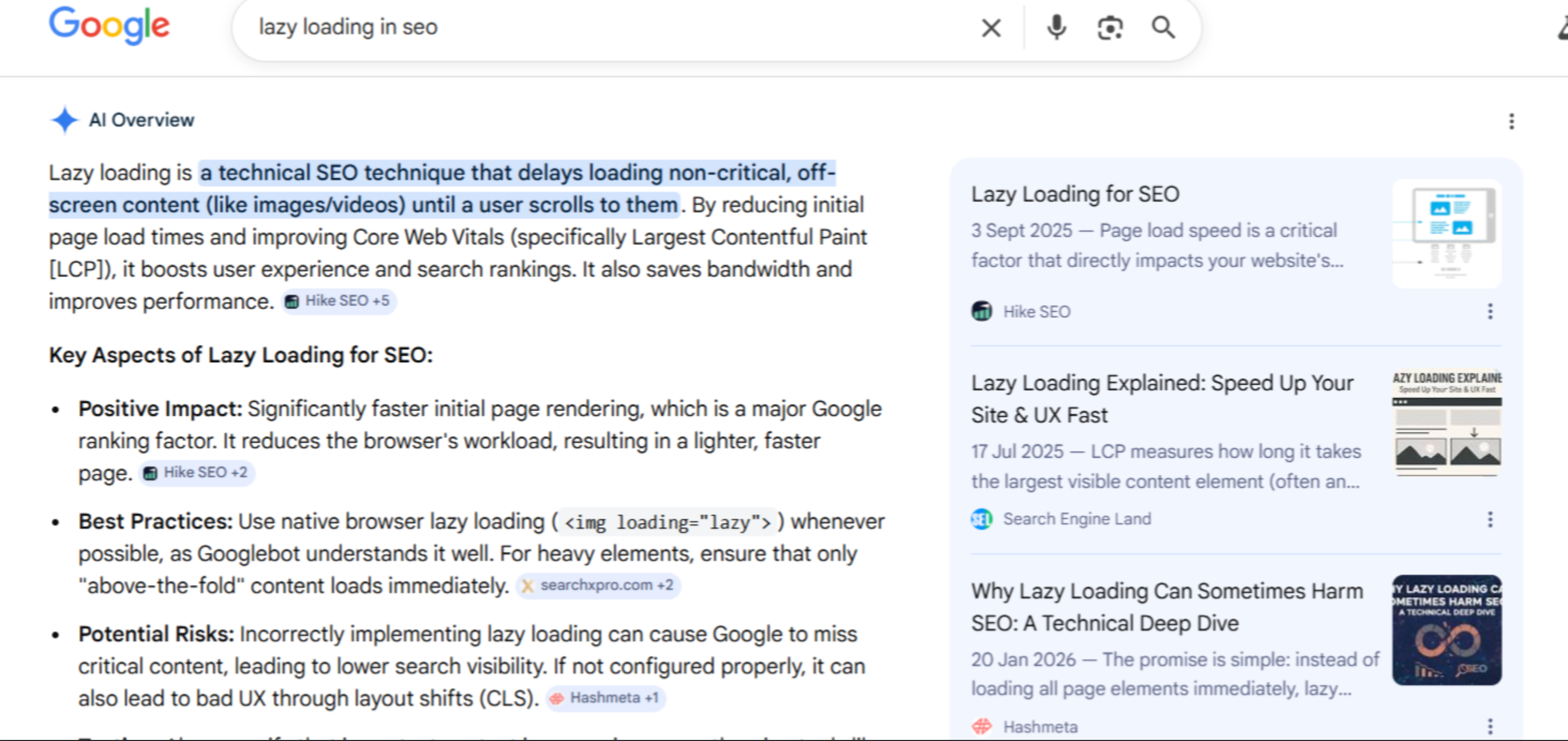
Screenshot showing how Google’s AI Overview system understands the concept of lazy loading based on a range of articles and sources to generate an answer directly on the SERP.
If an article lacks context, clear relationships, or supporting ideas, it’s unlikely to rank organically or be cited by AI answer engines. Google has been direct about this, emphasizing that content should be written primarily for people, demonstrate genuine expertise, and fully satisfy user intent, not exist just to rank. That’s why thin, keyword-driven content is steadily losing visibility.
As such, instead of asking, “Where do I place my keywords?”, my thinking has shifted to:
But helpful content doesn’t stop at the “what”. It explains why something matters, how it works, and what to do next. That depth keeps readers engaged and helps both search engines and AI systems recognize that the content satisfies intent.
Story-led content helps to bridge this gap between the “what”, and the “why” and “how”, because:
Today, search systems care far less about where a keyword appears and far more about whether a piece of content clearly satisfies a user’s intent. That’s the real shift. The good news is you don’t need complex workflows to adapt. What changes is how you frame ideas, structure meaning, and guide a reader through understanding.
These are techniques I actively apply in my own work, and they’re practical enough to use immediately:
Instead of opening with a definition or a keyword-heavy sentence, I now start with tension. A problem. A moment where something stopped working. Something the reader already likely feels but maybe hasn’t fully named.
That’s how people naturally enter a topic, not through definitions, but through friction. This isn’t just a writing preference. Users scan first and commit later. A narrative opening gives them a reason to commit. When readers stay longer and keep scrolling, those engagement signals reinforce that the content is doing its job.
Keyword-first intros may feel “SEO-correct,” but they often sound stiff and predictable. Keywords still matter, but now they should appear inside the story, not as the story. Once context is established, introducing the keyword feels natural. That improves readability for humans and gives search engine and AI systems the surrounding context they rely on to interpret meaning.
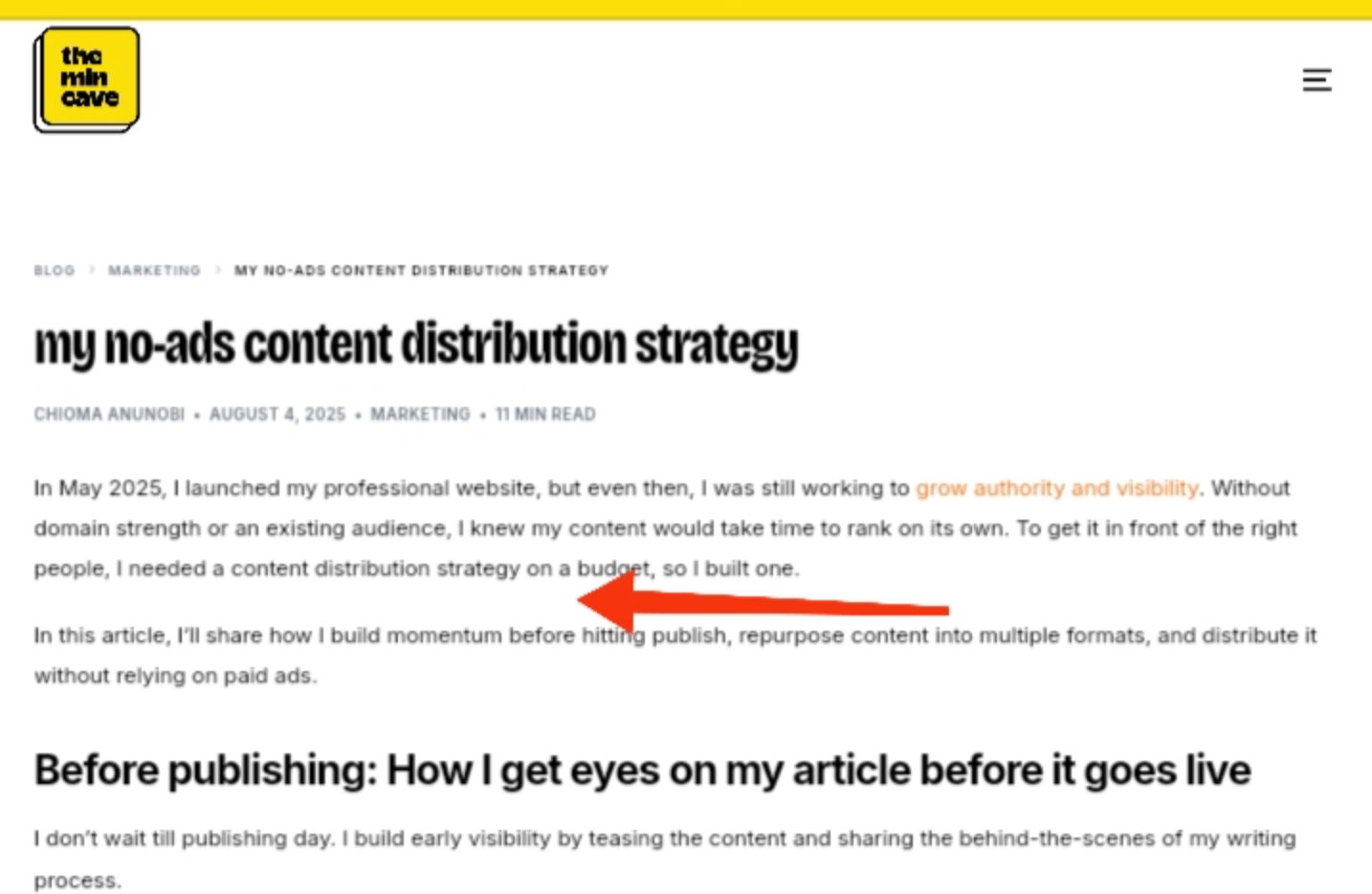
Screenshot of my article for TheMinCave which opens with a story before introducing the target keyword.
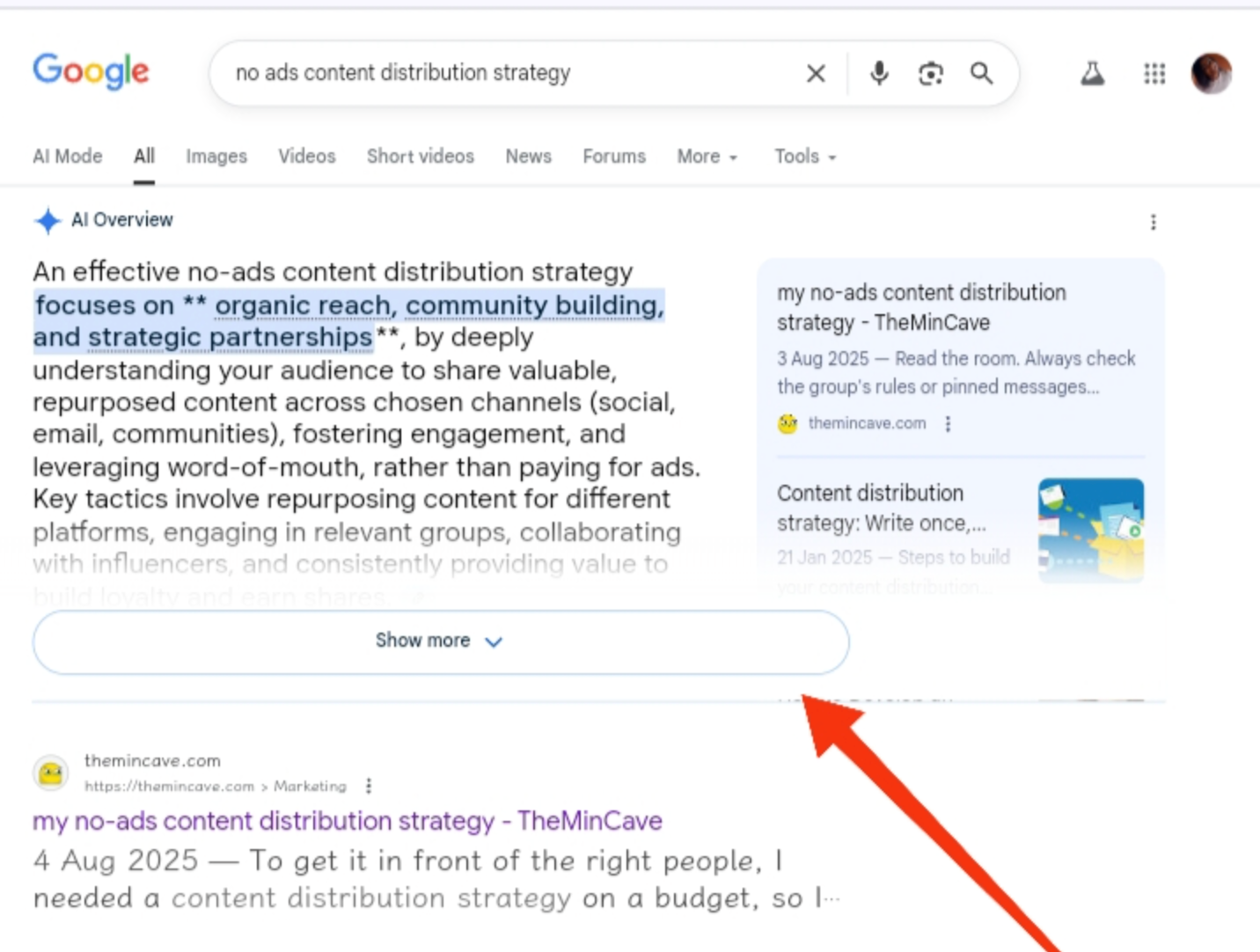
A screengrab of a Google search. My article ranks first organically and is also featured in the AI Overview.
Questions expose why someone searched in the first place.
Search behaviour has become increasingly question-driven. Google reflects this through features like People Also Ask and People Also Search For. These aren’t random suggestions. They represent clustered intent, and what people want to understand next, once their first query is answered.
When I structure content around questions, I’m not guessing intent; I’m responding to it. Question-based subheadings do three things at once:
Each section answers one clear question:
This reduces ambiguity. For AI systems, this means that they can clearly identify which part of the page answers which intent, making the content easier to summarize or cite. For readers, it removes friction. They don’t have to hunt for what they’re looking for; it's clearly labeled.
Entities include:
But entity optimization isn’t about listing names or stuffing references. It’s about placing entities where they help to explain something.
For example, instead of writing:
“E-E-A-T is important for SEO.”
I write:
“When I started aligning my content with Google’s E-E-A-T framework, especially the experience component, I noticed a difference. My articles were referenced more often in AI summaries, even when their rankings didn’t change.”
That single sentence connects:
That’s entity-based SEO in practice. Entities placed inside explanations help search systems understand relationships. They also signal depth to readers. They demonstrate that you understand the ecosystem around a topic, not just its definition.
I treat entities like supporting characters. They appear when they help the story make sense; not before, not after.
One of the biggest mindset shifts I’ve had to make as a writer is accepting that search visibility no longer lives in one place. My content doesn’t just compete on the traditional Google results pages anymore. It competes inside AI summaries, in generative search experiences, and sometimes without a click at all.
That’s the benefit of story-led content – because when my writing is clear, structured, and intent-focused, it travels across all of these surfaces.
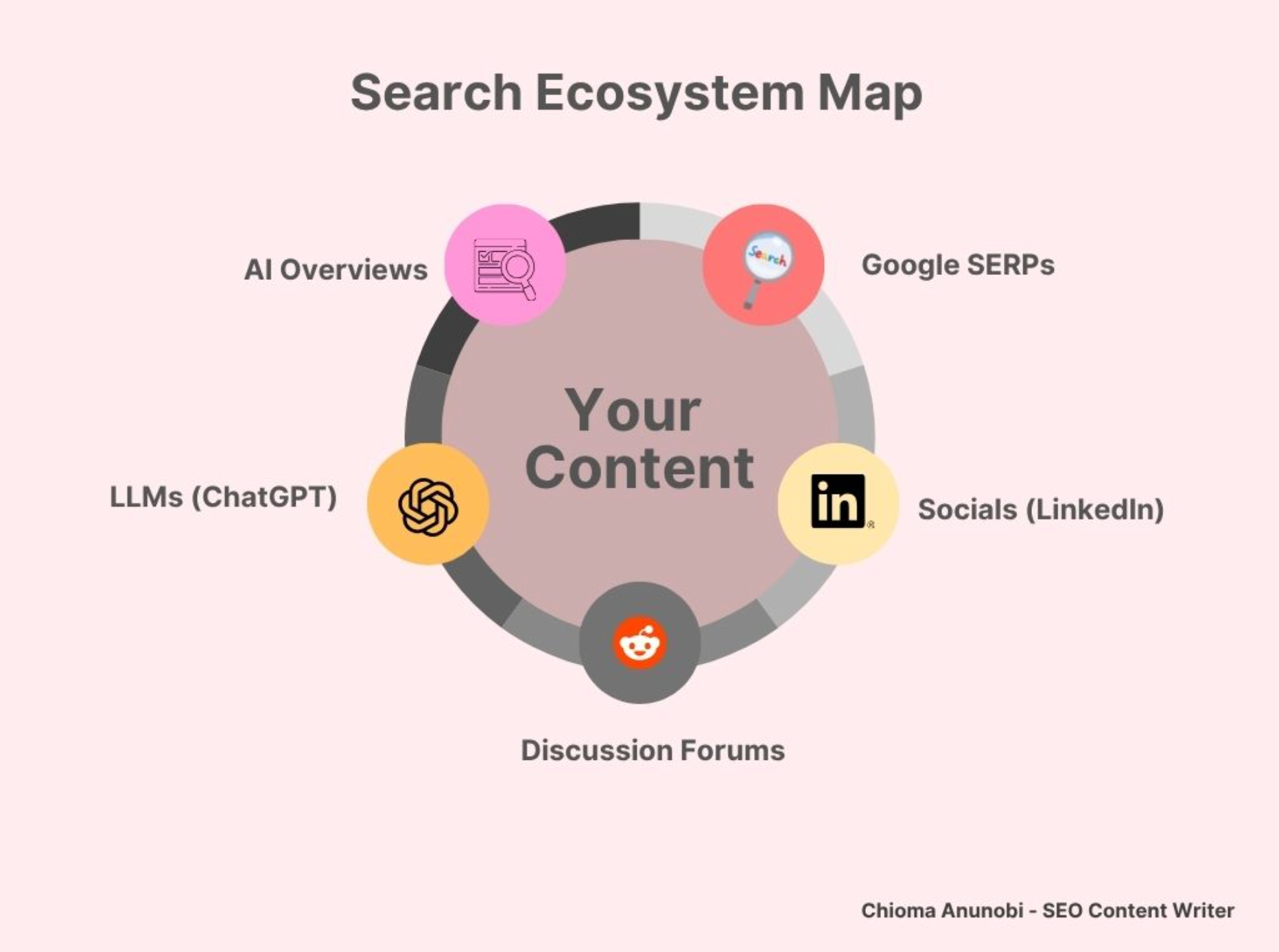
The Search Ecosystem. Content isn’t just discoverable via a single source, people find the answers to their questions via a range of sources including search engines, social media, discussion forums, LLMs, and AI Overviews.
Google explains that AI Overviews are designed to help users quickly understand a topic by summarizing information from multiple sources. In practice, that means AI is actively interpreting a range of potential sources, weighing clarity, structure, and trust signals, before deciding what to surface.
From experience, I’ve noticed content appears more “AI-friendly” when it consistently does the following: not in isolation, but together:
1. Answer quickly, then expand
AI systems look for clear explanations that they can extract early. That doesn’t mean collapsing everything into a single paragraph. It means satisfying user intent early, then working to deepen the readers’ understanding as the article progresses.
2. Define concepts inside the flow
Definitions work best when they’re followed immediately by explanation and application. This helps AI systems evaluate relationships between ideas and entities. When a definition is followed by reasoning and application, it becomes easier for systems to understand not just the term, but its role within the broader topic.
This means that I:
This layered context allows AI systems to summarize without flattening meaning.
3. Break content into summarizable sections
Clear headings and focused paragraphs aren’t just about readability. They help search engines and AI systems identify where an answer begins, what it covers, and when it ends. Featured snippets, People Also Ask responses, and AI summaries all depend on extractable units of meaning.
When each section answers one clear question, your content becomes easier to reuse across various types of search surfaces. Story-led content supports this because narrative flow gives the content direction, and the clear structure makes it reusable.
The goal isn’t to write for machines. It’s to write so clearly that machines can understand you.
One thing I’ve learned writing in the AI search era is that expertise is not something you claim; it’s something your content has to demonstrate.
That idea sits at the heart of Google’s E-E-A-T framework. Quality content is expected to show Experience, Expertise, Authoritativeness, and Trustworthiness, especially when accuracy and reliability matter.
What’s changed is not the standard, but how that standard is recognized.
This is where storytelling becomes a signal. Not because stories are emotional, but because they reveal how knowledge was formed, where it was tested, and why it changed. Search engines and AI systems look for those signals when deciding which content should be surfaced, summarized, or cited, and readers use these signals to decide whether or not to trust your content.
Here’s an overview:
Experience is arguably the hardest E-E-A-T signal to fake. You can say you’re experienced, but that statement means very little on its own. Storytelling, however, gives experience a shape.
For example, when I explain how my approach to content used to work, what stopped working, and why I had to adapt, I’m not just offering an opinion. I’m showing my own experiences with a real problem. There’s a before, a breakdown, and a response. That cause-and-effect trail matters.
Google explicitly recognizes this kind of lived or applied experience as a quality signal, especially when content reflects real use, observation, or involvement. Story allows that experience to surface naturally, without having to label it.
This is also why walking a reader through a process step by step works so well. It demonstrates understanding in motion. Instead of only stating what something is, you show how it works and why each step matters. Those layers: what, how, and why; are central to intent satisfaction. They are also far easier to communicate through narrative than through detached explanation.
Authority is a little different from experience. It forms over time, through consistency and depth.
Authority becomes visible when content consistently explores a topic from multiple angles: strategy, execution, mistakes, adjustments, and long-term outcomes. When those individual content pieces connect, they stop feeling like isolated articles and start functioning as chapters in a larger narrative.
This is how story-led content naturally supports topical clustering.
When you write multiple pieces around the same topic, each building on what came before, you're signaling the breadth and depth of your authority in a specific niche. Search and AI systems pick up on this, as do readers who are looking for guidance, not just answers. They need reassurance that those answers come from someone who has actually navigated the situation.
That’s how authority forms; not through claims, but through accumulation.
Future-proofing content is less to do with predicting the next algorithm update and more to do with how well your content can be understood and trusted.
Search engines, AI systems, assistants, and large language models are built to interpret meaning, context, and credibility before deciding how or if your work gets surfaced.
That shift changes what sustainable writing looks like. Here’s how I’ve learned to approach that shift in practice:
Writing for understanding means going beyond the surface-level, it means:
When I write now, I ask myself:
“If someone reads only this section, will they understand the reasoning behind the advice?”
If the answer is no, I haven’t written deeply enough. Understanding is what makes content reusable, referencable, and trustworthy across systems.
Clicks are no longer the only win. AI systems summarize, quote, and reference content without always sending traffic. That means visibility now includes being cited as a trusted source, not just ranking first. This means that being quotable is a visibility strategy now.
To be quotable, you need to:
Before I publish now, I think about the article not just as a whole, but in terms of its component parts.
I ask myself things like:
Because AI consumes ideas as connected concepts across formats and platforms, future-proof content needs to work throughout the ecosystem:
Story is the connective tissue here. Without it, everything falls apart. With it, your article explains your thinking, your LinkedIn post reinforces the lesson, and AI systems can trace meaning across all of these surfaces.
Story-led content sits at the intersection of human attention and machine interpretation. It helps writers explain ideas in ways people want to read, and systems can accurately process.
In an AI-first search world, visibility belongs to content that demonstrates understanding, experience, and clarity; not just optimization. Writers who adapt to this reality will create content that ranks, gets referenced, summarized, cited, and remembered, even as search continues to evolve.
ZipSprout connects brands with local nonprofits and events to build sponsorship links that drive local SEO and community impact.
Since 2016, they’ve facilitated 25,381 placements with community organizations across the US, raising over $9.2M in sponsorships.

We pay our authors, speakers & team to bring you helpful content like this.
We aim to always keep our content and community free and accessible.
If you've found value in WTS, please consider supporting us through our Buy Me a Coffee initiative.