
🌆 11 days until WTSFest Philly
⏳ & London early bird tickets close end of month
🌆 11 days until WTSFest Philly
⏳ & London early bird tickets close end of month
Something shifted in the last couple of years—and if you work in search, you felt it before you could fully name it.
The signals were subtle at first: a dip in click-through rates that the data couldn't fully explain, a customer telling you they'd already researched your product on ChatGPT before ever landing on your site. Then the signals got louder. Answer engines — AI-powered tools like ChatGPT, Perplexity, and Gemini — weren't just supplementing how people searched. They were replacing the journey for a growing slice of your audience.
I've spent the last year at HubSpot helping to build the measurement frameworks, workflows, and strategy necessary to navigate exactly this shift. What I've learned is that the teams winning in this environment aren't the ones who abandoned SEO. They're the ones who understood that SEO and AEO (Answer Engine Optimization) aren't competing disciplines — they're two lanes of the same road. The question is whether you know how to drive both.
Tailored research and data analysis are the non-negotiable foundation of customer acquisition in the age of AI. And AI citations are the key that unlock the whole strategy.
For a long time, the search landscape was a single surface. We optimized for search engines, aimed for the top five results, and were rewarded with website visits. But today, search is no longer one surface.
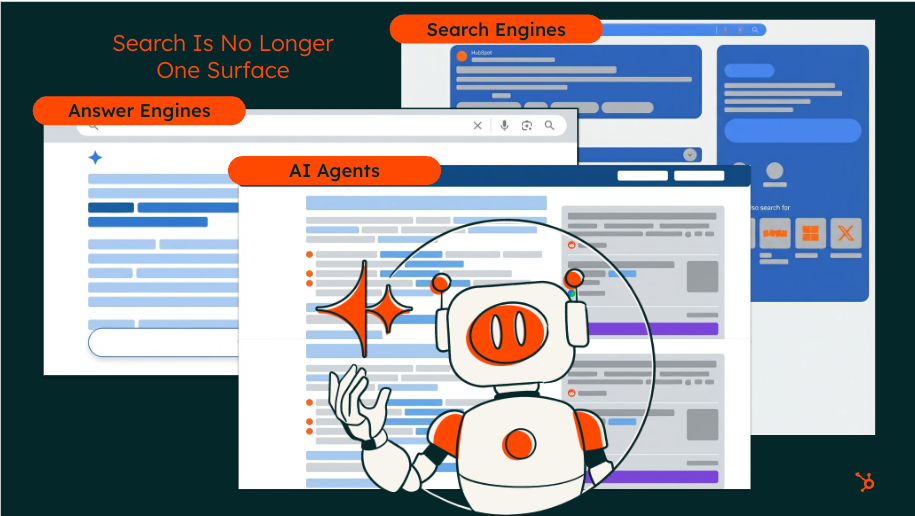
Search is no longer one surface – there are search engines, answer engines, and AI agents.
We are now operating across three distinct layers:
The variety of sources being pulled into the search journey is expanding. While the concept of content for the top, middle, and bottom of the funnel isn't new, the array of possibilities presented to your Ideal Customer Profile (ICP) is. They are no longer just seeing your blog; they are seeing a vectorized synthesis of your content, your competitors' content, and community discussions from sites like Reddit and LinkedIn.
To future-proof your strategy, you must understand that search engines, answer engines, and AI agents "read" your work through different lenses.
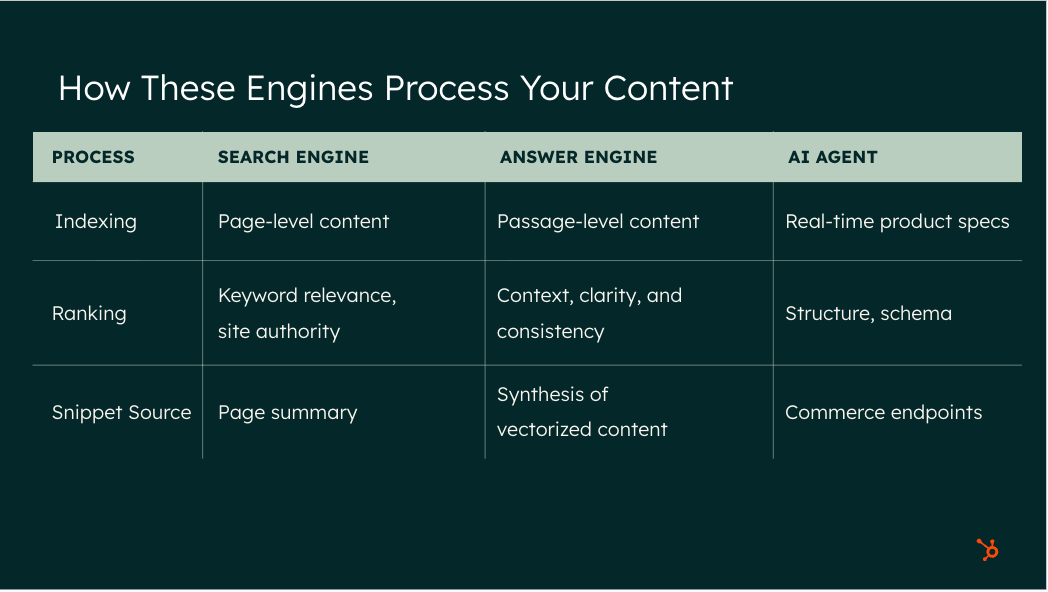
How these engines process your content
In traditional SEO, engines index page-level content. However, answer engines look at passage-level content. They aren't just looking for a relevant page; they are looking for the specific paragraph or sentence that answers a prompt. AI agents go even further, requiring real-time product specifications to map to customer requests and execute tasks.
Ranking is no longer just about keyword relevance and site authority. While those still matter for search engines, answer engines prioritize context, clarity, and consistency. AI agents, meanwhile, prioritize structure and schema—the machine-readable map of your site.
In the past, your "snippet" was a page summary. Now, in an answer engine, the response is a synthesis of vectorized content. For AI agents, the source might be attributes from commerce endpoints or APIs.
I cannot stress this enough: you cannot optimize what you do not measure. In the AEO race, your data analysis is your "eye on the dash".
If you want to drive demand, you must invest in two critical areas of research: Share of Voice and Citation Analysis.
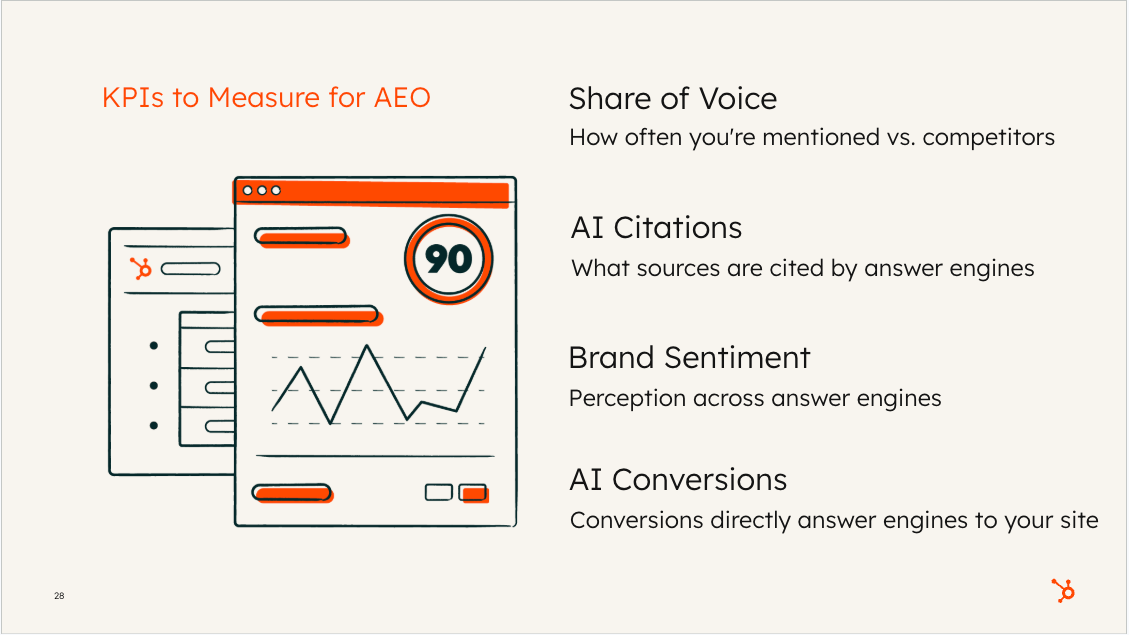
KPIs to measure for AEO
Share of Voice is a paramount KPI in the AI landscape. It measures how often your brand is mentioned across answer engines compared to your competitors. If your customers are hearing about your competitors more than you in ChatGPT or Gemini, you have an AI visibility gap.
Understanding the sources that answer engines tap is the key to unlocking access to your ICP. I use citation analysis to see which domains and content types are earning citations in the Retrieval-Augmented Generation (RAG) process.
To stand out in this evolving landscape, I recommend focusing on three pillars: Human-First Content, Machine-Readable Structure, and Agent-Executable Infrastructure.
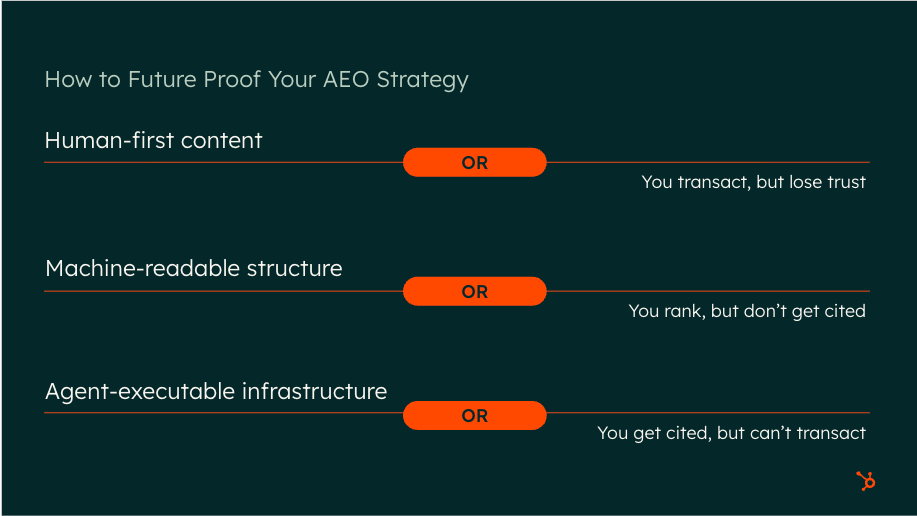
AEO Strategy Workflow
Your mission is to build and retain credibility by keeping humans at the center of your work. This means answering the key questions across the buying journey for your ICP.
Without a human-first approach, you might transact, but you will lose trust.
If your content isn't structured for machines, you might rank, but you won't get cited. This involves:
As we move toward agentic commerce, your site must be easy for an AI agent to scan and convert. This requires adopting schema, maintaining clean product feeds, and utilizing protocols like WebMCP. If you get cited but an agent can't help a user transact, you’ve missed the final step of the race.
The AEO race is not a one-size-fits-all sprint. It is about building systems that serve both humans and AI. At HubSpot, I’ve seen how identifying your AEO gap — the difference between where you are and where the answer engines source their citations — is critical.
Buyer behavior is changing, and search is no longer just a list of linked results. Stay agile, keep your eye on your AI visibility, and always solve for your customer first.
Take the wheel and be ready to pivot as you drive the future of search.

Christina Clark - Head of Product Growth, HubSpot
Christina helps businesses captivate their clients. Her passion is directing the unenthused and uniformed to rich knowledge and experiences. Her mission is expanding the reach of good companies, so that the people looking for good ideas can find them and everyone can benefit.
