Author: Krystal Taing
Last updated: 19/10/2026

Krystal Taing giving her "AI Picks the Shortlist" talk live at WTSFest Philadelphia 2026
For most of my career in local search, the goal has been fairly straightforward: make sure a business can be found when someone searches for it. We have spent years thinking about rankings, local packs, maps, location pages, listings, reviews, and all of the signals that help search engines understand where a business is, what it offers, and whether it is relevant to a customer.
Those things still matter. In fact, I would argue that many of them matter more than ever. But the way customers discover and choose businesses is changing. A customer can now open ChatGPT, Gemini, Perplexity, or another AI surface and ask something like, “Where should I take a client for dinner near Rittenhouse Square?” Instead of getting a page of results to evaluate, they may get three or four recommendations and an explanation of why each one is a good fit.
The State of AI Search 2026 report from AthenaHQ describes this broader shift as search moving from links to answers. As more of the discovery experience happens directly within AI generated responses, brands are increasingly competing to be part of the answer, not simply one of the links a customer might click.
That changes the question local marketers need to ask. For a long time, we have asked, “Do I rank?” Now, I think we also need to ask, “Does AI understand my business well enough to recommend it?” That distinction is especially important for multi location brands because the fundamentals of local SEO are not disappearing, but the outcome we are optimizing toward is expanding. We are moving from optimizing for visibility, toward optimizing for recommendability. Increasingly, the decision about whether your business enters the consideration set may happen before a customer ever clicks through to your website.
The traditional search journey was relatively predictable. A customer searched Google, evaluated a set of results, clicked a website or business profile, and then made a decision. AI changes that sequence. The journey can now look more like this: a customer asks a question, an AI system constructs an answer, a handful of businesses make the shortlist, and then the customer may visit one of those websites.
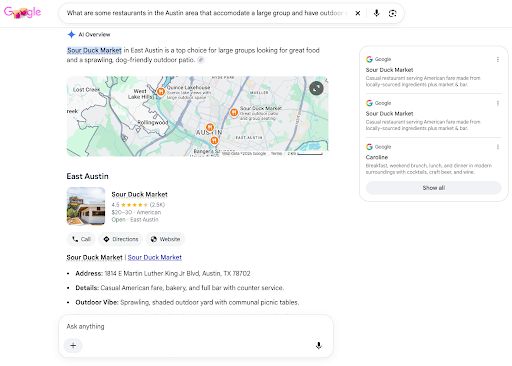
That “may” is important because the website is not disappearing, but the front door has moved. In an AI driven discovery experience, the customer may arrive at your website after an AI system has already decided that your business is worth considering, or they may never arrive at all. The decision is increasingly happening before the click. If you are not in the shortlist, you may not be in the consideration set at all.
That is a very different competitive environment from the one local marketers are used to.
Traditional search gave businesses multiple opportunities to be seen. Even if you were not the first organic result, you could appear in Maps, images, directories, review sites, local packs, or somewhere else on the page. AI compresses those choices. There is no meaningful page two when an AI assistant confidently recommends three businesses.
AI does not just rank. AI chooses.
Search engines have historically ranked pages and businesses against a query. Generative systems have another job to do. They need to construct an answer. For a local recommendation, that means the system needs enough information to conclude that a particular business belongs in that answer. It needs to understand that the business exists, where it is located, what it offers, whether it is relevant to what the customer asked, what people say about it, and whether other sources support those conclusions.
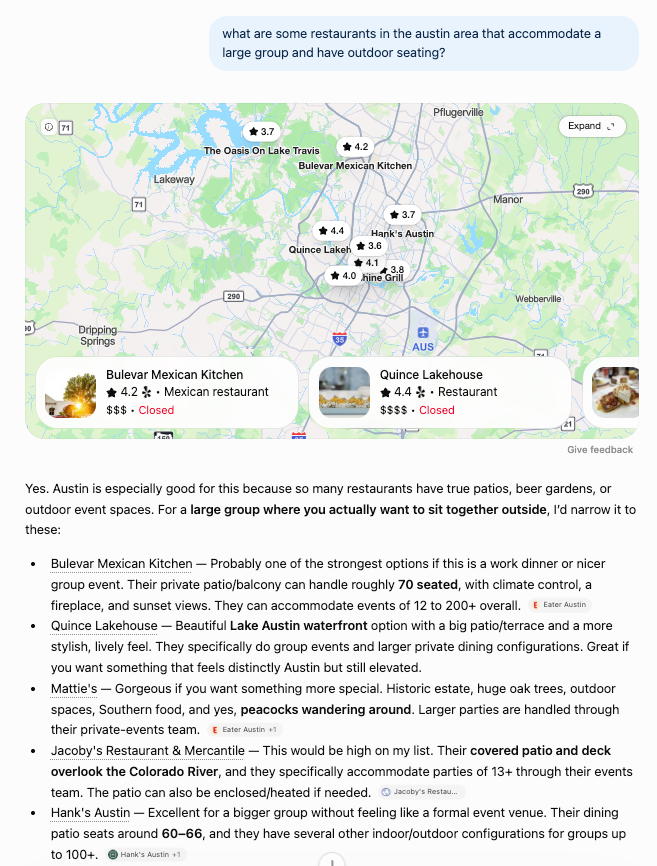
That confidence does not come from one perfectly optimized page. It is built through agreement across an ecosystem of sources. I sometimes describe the difference this way: SEO built visibility. GEO builds recommendations. That does not mean GEO replaces SEO. I see it more as an evolution of what we are asking all of those foundational signals to accomplish.
One of the things I find frustrating about some of the conversations around GEO is how quickly they become another website optimization checklist. Add schema. Publish more content. Create FAQs. Rewrite pages so an LLM can understand them. There is value in all of those things, but I think that framing misses something particularly important for local search.
A local business does not exist online as a webpage. It exists as an entity connected to locations, services, products, reviews, listings, photos, third party mentions, community conversations, and other sources. An AI system might encounter information about a business through its website and location pages, Google Business Profiles and other listings, reviews and ratings, forums, communities, or third party and editorial coverage.
When I think about what makes a local business easier for an AI system to understand and recommend, I keep coming back to five areas:
Entity accuracy starts with the boring stuff: name, address, hours, categories, services, and attributes. For a multi location business, that information needs to be correct at every location.
We have spent years talking about data accuracy in local SEO, so it is tempting to view it as an old tactic. I think AI makes it more relevant, not less. If different sources disagree about whether a location exists, when it is open, what category it belongs to, or which services it offers, we are asking the model to resolve those conflicts before it can even decide whether the business is a good recommendation.
Consistency is closely related, but I think about it slightly differently. The information does not have to be word for word identical everywhere, but it should tell a coherent story. Your website says one thing. Your Google Business Profile says another. Yelp has old hours. A directory uses an outdated name. Your location page does not mention a service that another profile says you offer. Each one may seem small on its own, but together they create uncertainty. If we are trying to build enough confidence for a system to select a business, uncertainty is exactly what we do not want.
Reputation adds another layer. Reviews have always mattered in local search, but I think AI should push us to broaden the way we think about them. Instead of only asking how many Google reviews we have or what our average rating is, I want to know where customers are talking about the business, how recent those conversations are, whether there is meaningful reputation data at every location, and which platforms seem to matter for that particular category.
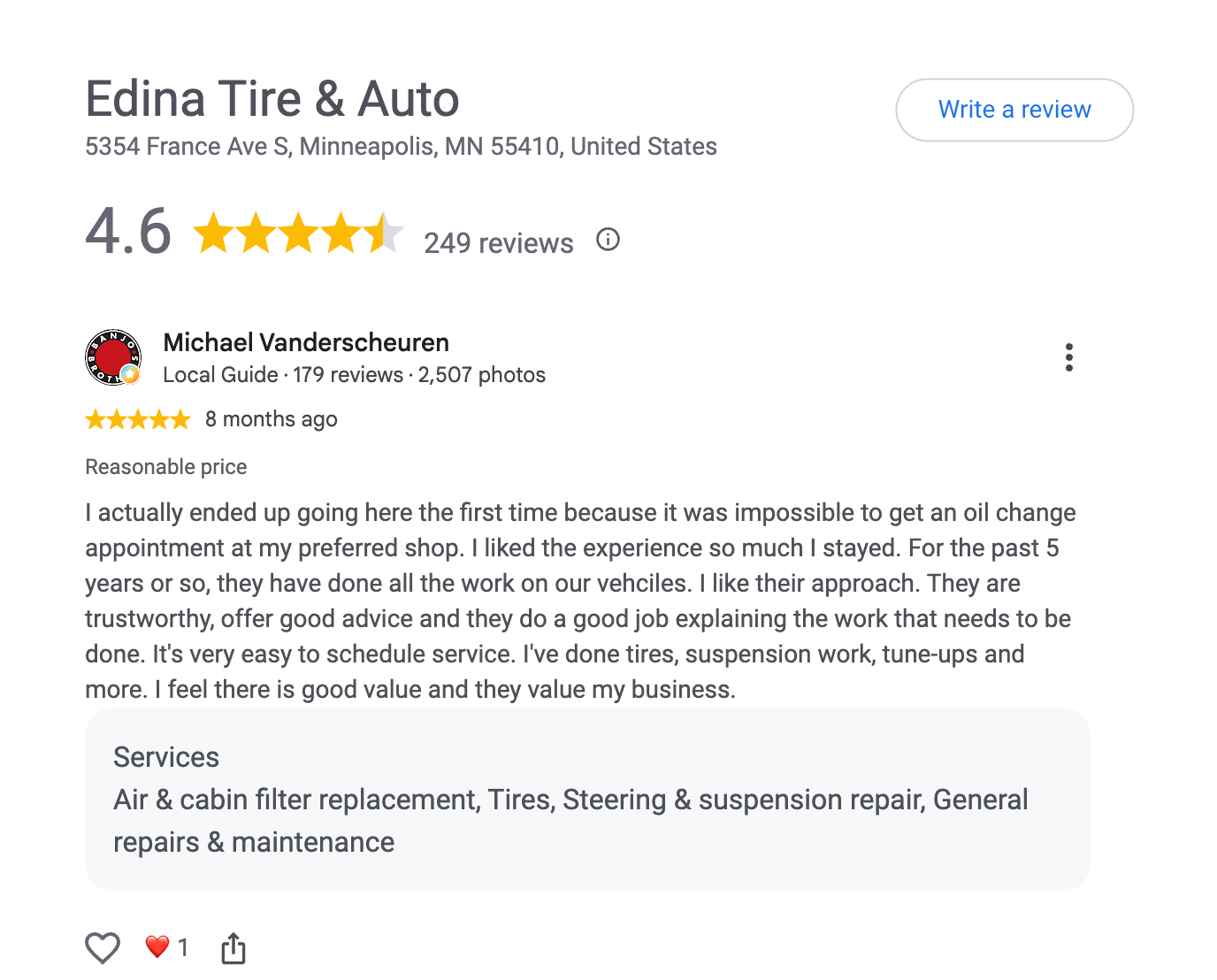
Content still matters too, but I think the starting question should change. Instead of always beginning with “What keyword should this page rank for?” I want marketers to ask, “What is the customer actually trying to understand?” Then answer that question clearly.
Finally, there is authority. You can say anything you want about your own business, but the picture becomes more convincing when credible sources across the web support what you are saying.
Taken together, these signals create something much bigger than an optimized website. They create a connected digital representation of the business.
A company may think of itself as one brand with 400 locations. The internet may not.
An AI system may instead encounter 400 seemingly disconnected businesses with slightly different names, categories, URLs, services, reviews, and attributes.
That is not primarily a content problem. It is a relationship problem. For a local recommendation, the model needs to be able to connect:
I think this matters because local intent eventually has to resolve to a place. Customers do not usually ask, “What is the best national restaurant brand?” They ask, “Where should I get tacos near me?” Or, “Who can repair my tire today?” Or, “Which urgent care near me is still open?” The corporate brand matters, but the recommendation often needs to resolve to a specific location that can actually satisfy the customer's needs.
That means location optimization cannot be an afterthought in a GEO strategy. The relationship between brand and location needs to be clear. The services available at that location need to be clear. Its hours and attributes need to be clear. Its reputation needs to exist at the location level. Ideally, those facts should also be supported by more than one source.
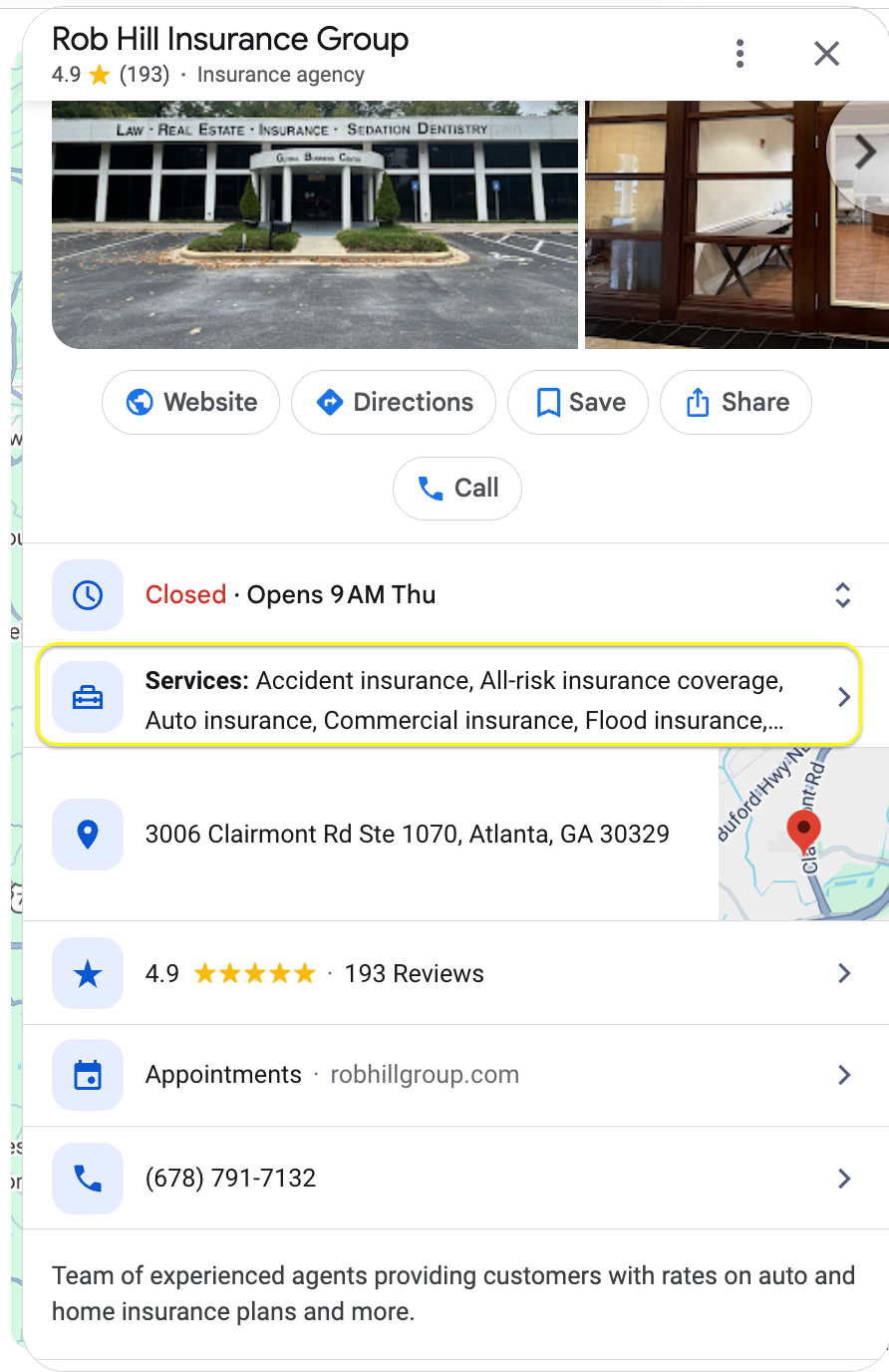
This is also why I think some organizations will find GEO harder to operationalize than to understand. Most of these concepts are not particularly complicated. The challenge is ownership. Listings may sit with one team, reviews with another, website content with another, social somewhere else, and PR and third party mentions may barely intersect with local search at all.
From an organizational perspective, those are separate workstreams. From the model's perspective, they are all signals describing the same entity. That distinction matters.
We are still early in understanding exactly how generative systems make local recommendations, and I am cautious whenever I see an individual GEO finding immediately turned into a universal ranking factor. Models change. Their sources change. Results differ by category, market, prompt, and context. What I find much more useful is looking for patterns.
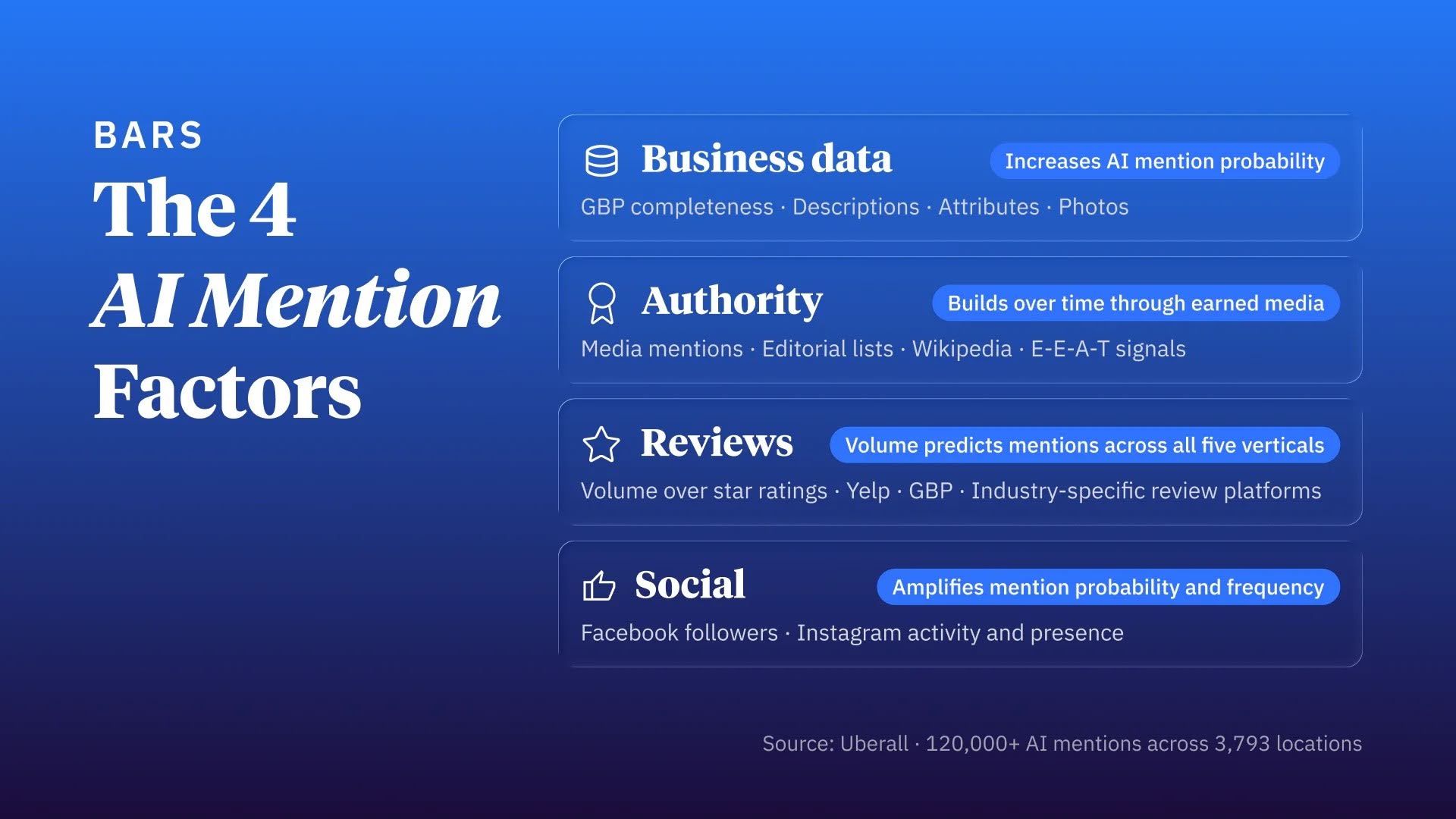
In research my team conducted in 2026, we analyzed 567 businesses across eight prompts and 100 runs, producing more than 39,000 AI mentions across five models. I am cautious about turning any single study into a universal ranking factor, but several of the patterns challenged the way I had been thinking about familiar local signals.
Review volume, for example, appeared to matter much more than star rating in this particular study. Businesses being surfaced had 70% more Google reviews and 109% more Yelp reviews, but star ratings showed no correlation with the outcome being measured. I do not interpret that as meaning that star ratings no longer matter. Customers absolutely care about ratings. Instead, I think it highlights an important distinction between persuasion and confidence.
A 4.9 star rating may be incredibly persuasive once a customer is looking at your business, but a deeper body of reputation data gives a system more information about that business in the first place.
Yelp was another finding that caught my attention. Businesses with 1,000 to 2,000 Yelp reviews reached a 93% citation rate in our study. I would not walk away from that thinking every business suddenly needs 1,000 Yelp reviews. That is exactly the kind of conclusion I think we need to avoid with GEO research. My takeaway is broader: Google is not the entire local ecosystem anymore, if it ever was.
The platforms that matter will vary by business and category, but marketers need to understand where AI systems are finding corroborating information about their businesses. That becomes even more interesting when you look at platform breadth. Businesses with no third party platform presence had a 51% citation rate in our study. Those present across four platforms reached 90%. To me, that reinforces the idea that confidence comes from an ecosystem rather than one perfectly optimized source.
The importance of photos surprised me too. Image count was the strongest predictor of mentions in our analysis.
Businesses being mentioned had an average of 3,124 images compared with 1,002 among those that were not. Again, I would not turn that into a magic number. Uploading 500 photos is not suddenly my GEO strategy. But it does make me rethink the way many businesses manage local imagery. Photos are often treated as a launch task: claim the profile, add a storefront photo, upload the logo and a few product images, and move on. I think there is a strong argument for treating visual content as an ongoing part of location health instead.
The finding I keep coming back to most, though, is that 95.7% of the recommendations in our research named a location, not simply the brand. For anyone working in local search, that should get our attention. It reinforces something I think we already instinctively know: the location is not a supporting asset in local discovery. It is often the actual entity being recommended.
Another experiment, which we presented at SMX Advanced in 2026, looked at what happened when existing video content was structured in a way that made the information easier for AI systems to consume.
What stood out for me was how simple the changes were. We used answer style titles, short introductions, one clear angle, and summaries. We published transcripts with headings and schema and connected the video and written content. In that experiment, share of voice moved within 48 hours and mentions and citations eventually doubled across the broader prompt library.
What interests me about that experiment is not really the video. It is the principle behind it: publish answers, not content for content's sake.
For years, SEO work was largely keyword-driven. There is search volume, so we need a page. There is a content gap, so we need an article.
AI gives us a reason to start with the person instead. What are they actually trying to understand? What would they ask if they were having a conversation rather than typing a few words into a search box? Think about how well your content answers that question. Can someone understand the answer quickly? Can a machine extract the important information cleanly? Does the rest of your digital ecosystem support what you are saying? To me, that is a much more interesting content strategy.
If the customer journey changes, measurement has to change with it.
Traffic, rankings, impressions, sessions, and click through rate still matter. I am not advocating that anyone throw away their SEO reporting. But those metrics cannot tell us whether an AI system recommended the business before the click ever happened.
I think local marketers need to start asking a different set of questions:
Those questions lead to metrics such as AI share of voice, recommendation rate, prompt coverage, brand and location mentions, and trusted citations. But I care almost as much about the process as the individual metric. Running one prompt in ChatGPT once, getting a result you like, and taking a screenshot does not tell you very much. Model behavior varies. Different systems produce different answers. Even the same prompt can produce variation.
I would rather see a brand start with a small, meaningful prompt library based on questions customers genuinely ask. Pick 20 prompts for a market or service line. Run them across multiple AI experiences on a consistent cadence. Record who gets named, which locations appear, how often competitors show up, and which sources seem to influence the answer. Then look for patterns.
The process I use is simple: ask, measure, identify gaps, optimize, and measure again. GEO measurement does not need to be perfect before we begin doing it. We just need a baseline that is consistent enough to show us whether things are changing.
One of my concerns with GEO right now is that we are making it sound much more complicated than it needs to be. There is a new study every week, a new tactic, a new acronym, and a new list of things brands supposedly need to do immediately. That can make it difficult to know where to begin.
If I were starting today, I would focus on five things:
But I would not try to do all five at once. Instead, pick two.
Start by figuring out whether you are showing up at all. Run questions your customers genuinely ask across ChatGPT, Gemini, Perplexity, or whichever AI experiences matter to your audience. Write down who gets recommended, which locations appear, and which sources are influencing those answers.
Then look at your foundation. If your names, addresses, hours, categories, attributes, services, or URLs are inconsistent across locations, I would fix that before chasing more advanced GEO tactics. Look at reputation at the location level too. Do not be distracted by a strong brand-wide average if a significant percentage of your locations have very low review volumes or a lack of recent activity. Do not automatically limit that analysis to Google either. Look at the platforms that actually appear in the answers you are measuring.
I would do the same with photos. Instead of treating them as a one time profile optimization task, start measuring visual coverage across locations and build a process for keeping it current.
Finally, publish something genuinely useful on a regular basis. It can be a video, FAQ, article, location page update, or another format. The format matters less to me than whether it answers a real question clearly and whether the rest of your digital presence supports the answer.
You do not need to “solve” GEO in a month. You need to understand where you stand, identify the biggest gaps in confidence, and start closing them.
I do not think AI means SEO is dead. I actually think that framing distracts us from the much more interesting conversation. Many of the things local marketers have spent years getting right are becoming even more important: accurate information, strong location pages, structured data, reviews, useful content, photos, and a healthy presence across the platforms customers use.
What is changing is what all of those signals ultimately need to accomplish. It is no longer enough for a search engine to find your business. An AI system needs to understand it. It needs to connect your brand to your locations, your locations to what they offer, those locations to their reputation, and your claims to sources it can trust. Ultimately, it needs enough confidence to put your name on the shortlist.
That is why the question I keep coming back to is not just, “Are we ranking?” It is, “When a customer asks AI where to go, what to buy, or who to trust locally, are we even showing up?”
Because I do not think AI is going to replace your website. But it may increasingly influence whether or not a customer ever decides to visit it.

Krystal Taing - VP of Solutions, Uberall
Krystal Taing is VP of Solutions at Uberall, where she helps multi-location brands improve performance through local SEO, reputation management and AI-driven discovery. A Google Business Profile Product Expert, she specialises in scalable local search strategies for multi-location organisations.
The same WTSFest experience you love - welcoming, kind, connecting, & helpful - with a few more voices & insights 💜
15 brilliant experts on stage (instead of our usual 10) & 2 wonderful hosts!
We're launching our Connect Session - 2 panels of experts talking about the latest industry trends.
See you at the Barbican on Friday, March 19th 2027!