
🌲 WTSFest Portland - May 7th 2026 | 🥨 WTSFest Philadelphia - October 1st 2026
🌲 WTSFest Portland - May 7th 2026 | 🥨 WTSFest Philadelphia - October 1st 2026

Author: Emina Demiri-Watson
Last updated: 14/01/2026
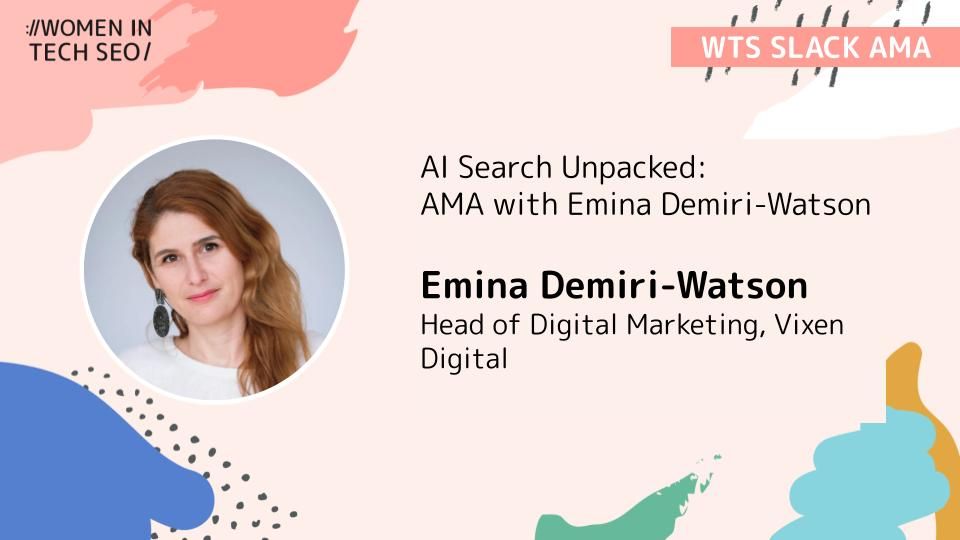
We recently had the pleasure of hosting Emina Demiri-Watson for an Ask Me Anything (AMA) in our Slack #digital-ai channel.
Emina is the Head of Digital Marketing at Vixen Digital, a UK-based agency. She has over 10 years of experience in SEO, email automation, PPC & organic social. She’s passionate about data-driven performance, selecting the right combination of channels to maximise success, adopting a test-and-learn approach, and building lasting partnerships with clients and other agencies.
She loves to share her expertise with the marketing community, she’s spoken at conferences around the world, appeared on a range of podcasts, and has written for numerous industry publications.
Emina answered a range of questions, including how to get started with AI Search, what works and what doesn’t, tools and tracking, and more!
Our live AMA sessions take place on the WTS Slack Workspace, a safe, private space for community members to ask questions and share their knowledge. Out of respect for our members and their privacy, rather than publishing full transcripts of these sessions, we curate edited recaps which capture a selection of the questions and answers from each session.
Want to take part in our next Slack AMA? Join the WTS community!
First-up, I would definitely suggest gaining a clearer understanding of how LLMs actually work. Britney Muller’s Actionable AI For Marketers Course, and Lazarina Stoy’s Introduction to Machine Learning Course are both great starting points.
Honestly, there is so much misinformation in our industry at the moment. How we define chunking is not really what chunking is. So I definitely wouldn’t worry about that.
Re: tracking prompts, yes you should be doing that, but the way that it’s presented is all around rankings and there are no rankings on LLMs. I think the best approach is to explore what these prompts tell you about your customers, and how your brand is talked about online. I think it’s also worth looking at how your brand is positioned within the topics that your customers care about.
For example, one of our clients is in the office furniture space, and we found out that actually there is a lot more we need to be doing around the topic of DEI assessments. The connection between our client and that topical area was the weakest, and yet it was one of the most important topics for their customers.
It really depends on the industry and how competitive the market is. But typically I’d recommend that first you check that the trust signals on your website and your socials are on point; then I’d look to build brand awareness by investing in things like PR, and/or paid social.
What I’ve found consistently is that many of the core tactics and strategies that I use as part of my SEO and marketing activity also impact LLM visibility.
Specifically, consistency of brand image (i.e. how people talk about your brand online) seems to be particularly important. This is why I favour tracking tools that don’t just focus on visibility in LLMs, they focus on how the brand is represented across all of the data sources that the LLMs draw from (e.g. news sites, social media, Q&A sites, reviews, etc).
Another area that I’m super-interested in is product feeds. With agentic e-commerce I think that’s going to be super-important (but it probably will sit with PPC eventually). Again, on the agentic side of things, another important one for me is good UX. Humans are much more forgiving and they are much more persistent with websites that have terrible UX, but I don’t think agents will be.
I definitely would NOT recommend just churning out a bunch of AI-generated content. Whilst you might see good results initially, it’s not worth the fallout when the party is over. Check out my article on Search Engine Land for more on this: SEO shortcuts gone wrong: How one site tanked – and what you can learn.
Also, I’m still not convinced that many of the standards that claim to be useful, actually are, e.g. llm.txt.
Ultimately, writing a “best XXX” listicle, and putting yourself first is really not trustworthy, and I think that eventually it’s going to stop working (hopefully in both LLMs and in traditional search too).
However, for now, there’s nothing really stopping you from doing it and it can be effective. But, be careful – these types of articles can become a total time suck – for example, in the past, I’ve expended a huge amount of time and energy on articles like these. Every time there was an update our rankings would drop, and then I’d spend a bunch of time trying to get those articles ranking again. Then, the amends I’d made would negatively impact conversion rates, and I’d need to do a bunch more work. Honestly, that time would have been much better spent elsewhere.
In my experience, exact match domains can still perform well in organic search, and, as such, can also gain visibility in LLMs. But an EMD by itself isn’t enough, you still need to do the usual SEO and marketing work in order to be successful.
I don’t have all of the answers, but I suspect many publishers will have to rethink their commercialisation models, because if they’re not making enough money, the quality of their news reporting is going to drop. To me that’s a big red flag for informed citizenship and human rights. Personally, I’m not sure that paywalls are the right solution.
Some of the things that we are looking at with our clients include data capture, and building communities e.g. asking people to sign up to see articles, but not asking them to pay for them. Capturing data on readers will then allow these publishers to engage in things like email marketing.
A huge amount of results in LLMs are Retrieval-Augmented Generation based, so they understand as much as organic search engines do. We know that originality is important there already, and that style also comes into play.
However, it’s worth nothing that for an LLM, every word is a vector. A vector is the mathematical encoding of a word (or phrase) based on its context and meaning within a dataset. As such, an LLM will focus more on coherence, relevance, and semantic depth than subjective style preferences (unless such preferences are explicitly trained or defined as part of the evaluation criteria, which I doubt is the case in most instances).
The news sites that perform well in organic search, also perform well in LLMs – a good example from the UK is the Guardian. There is a brilliant Slack group called SEO for Journalism which you should join if you’re interested in learning more.
Waikay is my go-to tool.
To my knowledge, there isn't a reliable way to see the exact prompts that drove site visits. Even if you could, it might not be all that useful. The key issue is that these searches or prompts occur within a chat interface, making them conversational in nature. Plus, they’re often multi-step, meaning users might ask several questions before getting the answers they need, which makes it difficult to trace the exact prompt that led to the visit.
Right now, I’m pulling in data from Reddit and TrustPilot, but I also find sales calls and customer service recordings really helpful. I then crunch this data to get a clearer understanding of what customers want and need.
I haven’t looked into the APIs of some of the other social media networks yet, but I would imagine they’re not as easy as Reddit. The TrustPilot API was a nightmare; I ended up getting our developer to just pull out CSVs for me. I’d also like to play around with the Slack API, but I hear it’s a nightmare as well. I would also love to be able to use something like SparkToro, but our clients just aren’t big enough for it.
By doing what I would usually do for conversion rate optimisation but hiding it behind an agentic AI excuse! I am still on the fence with regard to whether or not agentic commerce will happen, but it doesn’t stop me from trying to push for better UX. My personal opinion is that if it’s good UX for users it will be good UX for agents. CAPTCHA is an issue though, agents have problems with accepting even the simplest ones, and I’m not sure how they’re going to get around it. It’s an area that I’ve recently been looking into because of a couple of tests that I did for clients.
Aimee Jurenka, Aleyda Solis, Arnout Hellemans, Britney Muller, Dawn Anderson, Dorron Shapow, Gerry White, Lazarina Stoy, Marie Haynes, Mark Williams-Cook, Ramon Eijkemans, and Robin Allenson.
Lazarina Stoy’s Introduction to Machine Learning Course
Britney Muller’s Actionable AI For Marketers Course
If you’re looking for a more general technical SEO course, check out Mark Williams-Cook’s Complete SEO Course From Beginner To Professional.
Learn how LLMs actually work
Gain a deep understanding of the technology before you execute any tactics
Stop obsessing about tracking 'rankings' in LLMs
Instead, track how your brand is presented and whether it shows up at all within the topics you care about
Gather audience insights
Analyse reviews, forums, and customer call data to identify the topics your customers care the most about
Avoid churning out low-value AI-generated content
Those short-term wins carry significant risk
With the rise of AI Agents, UX matters even more than before
Agents are far less forgiving than humans, so good UX is critical
Don't forget the fundamentals
Traditional SEO, marketing and PR activities also drive LLM visibility

Emina Demiri-Watson - Head of Digital Marketing at Vixen Digital
With a career rooted in digital marketing growth, Emina has led teams, built strategies, worked agency- and client-side, and learned by doing. Today, Emina helps clients and agencies grow through performance-focused marketing, strong partnerships, and continuous testing across SEO, PPC, CRO, and automation.