🌲 WTSFest Portland - May 2026 | 🥨 WTSFest Philadelphia - Oct 2026 | 🎥 On-Demand Video Hub - 2026
🌲 WTSFest Portland - May 2026 | 🥨 WTSFest Philadelphia - Oct 2026 | 🎥 On-Demand Video Hub - 2026

Author: Zoe Burke
Last updated: 16/02/2026
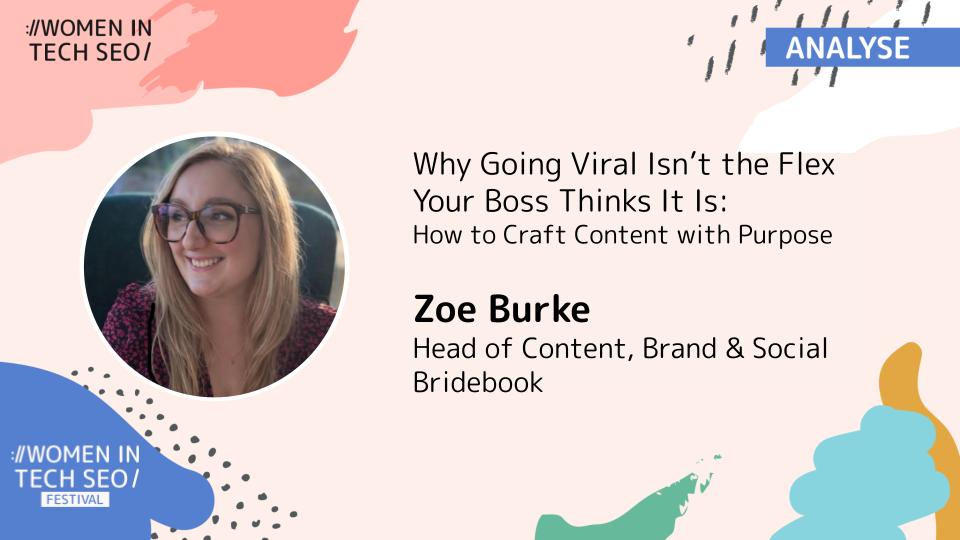
There’s no question in the world that fills me with more dread than: “Can we make it go viral?”
Not “Can we talk?”, not “Do you have five minutes?”, not even “Shall we skip dessert?”
I’ve lost count of how many times I’ve been asked that question over the last 15 years of working in content – usually with a hopeful smile, a vague brief and the expectation that a video of me under the office’s fluorescent lighting is going to be lapped up by hundreds of thousands of keen viewers.
And the frustrating thing is, as content experts, we probably could make something go viral if we really wanted to. But the better question – the one I wish more people would ask – is whether we actually should.
I’ve spent my whole career working on content for niche audiences, and I’ve learned that trust matters far more than reach.
My working mantra is:
Going viral is NOT a strategy. It’s a side effect.
This core belief has led to me creating a framework that has guided my work – the one I shared in my WTSFest talk, called “Crafting Content with Purpose”. It’s built around a simple mnemonic: PURPOSES.
And just for the avoidance of doubt, striving for virality is not a purpose.
My PURPOSES framework should serve as a decision-making system for marketing teams – particularly for anyone who is tired of chasing ideas that look good in isolation, but don’t work as part of the bigger picture.
Let’s face it, we’re all under-resourced, so everything we do needs to work harder (so we don’t have to!).
Let’s break it down:
You’ve heard my least favourite question, now for my favourite one:
“What’s the point?”
It’s a question I love to ask, although context does matter. Ask this in a pub at 11pm, and you’ll kill the vibes stone dead. Ask it on your morning commute and you might start a revolution. Ask your partner and watch them freak out.
But the best place to ask “What’s the point?” is at work.
I know that it can feel confrontational, maybe even rude – but that’s why it’s so powerful. And I truly believe that sometimes, the bravest thing you can do is ask a powerful question.
When you’re being asked to create and deliver content at speed, often by stakeholders who don’t always understand what you’re doing, it’s the best question to ask to ensure there’s a clear reason why.
If you ask “What’s the point?” and you get a response like:
Well, I’d argue that isn’t a point, and therefore it can’t be a purpose.
This question is liberating when you start asking it. It forces clarity, creates accountability, and makes people really think about the why behind what they’re asking you to do.
Over time, you should see an improvement in the quality of the briefs you receive, because people will know they have to answer that question for you.
Having a clear purpose behind the content you create can also help protect your own creativity. When the point of what you are doing is clear, you can make better decisions and design content that matches and serves your goals.
When we talk about user intent, most of us default to the tidy categories we see on our favourite search tools – informational, navigational, transactional, commercial. And they’re useful, but are they sufficient?
Intent is a very human thing, and we humans are messy. We rarely have one specific intent when we are searching.
I work in a niche industry: weddings. Some tools will tell me that nearlyweds searching for wedding venues have a “commercial intent”, but I know how these couples actually behave. I’ve met them, I’ve spoken to them, I’ve studied them – they aren’t all shopping. They’re dreaming, they’re comparing, they’re panicking, they’re negotiating, they’re shortlisting and more.
You can’t truly understand intent unless you’ve engaged with real users.
This means getting out of your comfort zone, talking to them, reading what they post on social media, watching how they use different platforms, and looking at what they do after they click.
You can’t squeeze all of that into one single intent category – not if you want to create something that actually supports your users through their journey. You need to reflect how they actually think and behave, which all too often defies neat intent categorisation.
No matter what your job title, when it comes to research, act like a journalist. Once you know who you are creating content for, and why, you need to get real. No assumptions, shortcuts or overreliance on SEO keyword tools.
Whenever I am working with a team, I push them to look beyond basic metrics like search volume. Look at the SERPs. Read your competitors’ content (yes, you have to begrudgingly give them a click sometimes). Discuss it – what’s missing, what feels weak, what can you bring that they haven’t?
Even if you’re in the lucky position of having no competitors outperforming you, don’t work with blinkers on. Complacency kills conversion, so make sure you’re still thinking like a journalist looking for a front page splash. Investigate, look for new angles, challenge the narrative. Find a story worth telling.
It takes longer, but it pays off – your content will feel informed, distinctive and be seen by your readers, and by search engines as genuinely useful.
One of the biggest issues I see in businesses right now is siloed thinking. It even happens within supposedly integrated teams – scratch the surface, and you may find that your content writers, your social team, and your PR people are all working separately.
I often see different people all working towards the same goal, but thinking in a single-minded way: what will this do for my specific platform/goals/reputation. Then they try and retrofit that idea everywhere else.
Content doesn’t work like that anymore.
When planning content production, it’s really important that you think about how your ideas will come to life across different platforms from the very beginning. Desktop, mobile, email, social, PR – they’re all part of the same eco-system.
Make sure your teams are communicating. Build a workflow that is centred on collaboration, creating cohesive ideas that connect across all your channels. If your idea only works on one platform, I’d argue it’s not strong enough yet.
We can’t talk about content without talking about optimisation, but this isn’t just about serving Google. Optimisation should be everywhere.
Your users want answers instantly, wherever they’re looking. They might be using a search engine, but they might also be on a social platform, using an AI answer engine, in their inbox, or on a website already.
Think about your headlines, your hooks, your formatting. Don’t sleep on your accessibility, your metadata, your captions and your timing – it all matters.
I imagine every user as a screaming Verucca Salt, the spoiled, demanding character from Roald Dahl's Charlie and the Chocolate Factory (and honestly, in the wedding world, it happens) – users are impatient. They have demands and they will go elsewhere if they’re not being met.
Optimise your content to meet them where they are, and deliver it to them in the format they expect, with as little friction as possible. Forget gaming the algorithm and focus on meeting your audience’s needs.
Social media shouldn’t be an afterthought. If you’re writing content or coming up with ideas, then handing it over to your social team and expecting them to do something with it, you’re doing it all wrong. The social angle will be forced, and your users will see through it.
Search and social are two sides of the same coin. You should be aligned from the start, the social team should be at the brainstorm and the idea should be created with the social angles firmly factored in.
Think about different formats to suit different platforms. Collaborate with your social team, and use the instant insights you get from seeing how the content you’ve created lands to develop more content, and shape your next idea. Test different hooks and review the data together.
And never listen to someone who says “Oh, we already posted that.” Content is not one-and-done, especially on social media. Spinning your ideas properly means allowing them to evolve while still getting your key messaging across, in a way your audience will respond to wherever they are.
Hot take: evergreen content is dead.
Once upon a time, when I was an intern with lots of natural collagen, and no need for blue-light filtering glasses, I could publish a piece of content, watch it rank, and then revisit it every year or two for a light refresh.
Much like my natural collagen, my 20s, and my eyesight, those days are gone.
Search results are volatile, core updates happen with increasing frequency and competition is fierce. You can create something amazing, and see it be toppled off the top spot in a matter of days.
That doesn’t mean your work has failed, but instead that it needs to evolve.
Content shouldn’t be static anymore. Identify your “hero” pieces – the content that performs the best, across all platforms, and commit to improving them regularly. Create a quarterly roadmap, and factor in your updates, using your realistic research to deepen, improve, and evolve the content each time.
When it comes to how often you can improve your content, the limit does not exist. Evolution isn’t a chore or a task to tick off – it’s the chance to compound value and cement your position over time.
This goes out to all my eco SEO warriors – it’s about sustainability just as much as it is about strategy.
There is constant pressure to produce endless content. Stakeholders (so-called as it sometimes feels as though they are holding a sharpened stake above your head) want more posts, more pages, more visibility.
But creating content to serve a single purpose rarely benefits anyone in the long run. If something doesn’t fit into your broader plan, it shouldn’t be brought into being.
This means saying no to ideas that sound good in isolation, but don’t serve your users, don’t work across multiple platforms and don’t have a clear point to them. Instead look at how you repurpose and develop what you already have, and recognise that your time and energy matter too.
Purpose-driven content that has multiple uses is always going to work better for everyone – including the people creating it.
Let’s be clear here: following my PURPOSES framework isn’t going to help you deliver the viral content your CEO craves – but that’s the point.
We’re not going to chase trends or post things for the sake of it anymore. But what we can do is create work we can proudly stand behind – work that’s grounded by intent, is informed and informative, designed to travel, and built to evolve.
And you can do all this without burning out in the process.
Whether you attended my talk at WTSFest London, or just read this article, I hope you know that all of your content needs to have a purpose.
The pressure to go viral, publish more, chase every idea is real. I’ve sat under that pressure for years, which is why I won’t do it anymore. Instead, I expect teams, stakeholders, or clients to come to me with a clear point, a genuine understanding of the audience, and a plan for how this content can evolve. If they can’t do that, they can get out of my (metaphorical) office.
Use this framework to challenge weak ideas, collaborate more and to create really useful content that serves users, as well as you. Focus on building trust, consistency and impact to demonstrate that value always wins out over virality.
You can access all 10 recordings of the wonderful talks at WTSFest London 2026, for just £99!

Zoe Burke - Head of Content, Brand & Social Bridebook
Zoe is a UK wedding industry expert and award-winning content and brand leader with 14+ years’ experience driving digital growth. She has led major platforms through relaunches and industry change, building high-impact, SEO-led content strategies. Her work has featured on BBC Breakfast and in Newsweek, and she shares inclusive wedding advice with hundreds of thousands via @wedding_editor on TikTok.
We pay our authors, speakers & team to bring you helpful content like this.
We aim to always keep our content and community free and accessible.
If you've found value in WTS, please consider supporting us through our Buy Me a Coffee initiative.