Author: Laura Smith
Last updated: 12/10/2026
At October 2026’s brightonSEO, I shared my thoughts on this new era of AI search.
I believe e-commerce brands in particular should be focused on developing distinctiveness to ensure they are both visible in AI search, and most likely to be chosen by the consumer at the moment of search.
I’ve been working on our evolved proposition for search in 2026 and beyond here at ICS for over a year now, and am particularly excited about how brands should be considering behavioural science and established marketing approaches as part of a modern, multichannel approach to digital growth.
I’d love to walk you through my thinking and approach in a bit more detail below - you can also view the slide deck here!
For many years, marketing has been built around influencing human memory.
In ‘How Brands Grow’, Byron Sharp introduced the concepts of mental and physical availability.
In essence, in order to effectively grow, brands need to build memory structures so they are remembered by people (mental availability) when a need arises, while also being available and easy to purchase.
A customer is less likely to buy a product they can’t remember, and can’t buy one that isn’t on the shelf.
Physical availability in the digital era means much more than just traditional shelf space, with the Google SERPs presenting a whole host of ways to be “physically” available - whether through organic or paid placements.
And now, with the rise of AI search, I think we need to consider a third form of availability: retrieval availability. Is your brand surfaced by AI and LLM systems when someone describes a relevant need or buying situation?
I talk about this concept in more detail in a recent blog.
When it comes to AI visibility, I think we can be guilty as an industry for focusing too much on physical and retrieval availability.
Mental availability has to play a key part in our work. Being surfaced creates an opportunity to be considered. It doesn’t guarantee that someone will recognise, remember or choose your brand.
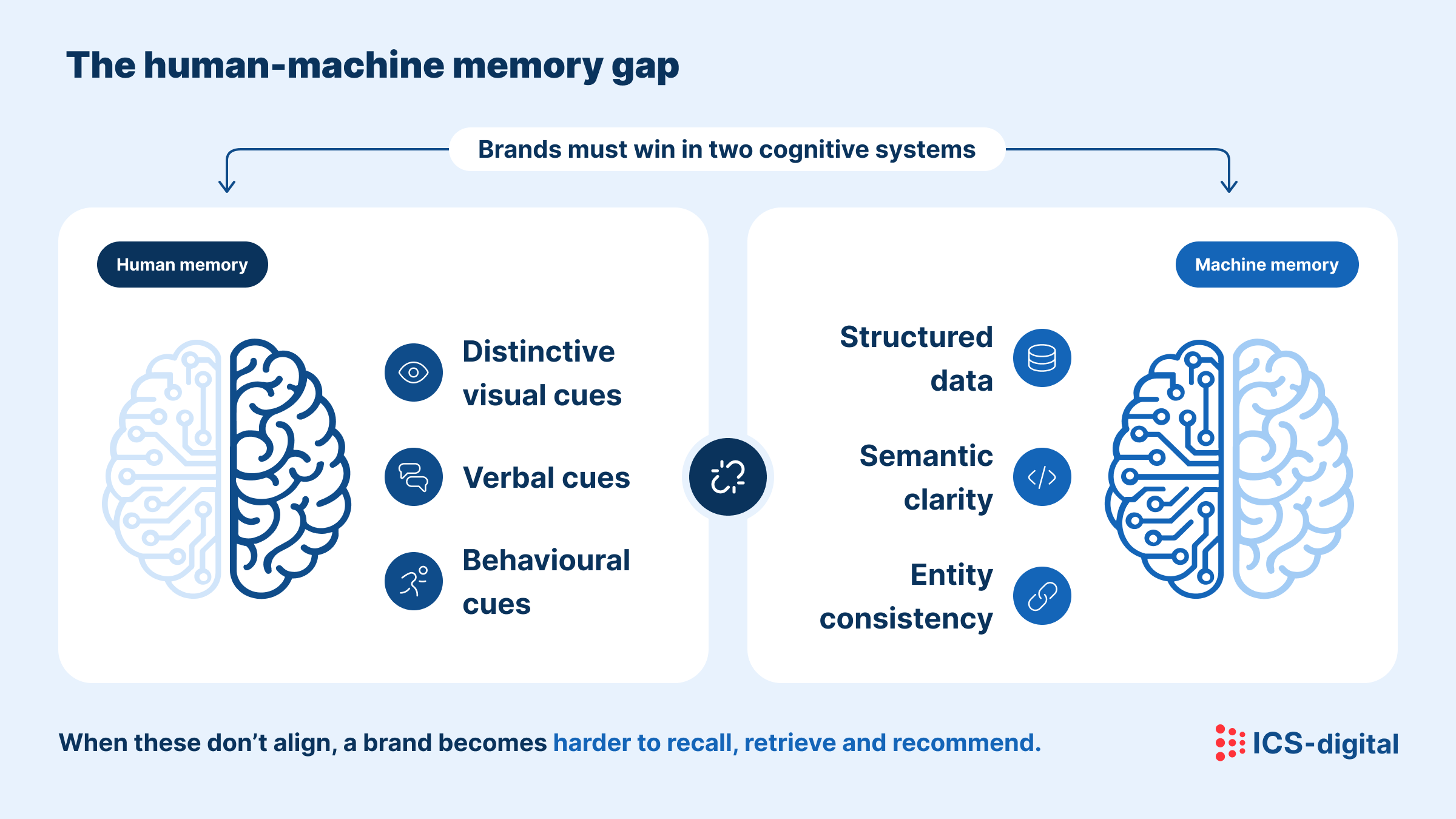
In the simplest terms, the Human-Machine Memory Gap emerges when people’s associations with a brand differ from how the brand is surfaced by machines - whether in the traditional SERP or in AI.
So a brand may be very well known and be investing heavily in their brand awareness, but have less AI visibility than competitors, or vice versa, a brand may be making great gains in AI, but isn’t well known enough by people to be the brand that is chosen.
Where brand choice can be compressed to only a handful of options, this becomes huge!
If you’re presented with three brands after asking ChatGPT for recommendations, and you already recognise one, that familiarity may influence which you explore first.
Being included in the answer matters, but so do the associations someone brings to receiving that recommendation.
Drawing on concepts from ‘How Brands Grow’ and the work of Byron Sharp, Jenni Romaniuk and Ehrenberg-Bass; distinctiveness makes brands easier to recall and recognise by building memory structures.
Distinctive brand assets (DBAs) help build mental availability and support brand growth.
A DBA is defined as any sensory cue, such as a colour, shape, sound or character that allows consumers to instantly recognise a brand without needing to see or hear the brand name.
Let’s bring this to life with some examples:
It’s highly likely you would name McDonald’s as the associated brand if presented with a photo of the golden arches.
What about if you heard ‘I’m lovin’ it’?
Or saw a picture of Ronald McDonald?
McDonald’s is a household name that has managed to develop multiple DBAs that allow consumers to identify the brand without even seeing the name.
Amazon’s brown packaging and the A to Z arrow / smile of their logo are synonymous with the e-commerce giant.
What I think is particularly interesting is that Amazon has managed to develop the associations with their DBAs and their brand over the years from bookseller to a seller of millions of products worldwide.
For me, I very much associate AO.com with the song ‘Blitzkrieg Bop’ by The Ramones - ‘Hey! Ho! Let’s Go!’.
That song combined with the iconic green has definitely built memory structures for me, as when I moved house a couple of years ago the first place I looked for appliances was ao.com.
The Ehrenberg-Bass Institute describes DBAs as needing to be both unique and famous to create those memory structures.
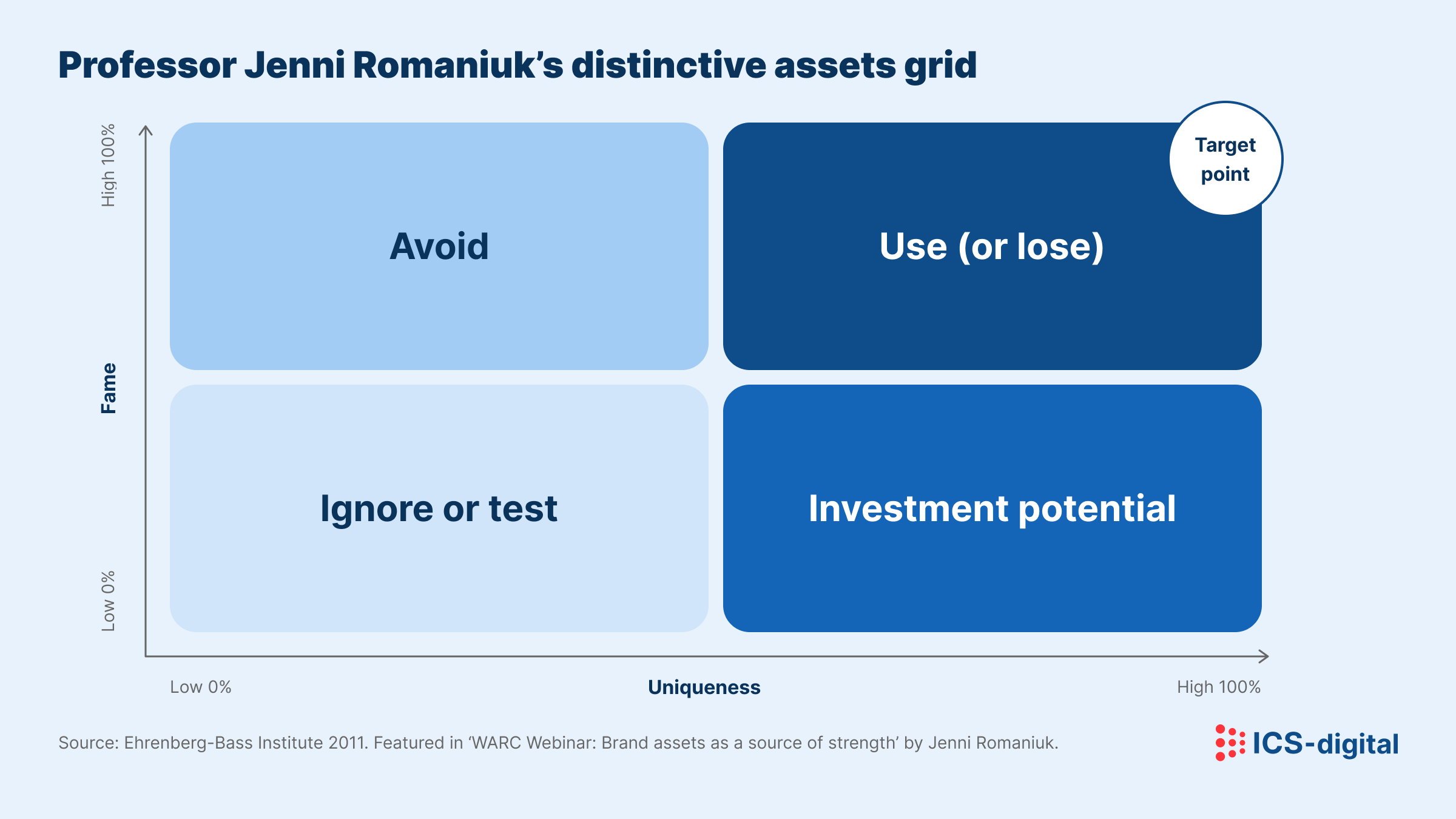
For me, this has clear implications for search strategy.
Your brand needs to be recognisable when it appears, and the associations you want to build need to be reinforced across the digital ecosystem. Or, in my own words (definitely not those of Byron Sharp) you need to show up in a way people recognise as yours, and reinforce those associations in lots of different places.
Recognising a brand doesn’t necessarily mean that you will think of that brand when a need arises. Different contexts activate different memories.
So the brand you choose could be impacted by where you are when you buy, the emotional state you’re in or what time of day the need arises.
For example, people have been found to be particularly susceptible to switching brands when they undergo a disruptive life event.
For human memory then, distinctive brands that are also linked to the right contexts will become the natural choice.
For AI systems, brands consistently connected to specific contexts are more likely to be retrieved and recommended.
By combining distinctiveness with clear contexts, brands can start to close the human-machine memory gap.
To test this theory and see if I could find a gap in action, I focused on brands I personally love and purchase.
Free Soul is a brand I first came across on TikTok.
Their work with influencers reached my For You Page, and when I wanted to try adding protein powder to my morning smoothies, I ordered from them. I’m sure I see other protein powders either on TikTok or other social channels, but the pink packaging and clear messaging around women’s wellness stuck with me.
For me, Free Soul is doing a great job at starting to build a distinctive digital presence.
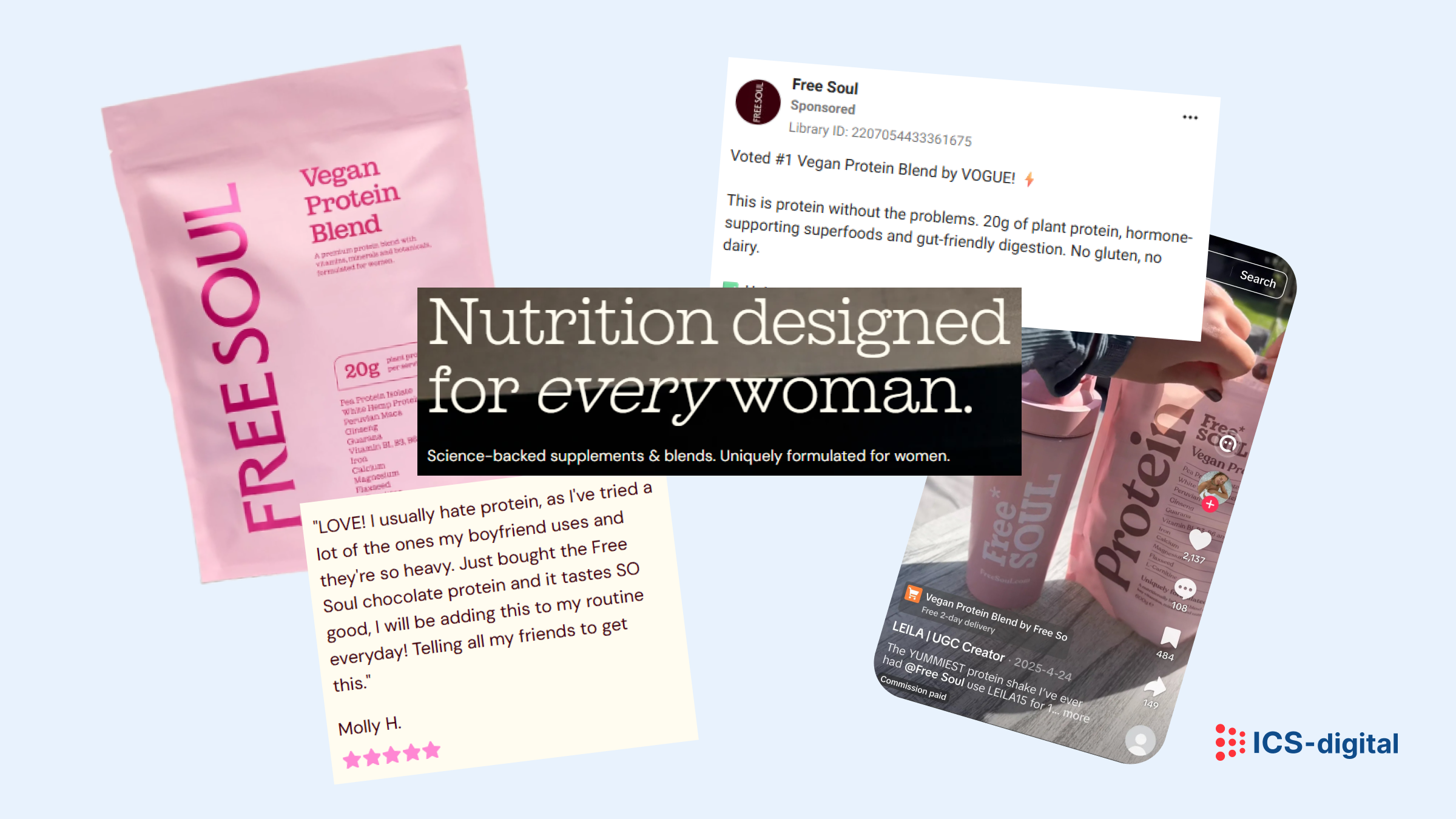
And when you look at its website, its assets, its reviews, Free Soul is communicating “women-first wellbeing” in seconds! But, does AI retrieve it in the same way? And what contexts do people associate with it?
In Brighton I presented two snapshot studies:
These were one-off tests conducted on 13 September 2026, with visibility measured as the percentage of responses mentioning Free Soul.
The findings are illustrative snapshots. I have since built on this initial data, and you can read more about those findings on the ICS-digital blog.
In the snapshot AI visibility study, Free Soul was clearly known for women’s wellness, with 50% visibility for broad category prompts.
But, I found that this dropped to 25% in prompts related to specific contexts such as strength training or menopause.
Across my three strength / active use prompts:
Free Soul appeared in only 1 of 15 tests - 7% visibility.
In all five ‘best protein brands for women’ tests, Free Soul appeared - 100% visibility.
I could see that Free Soul was strong on broad category queries, but its visibility dropped when queries related to specific contexts.
But as we know, it’s the context that activates human memory, and ultimately how people are likely to be searching.
In the snap poll, women did connect Free Soul with strength training.
4 of 22 people considered Free Soul when starting strength training, second only to Myprotein’s 11 people, whilst none of the AI platforms retrieved Free Soul for the equivalent prompt.
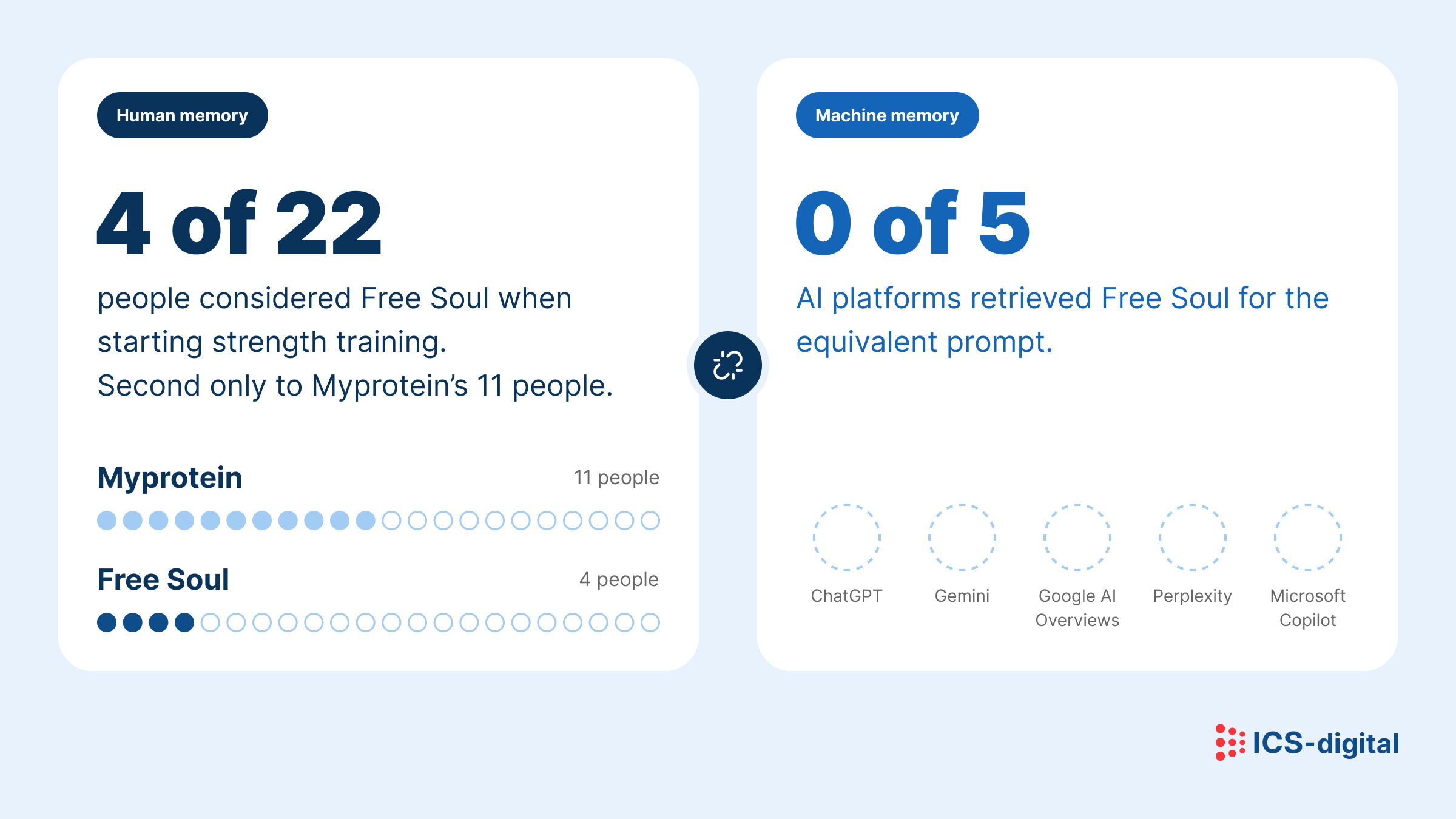
Brands are not remembered or retrieved in the abstract, they are recalled and surfaced in relation to a particular need, situation or context.
So if Free Soul is recalled by people in a strength-training context, but AI is not retrieving it, that is the Human-Machine Memory Gap in action.
In my tests, someone asking about protein powder for women starting strength training wouldn’t have been presented with Free Soul, despite the brand having built memory structures and mental availability.
Identifying the contexts your brand can credibly own helps guide your search strategy. But where do you start?
There are four areas where you can collect data to help inform those contexts.
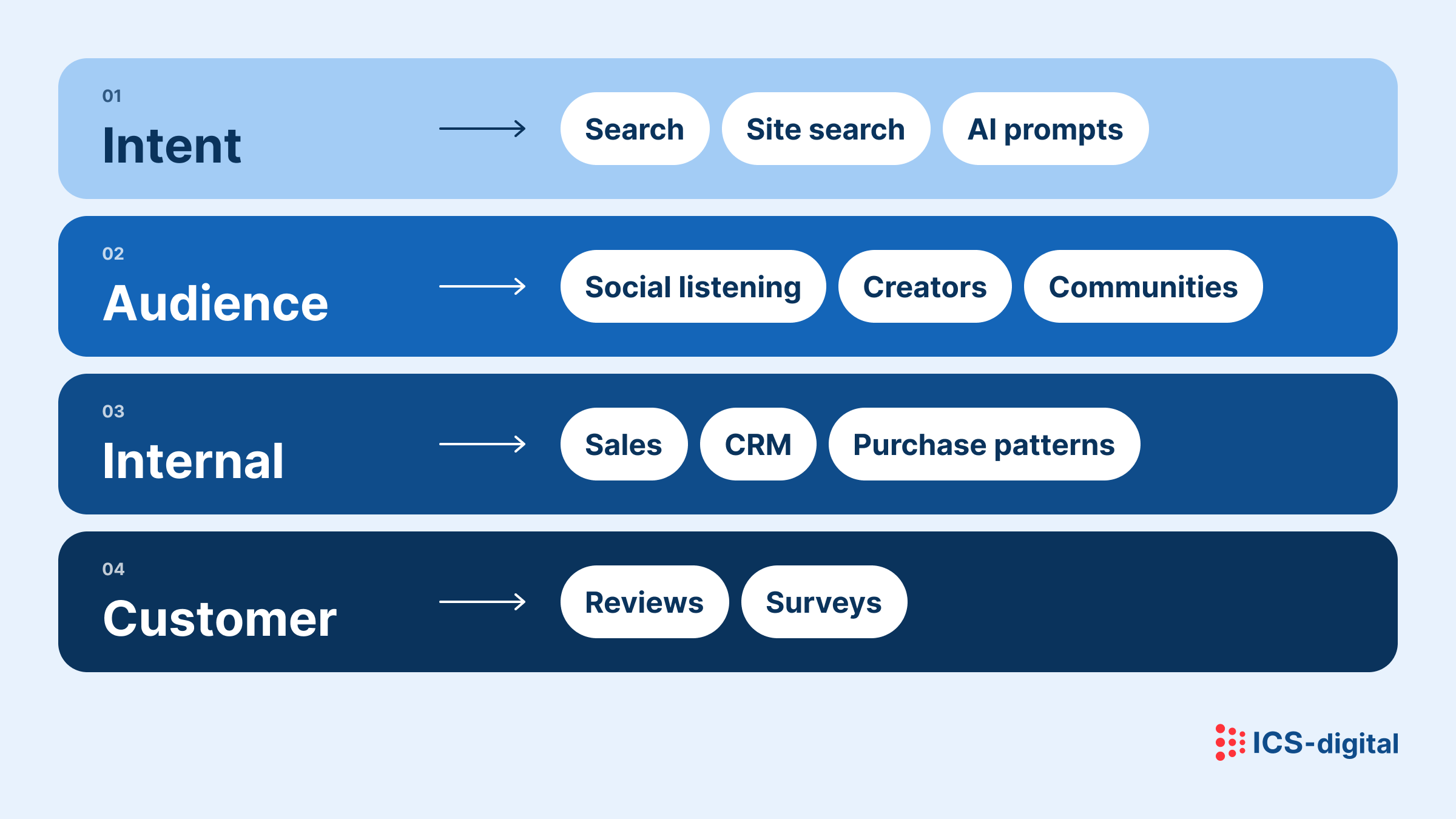
What needs, problems or occasions sit behind the searches?
Review keywords, prompts and unbranded search behaviour, as well as searches happening on your own site for products or categories.
In what situations do people discuss, use or recommend products like yours
Combine social listening on social media platforms with deep dives into relevant communities and analysis of creator content.
What can purchase patterns reveal about why people buy or what triggers a purchase?
Analyse actual sales data, your CRM data and purchase patterns - this can be a real goldmine!
What circumstances do customers describe when explaining why they chose you or how they use your product?
Look at what your customers are saying in reviews or even in brand surveys.
You can use AI to suggest possible contexts and then validate them against those four evidence sources - relevance to your products alone doesn’t establish that customers experience or search within that context.
Ultimately, identifying these contexts gives you an understanding of your customers and a starting point for how you’ll build associations - then you can start mapping them to search behaviour.
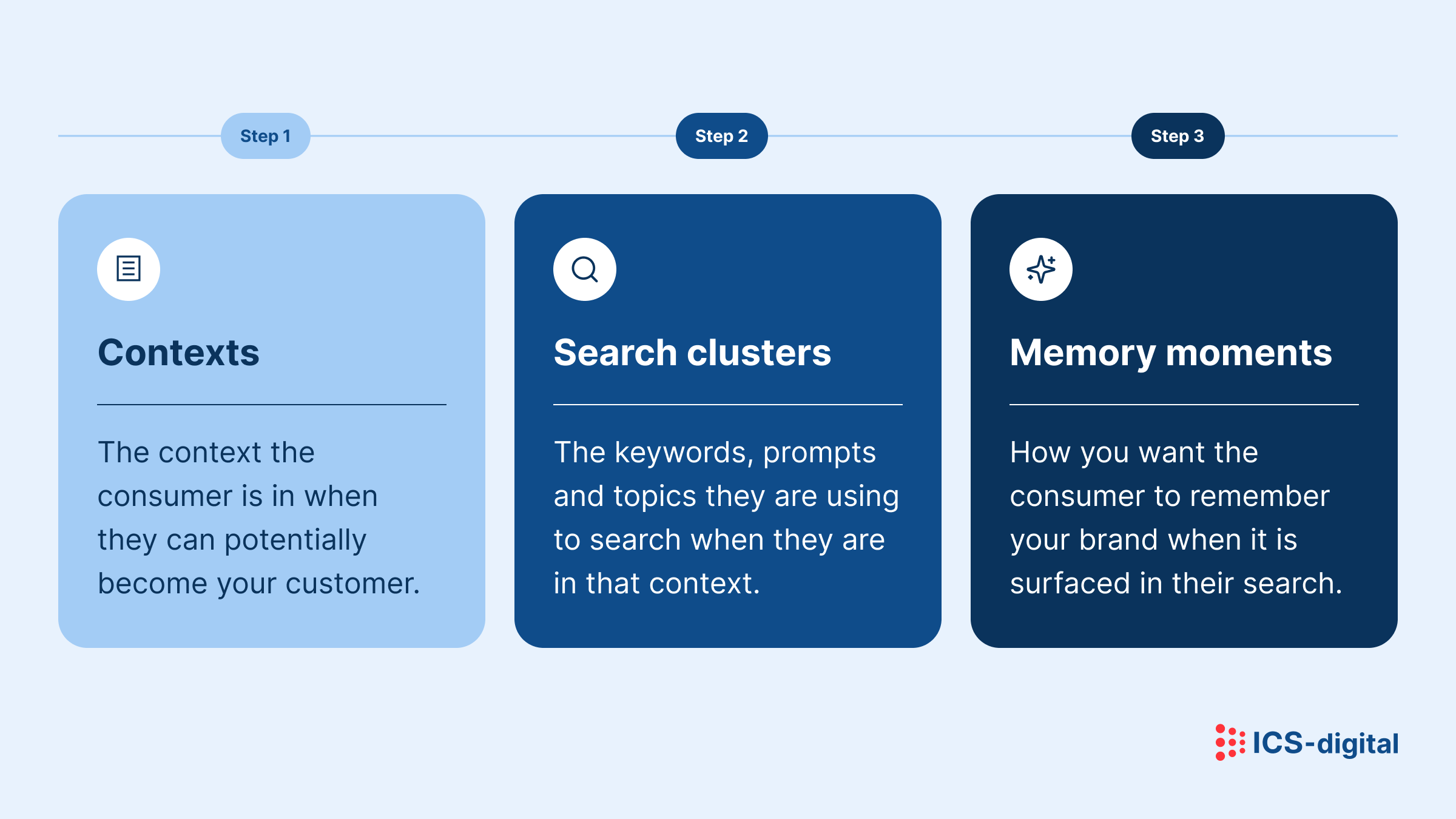
Let’s use a fictional brand now to look at how you could do this in practice.
Imagine an online luggage brand.
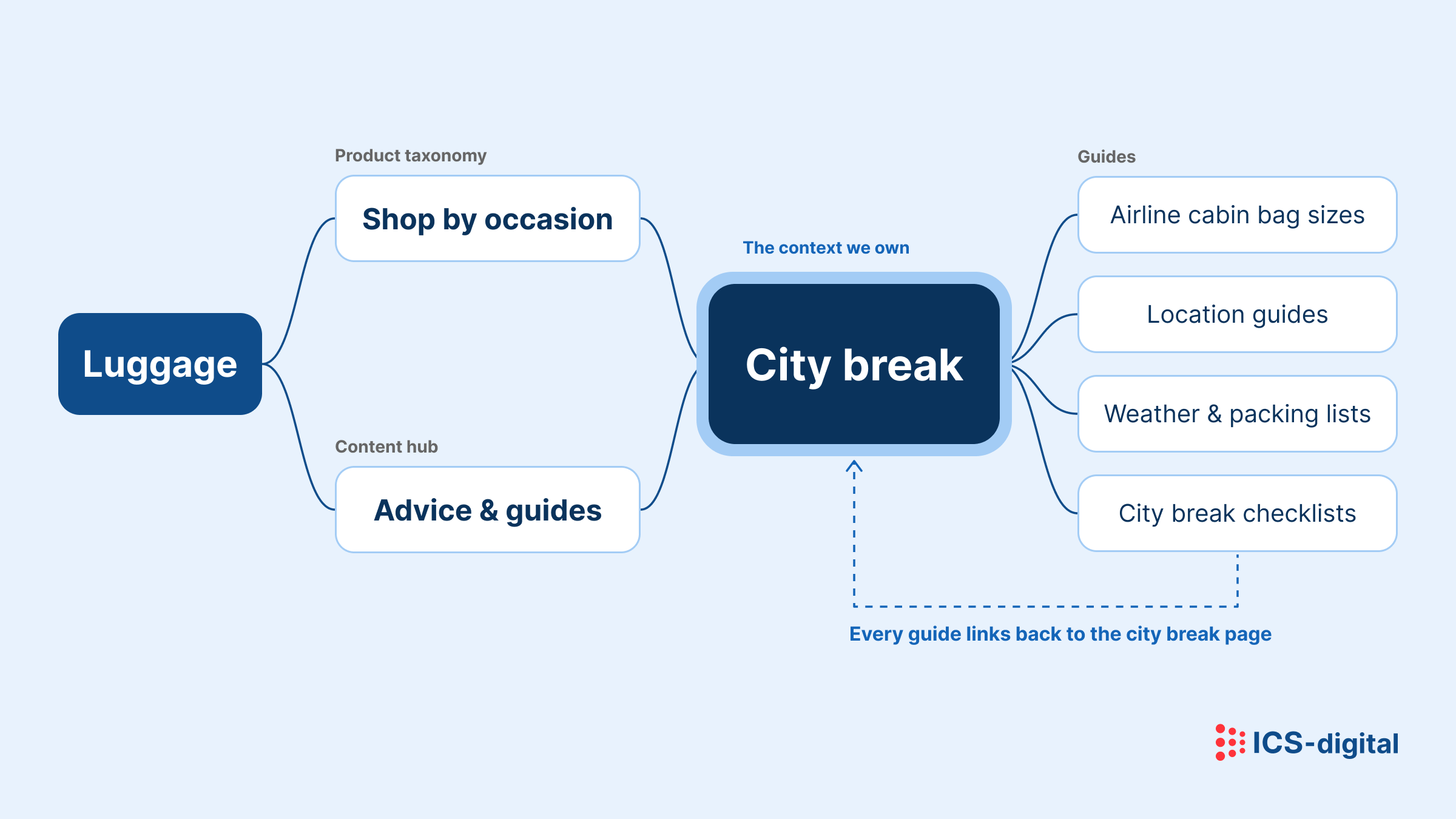
You do the research and a clear context emerges: planning a city break and determined not to check a bag.
Important to note that the context is specific - I think specificity at this stage can help keep you focused and therefore more distinctive. This isn’t just about people going on city breaks, it's about a specific intention, constraint or feeling the person has.
To map this context to your search clusters, you’d undertake keyword and prompt research - the searches in your clusters might show up as something like:
You then need to pick your ‘memory moment’.
If someone searches and sees your brand, how do you want them to remember you? What comes to mind? What makes them click?
“The luggage brand that’s perfect for city breaks.”
Yes, it’s simple. But if this is what you want to own, you can then build a distinctiveness system that reinforces that memory moment, for that context.
Once you’ve done the mapping, you then need to ensure the relevant associations are reinforced across the digital ecosystem.
First, make “city breaks” a context the site can own by ensuring product categories and guide content both support that context.
Then don’t just enter the context, look different in it.
Your creative assets should always be clearly yours and not interchangeable with another brand in your space.
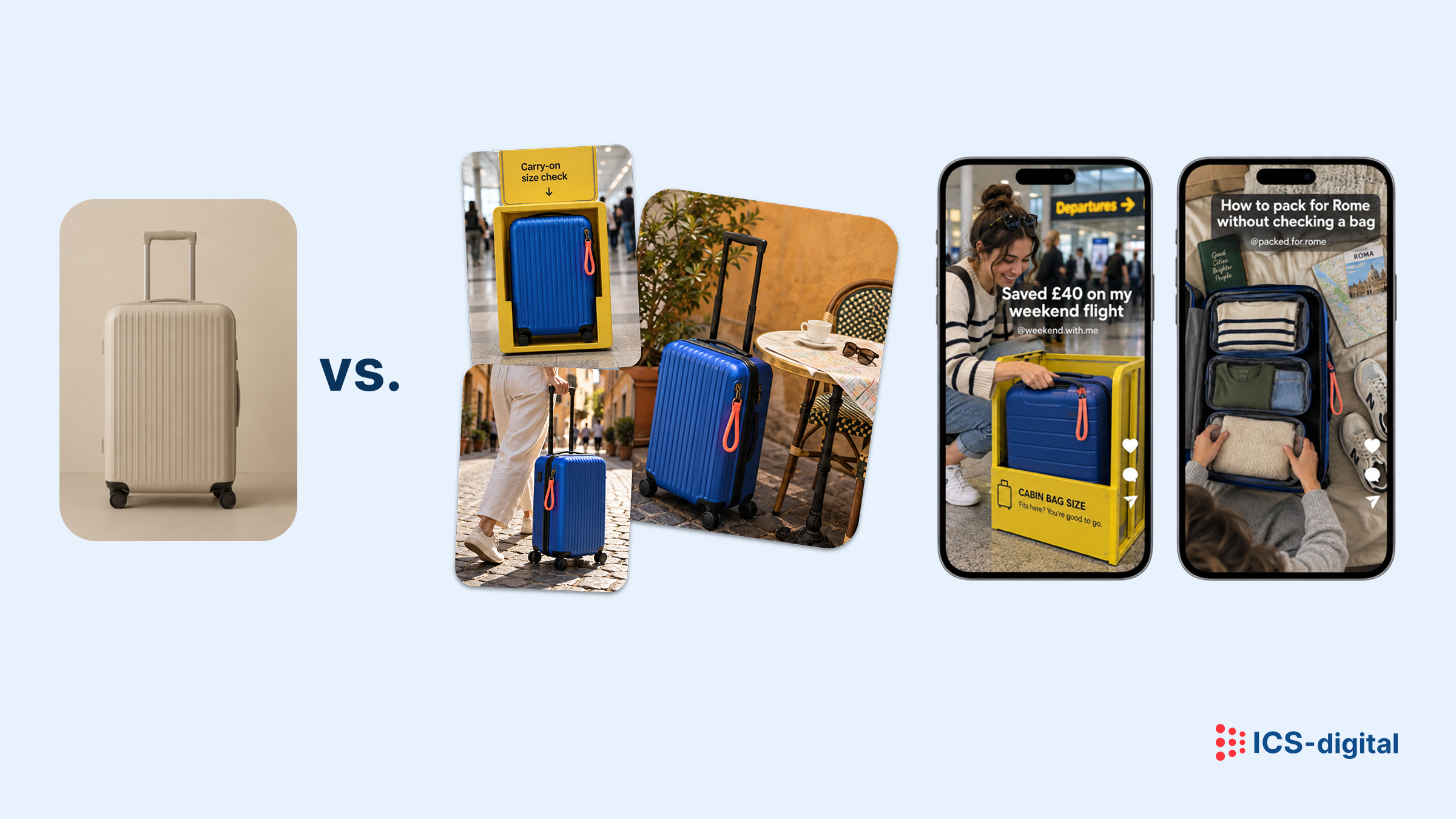
Then you need to let trusted voices reinforce the context - this could be through PR activity, creator partnerships or community building.
Every channel needs to teach the same association.
The volume of activity creates exposure, and consistency turns that exposure into memory.

Laura Smith - Head of Client Strategy, ICS-digital
Laura Smith is Head of Client Strategy at ICS-digital, where she helps brands connect digital activity to business goals through insight-led, creative strategy. Previously a Digital PR lead, she brings experience in creative campaigns, client service and search; she hosts and guests on the ICS: Everything Digital podcast and speaks on SEO, AI search and digital marketing. Laura has been named CIPR’s Outstanding Young Communicator (Yorks & Lincs) and PR Moment’s Young Professional of the Year (North).
Distinctiveness Intelligence® is our proprietary strategic framework that builds distinctiveness across digital layers: Technical SEO, Onsite Content, Creative, Digital PR, Social Media, Influencers & Paid Media.
You can find out more about the framework, read our whitepaper & listen to our recent podcast:
The same WTSFest experience you love - welcoming, kind, connecting, & helpful - with a few more voices & insights 💜
15 brilliant experts on stage (instead of our usual 10) & 2 wonderful hosts!
We're launching our Connect Session - 2 panels of experts talking about the latest industry trends.
See you at the Barbican on Friday, March 19th 2027!