🌲 WTSFest Portland - May 2026 | 🥨 WTSFest Philadelphia - Oct 2026 | 🎥 On-Demand Video Hub - 2026
🌲 WTSFest Portland - May 2026 | 🥨 WTSFest Philadelphia - Oct 2026 | 🎥 On-Demand Video Hub - 2026

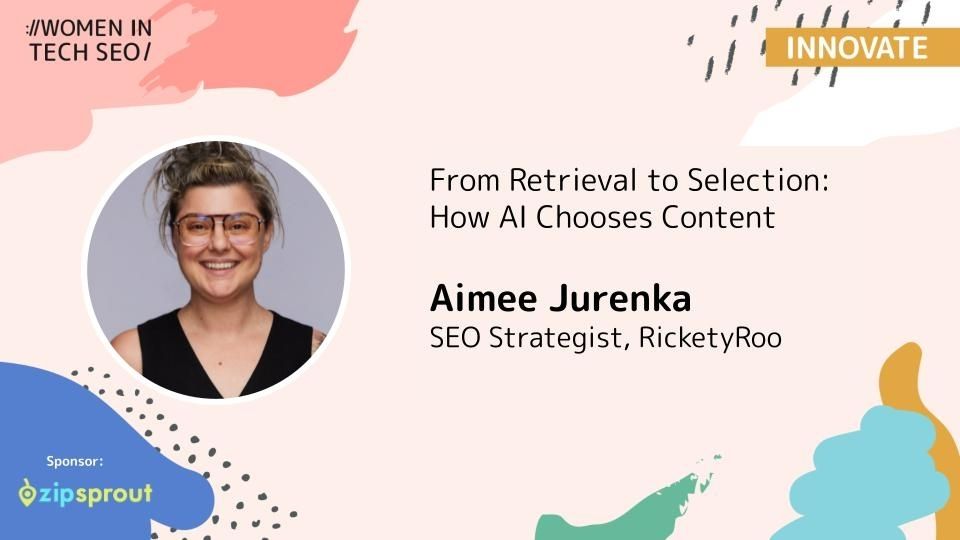
Author: Aimee Jurenka
Last updated: 09/02/2026
Large language models (LLMs) don’t rank pages & wait for clicks. They assemble answers. They retrieve a large pool of content, discard most of it, & select only a small number of sources they feel confident using to construct a response.
To gain visibility, your content needs to survive this process. That’s where SRO comes in.
Yes, another acronym has entered the chat. Selection Rate Optimization (SRO) is the practice of increasing the likelihood that an AI system selects your content when constructing an answer.
SRO operates across three layers:
SRO comes in after your SEO fundamentals are in place & focuses on what happens after retrieval – when the model decides what survives.
How do LLMs assemble answers? At a high level, the process looks like this:
Okay, now for the good stuff. What can we do to optimize for selection?
Large-scale analysis from Search Atlas, spanning more than 5.5 million AI responses, shows that word count alone has little correlation with citation behavior. Long pages aren’t preferred because they’re long. They’re preferred when they contain more extractable facts.
In other words, density beats length.
Here are a few ideas on how to beef up your content:
Essentially, if you want to be cited, give the model something to work with.
Structure is a shortcut to selection. In AI search, how your content is formatted directly impacts whether it gets surfaced. Research from Writesonic, and Airops shows that list-based content accounts for nearly 30% of AI citations, and pages with tables earn significantly more citations than those without.
Clear hierarchy, predictable layouts, and obvious sectioning reduce ambiguity. Less ambiguity means lower risk. Lower risk means a higher likelihood of selection.
Entropy comes from mixed signals. When your services, scope, or language shift, model confidence drops. A study by Yadav et al. shows that if AI's understanding of your brand is "wobbly" the model may ignore or leave you out of the final answer because it isn't "sure" about your relevance.
Yes, I’m including the dreaded “chunking” we are all hearing about. LLMs don’t evaluate pages the way search engines do. This is why information density, not length, is what actually increases the odds your content survives selection. A DEJAN report reinforces this shift: models operate at the passage level, lifting short snippets (often ~15 words) from ranked sources rather than whole pages. Only about 13% of long-form pages get used at all.
To improve selection:
This is what people usually mean when they talk about “chunking.” A strong chunk (paragraph) is one that’s safe to cite by itself.
LLMs are not brand strategists; they are pattern matchers that get nervous when your signals don’t line up. When the same company shows up under slightly different names, abbreviations, & formats, the model treats that as uncertainty, and uncertainty equals factual risk.
Your goal is simple: provide one clean, consistent identity that is repeated everywhere.
Standardize:
Use the same format everywhere:
This isn’t about branding polish. It’s about giving the model one clear story it can repeat safely.
Consistent entity signals in content aid contextual grounding. Contextual grounding is when an AI system bases its answers on the specific documents, entities, and context retrieved for a query, not just on generic training data. Content that’s factual, well-structured, and entity-clear reduces uncertainty, making it safer for models to select and reuse.
Use full, explicit addresses where applicable:
Avoid mixing:
If your location signals are vague, mixed, or implied, relevance becomes fuzzy, especially for local, regional, or jurisdiction-specific queries.
Not because of Google, but because it reinforces entity boundaries.
NLP systems use entity boundaries to define the start and end of a "thing" in text. These boundaries are crucial for classifying entities, connecting concepts, and information retrieval. The span of an entity, like "Eric Adams" versus "New York City Mayor Eric Adams," dictates its context and meaning. NLP models rely on accurate boundaries to form the semantic relationships that AI systems use for organization, query matching, and content reuse.
Ensure:
Pages don’t build confidence. Entities do.
SRO flips the script: it’s not about rankings, it’s about confidence. Traditional SEO tracks position & visibility. But AI search systems don’t rank pages; they make decisions based on how confident they are that your content is trustworthy, relevant, and safe to use. That confidence comes from how well the model understands who you are, and whether it sees you as a credible source for the topic.
So instead of chasing share of voice, the goal is to monitor the internal confidence signal. One way you can do that is through bi-directional probing.
Ask the model:
Ask the model:
Taken together, these don’t produce a rank or a score; they produce a directional confidence signal.
SRO is about being the least risky option in a high-stakes environment. You’re seeking to reduce ambiguity, reinforce your entity, and give the model something it can safely use, over and over again.
If you’re looking to get started with SRO for your organisation, I’ve put together a checklist to help you – use this while writing, editing, or auditing content for AI search visibility.
Click here to download the SRO checklist.
If you don’t pass this layer, nothing else matters.
□ Can you describe what the brand does in one clear sentence?
□ Is that same sentence (or something very close to it) used on: the homepage H1 or intro, your “About” page intro, author bios, and schema (Organization, Person)
□ Have you avoided “& also” positioning (e.g. SEO + AI + content + growth + consulting)?
Rule: Narrow beats clever. Pick one primary definition & repeat it.
□ Legal business name is identical everywhere
□ DBA usage is consistent (or eliminated)
□ Abbreviations are standardized
□ Same format appears in: the footer, schema, Google Business Profile, LinkedIn company page, and press mentions
□ Full location explicitly stated (City, State, Country)
□ Same formatting used everywhere
□ No unexplained multiple HQs
□ If remote/global, that is stated clearly & consistently
□ Content has a named author
□ Author has a dedicated author page
□ Author page links clearly back to the organization
□ Person & Organization schema are present & aligned
Reminder: Pages don’t build confidence. Entities do.
□ Clear, predictable heading hierarchy (H2 → H3)
□ Lists & tables used where appropriate
□ Sections are visually scannable
□ No “wall of text” paragraphs
Gut check: Could an AI safely lift one section without the rest of the article?
For each major section:
□ Heading matches a real question or intent
□ Direct answer appears immediately after the heading
□ Section focuses on one idea only
□ Paragraph makes sense without outside context
If a chunk can’t stand alone, it’s risky to cite.
□ Does the page include net-new information?
□ Are there specific numbers, stats, or thresholds?
□ Are claims concrete instead of vague?
□ Does each section contain at least one extractable fact?
Rule: Long pages win only when they contain more usable facts.
□ Product, service, or brand name is mentioned inside each logical chunk
□ No pronoun-only references (“this tool,” “we,” “they”) without context
□ If a paragraph were quoted alone, the subject would still be clear
□ Core phrases reused intentionally
□ No unnecessary synonym swapping for style
□ Same terminology is used across: pages, bios, schema, and off-site mentions
□ Content stays within the brand’s declared expertise
□ No unexplained expansion into adjacent services
□ Old or conflicting pages cleaned up or removed
□ Is this the clearest version of this information on the web?
□ Does this reduce uncertainty or introduce it?
□ Would a cautious system feel safe repeating this?
ZipSprout connects brands with local nonprofits and events to build sponsorship links that drive local SEO and community impact.
Since 2016, they’ve facilitated 25,381 placements with community organizations across the US, raising over $9.2M in sponsorships.

We pay our authors, speakers & team to bring you helpful content like this.
We aim to always keep our content and community free and accessible.
If you've found value in WTS, please consider supporting us through our Buy Me a Coffee initiative.