🌲 WTSFest Portland - May 7th 2026 | 🥨 WTSFest Philadelphia - October 1st 2026
🌲 WTSFest Portland - May 7th 2026 | 🥨 WTSFest Philadelphia - October 1st 2026

Author: Hannah Smith
Last updated: 03/02/2026
We recently had the pleasure of hosting Hannah Smith for the first WTSTalk of 2026, live on Zoom.
Hannah is the Head of Content at WTS, in addition to running her own company, Worderist.com. Through this company, she often works as either a Fractional Head of Creative, or a Fractional Head of PR for agencies and inhouse teams; plus she also offers creative content consultancy, content strategy, training, and executive coaching.
In this session Hannah shared the highs and lows of a challenge she set herself in 2024, and how she discovered it was emotion management rather than time management which was holding her back. She then went on to explore some of the reasons why we fail to achieve our goals, and what to do about it.
If you missed the live session, you can watch the recording: The capacity to tolerate minor discomfort is a superpower; plus, Hannah’s written a recap of her session which you can read below.
Our live WTSTalks take place over Zoom.
Want to attend the next WTSTalk? Join the WTS community!
Over the years, I’ve set myself a bunch of challenges and goals; the vast majority of which I failed to complete. But, whilst these failures stung, I never really spent much time thinking about why I gave up.
Then, in 2024, I set myself a particularly tough challenge: to write 100 pieces of hybrid fiction in 100 days. And friends, this was the first challenge in a long time that I successfully completed.
Why was I able to complete this challenge when I’d failed to complete so many others?
Having reflected on this, I believe there were three key factors:
In this article, I’ll be explaining what these factors are, and exploring why I think they have such a big impact.
If you’re heartily sick of setting yourself challenges and goals which you fail to achieve; or, if your fear of failure looms so large that you actively avoid setting goals at all, this article is for you. I hope you find it useful.
Let’s do this :)
As I mentioned in the introduction, in 2024 I set myself a challenge: to write 100 pieces of hybrid fiction, in 100 days. Possibly you’ve noticed that I didn’t say that the things I wrote needed to be “good”, I just needed to write 100 of them. That was a deliberate decision, and (I think), an important one.
I elected to frame my challenge specifically in this way, because of something I learned from a 2010 interview with Ira Glass (the host and creator of the public radio program This American Life). In that interview, Glass spoke about his own experiences and challenges with producing creative work:
“Nobody tells this to people who are beginners, and I really wish somebody had told this to me.
All of us who do creative work, we get into it because we have good taste. But it's like there is this gap. For the first couple years that you're making stuff, what you're making isn't so good. It’s not that great. It’s trying to be good, it has ambition to be good, but it’s not that good.
But your taste, the thing that got you into the game, is still killer. And your taste is good enough that you can tell that what you're making is kind of a disappointment to you. A lot of people never get past that phase. They quit.”
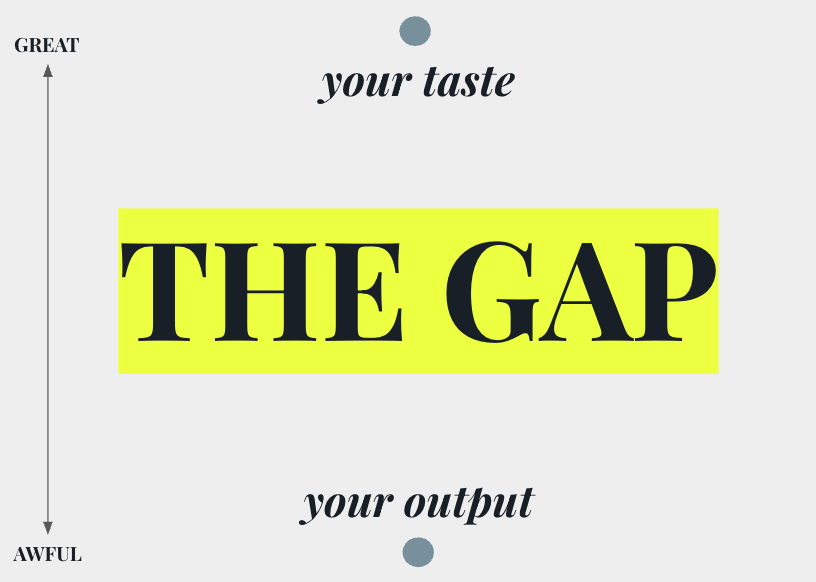
A visual depiction of the Taste Gap, a concept popularised by Ira Glass.
This interview resonated really strongly with me. When it comes to creative work, I have a strong sense of what “great” looks like, and a clear vision about the quality of what I want to produce. However, my output (i.e. the creative work I actually produce) rarely measures up to the lofty heights of my taste! And the problem is, the gap between my taste and my output often feels so big that I want to give up.
I think that the important thing to note here is that this concept isn’t unique to creative work, it’s universal.
Ira Glass calls this the “taste gap”, but I call it the “ambition gap”.
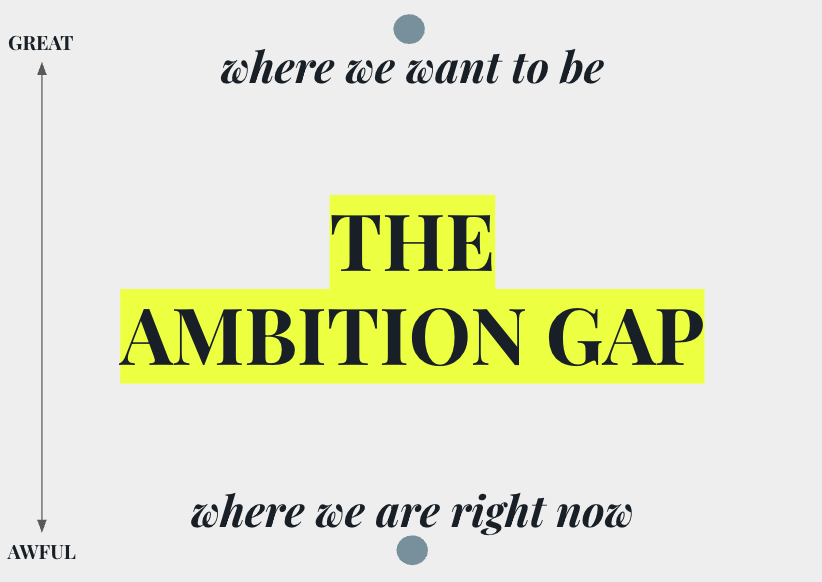
A visual depiction of the Ambition Gap.
When we set ourselves a goal or a challenge, we know what “great” looks like. But often, we’re so far away from “great” that the gap feels unbridgeable and so we give up.
And this isn’t just a beginners’ problem. The gap might narrow over time, but it will never truly close, because as the quality of our output increases, so does our ambition:
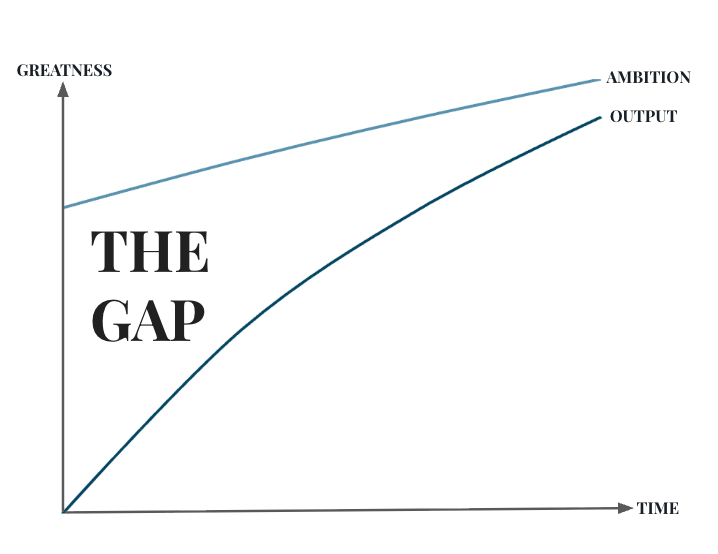
A visual depiction of the Ambition Gap over time.
Why is all this important? Because my challenge was: to write 100 pieces of hybrid fiction in 100 days, (and the things I wrote didn’t need to be “good”), I was effectively giving myself permission to “ignore” the ambition gap:
My goal wasn’t to write “good” stuff. My goal was just to write.
And actually, doing a lot of writing is the only way I can begin to bridge the ambition gap in any case, because the only way to get better at anything is to do a lot of work.
So, problem solved, right? Nope :(
Even though the way I set up this challenge gave me permission to “ignore” the ambition gap, it didn’t stop me from feeling it – the gap between the work I was actually producing, and the work I wanted to produce felt huge.
But I think that being aware of the ambition gap gave me the resilience to keep going anyway. And ultimately, I think that I decided that I wasn’t going to let how I felt about my work stop me from completing the challenge.
So, I just told you how I felt about the quality of my work during the challenge, but how did actually doing the work feel?
Sometimes it felt brilliant – I was fully engaged, and doing the work felt great. But most of the time it didn’t feel like that at all. Even when the quality of my writing was pretty good, I often felt pretty awful.
Sometimes feelings of doubt crept in.
Is this a bad idea?
Is this the right challenge for me?
Do I actually want this?
Sometimes the real world crept in.
I just remembered a thing I said I’d do, but haven’t done, and it’s kind of urgent, and I have to go do it right now, otherwise I won’t be able to focus.
Sometimes I was just distracting myself.
Without even fully realising what I’m doing, I’ve opened up that awful social media platform, and now I’m scrolling my feed.
Friends, I have an emotion management problem, and I don’t think I’m alone. In fact, I believe that many people who think they have a problem with time management, actually struggle with emotion management.
If you set aside time to work on challenges or goals, and actually sit down to spend that time working towards achieving them, but then:
AND/OR
AND/OR
Then time management isn’t an issue for you, what you’re struggling with is emotion management. And, the truth is, how we imagine we’ll feel when we’re working on our challenges or goals, is rarely how we actually feel:
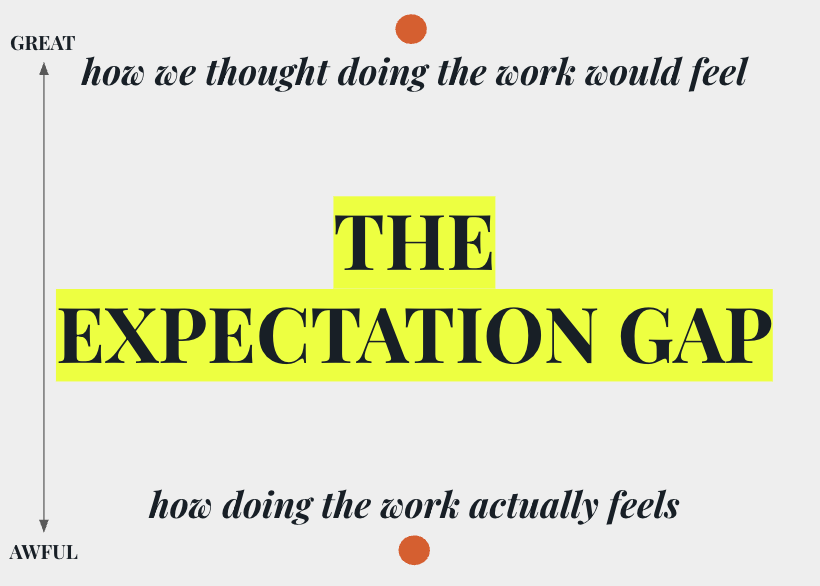
A visual depiction of the Expectation Gap.
When we set ourselves a goal or a challenge, we have a tendency to imagine it will feel “great” to work on this thing, and so, when it feels “awful” we feel like giving up.
But are we actually feeling “awful”?
Or, are we just feeling a little minor discomfort?
Big feelings feel BIG, in the moments when we’re feeling them. But most of the time, those moments don’t last very long. And these feelings are not actually intolerable (even if they feel intolerable at the time) — in fact they are pretty easy to tolerate.
According to Oliver Burkeman:
“The capacity to tolerate minor discomfort is a superpower.
It’s shocking to realise how readily we set aside even our greatest ambitions in life, merely to avoid easily tolerable levels of unpleasantness. You already know it won’t kill you – but you can waste years in avoidance nonetheless.
It’s possible, instead, to make a game of gradually increasing your capacity for discomfort, like weight training at the gym.”
Turns out, he’s right. I found that I could indeed increase my tolerance for minor discomfort. How did I do this?
By:
*There are limits – if a challenge consistently made me feel awful, I’d rethink it
Long before taking on this challenge, I recognised that I had emotion management problems when it came to some types of tasks. A classic example for me, is how I feel about doing my accounts. In my head I blow it out of all proportion, I’m like: DOING MY ACCOUNTS IS THE WORST THING IN THE WORLD! MY LIFE IS SO HARD, AND TRAGIC, AND SAD! BOO HOO POOR LITTLE ME!
Which is silly, because actually, I don’t find doing my accounts difficult, it doesn’t take me that long, and it’s really not awful at all. It’s not something I love to do, but it’s actually fine.
What I didn’t realise for the longest time, was that I don’t just experience emotion management problems when it comes to the things I don’t want to do; I also experience emotion management problems when it comes to stuff I REALLY DO WANT to do.
I first realised this in 2023, and in a lot of ways that realisation inspired this talk. In March 2023 I attended a Zoom course run by Oliver Burkeman, and pretty early on in the first session he said something like: “The key skill you need to develop is not time management, it’s emotion management.”
It was a proper lightbulb moment for me – I heard this, and suddenly a whole bunch of things made sense. When it comes to goals and challenges, I’m actually great at time management: I set aside the time, I actually sit down to spend the time I’ve allotted on whatever it is I’m supposed to do; it’s after that point that everything goes to hell.
When it comes to challenges and goals, “hell” comes in 2 flavours for me:
And when those feelings get too much, I’ll start distracting myself because I feel like I’d sooner do anything other than the thing I set out to do.
I think that the main reason I was able to complete my 2024 challenge was because I already knew I had this emotion management problem, and by that point I’d been working on “increasing my capacity to tolerate discomfort” (i.e. managing my emotions) for more than a year. What’s also noteworthy, is that on reflection, I think that emotion management problems were the main reason I failed to achieve many of the goals I set myself in the past.
Time is an all too real constraint that all too often, we completely forget about.
Let’s look at my challenge one last time: to write 100 pieces of hybrid fiction in 100 days.
Some of you might be thinking, if she can do a challenge like this, then I can too. Maybe writing isn’t your thing, but you could do whatever your thing is once a day, for 100 days, right?
Maybe you can. But also, maybe you can’t. Because a reasonable challenge for me, might be utterly unreasonable for you (and vice versa).
The truth is that we do NOT all have the same 24 hours in the day.
My life is not the same as your life.
This is really important to remember, because the goals and challenges you set yourself need to reflect what you have going on in your life.
And, there’s a really important thing I’ve failed to mention so far – this challenge I set myself really wasn’t reasonable, and it’s not something I would recommend that anyone else should try to do.
What are the issues with this challenge?
If I were to do a challenge like this again, I’d probably aim to: write 5 pieces of hybrid fiction in a single week; or, write 20 pieces of hybrid fiction in a single calendar month.
But, to be clear, I’m not recommending that for you. I’m recommending that you set yourself an appropriate challenge that reflects what’s going on in your life, and the time you have available to you.
I also recommend starting small and building up; or even, starting small and staying small.
The next time you set yourself a challenge or goal:
To get to “great” you’ll need to do a lot of work.
Don’t challenge yourself to “be great at [X]” instead, challenge yourself to “do the work”.
For example, let’s imagine that your goal is to run 10k in under an hour. Rather than challenging yourself to achieve that time, set yourself a challenge to run 3 times per week. If you’re fast it counts, if you’re slow, it counts. The challenge is just to get out there and run regularly.
Working on your goals and challenges won’t always feel great. But not feeling great is not a sign from the universe telling you to give up. It is possible to increase your capacity for discomfort, and I think this ability is a superpower :)
Acknowledge what you already have going on in your life. The time you have available to you is an actual constraint that no amount of “time management” can overcome.
Set yourself appropriate challenges and goals that reflect what’s going on in your life, and the amount of time you really have available to you.
For example, maybe you really want to speak at a conference. I totally get why you might feel like that’s a good goal, but the problem is you aren’t in control of the outcome – the conference or meet-up organisers you’re pitching to are the ones who will ultimately decide whether or not you’ll actually achieve it.
As such, rather than making “speaking at a conference” your goal, I’d encourage you to set yourself a goal to: ‘submit speaker pitches to 10 different conferences or meet-ups” instead.
Don’t set yourself a goal or challenge that involves you doing your thing EVERY SINGLE DAY. It’s inevitable that things will come up in your life that make this impossible, so make sure you build in rest days. Future you will thank you for your kindness.
This one’s for all the people-pleasers out there! At various points in my life I’ve felt huge pressure to set goals which other people thought would be great for me – for example my family, my boss, etc.
The problem is, it’s a lose/lose situation.
If you fail to achieve the goal you’ll feel bad about yourself. But even if you do achieve the goal, you still might not feel great.
Many times in the past I’ve achieved something that someone else wanted for me, (but if I’m honest, I didn’t really want for myself) and I felt kind of empty afterwards. I was just like: well, done that then, I guess? I didn’t feel much in the way of a sense of achievement.
I think it’s really important to make sure that you’re working towards achieving something YOU want to achieve.
Our live WTSTalks take place over Zoom.
Want to attend the next WTSTalk? Join the WTS community!

Hannah Smith - Head of Content, Women in Tech SEO
Hannah is the Head of Content at WTS!
Hannah also offers creative content consultancy, training & support to help develop teams, improve processes and deliver results. Her work for clients has won multiple awards, & she’s spoken at numerous conferences including MozCon, SMX, SearchLove, & BrightonSEO.
We pay our authors, speakers & team to bring you helpful content like this.
We aim to always keep our content and community free and accessible.
If you've found value in WTS, please consider supporting us through our Buy Me a Coffee initiative.