🇺🇸 17 days until WTSFest Philly
⏳ & London early bird tickets close end of month
🇺🇸 17 days until WTSFest Philly
⏳ & London early bird tickets close end of month
Author: WTS Team
Last updated: 30/07/2026
Customer reviews are more than reputation signals.
They contain the language people use to describe their needs, the problems they are trying to solve and the experiences that shape how they feel about a brand.
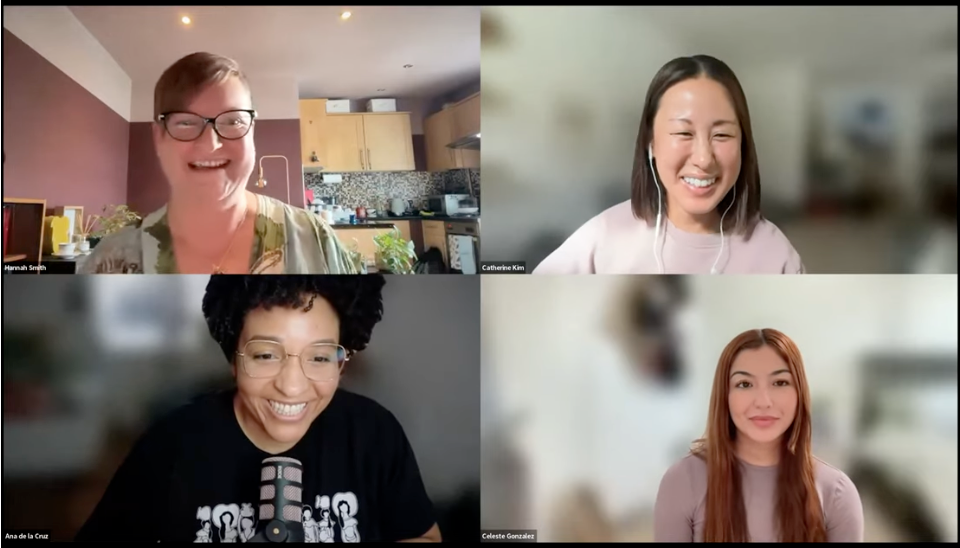
In this WTS Talk, Celeste Gonzalez, Ana De La Cruz and Catherine Kim shared practical ways to collect, analyse and organise review data - then turn it into useful content and business opportunities.
Check out a quick summary below of what you can expect to learn in the recording.
Most teams monitor their average star rating, but the deepest insight sits inside the reviews themselves.
Sentiment analysis helps transform large volumes of unstructured feedback like reviews into information you can filter, compare and act on. It can identify positive, negative and neutral language and sentence-level analysis can reveal mixed experiences that an overall rating may hide.
This matters beyond traditional customer research.
Review platforms are increasingly influencing how brands appear within AI-generated answers, particularly as users move closer to making a purchase.
Research shared during the talk found that review and trust platforms are the second-largest citation source within AI search, with their influence increasing significantly during later stages of the customer journey.
Celeste demonstrated how tools such as Apify can help teams collect public reviews from platforms including Google Business Profile and Yelp without needing custom infrastructure.
The workflow covered:
AI coding tools can also help people without a coding background create and adapt these workflows through plain-language instructions.
The important part is to keep API credentials private, start with public data and verify the raw output before adding another layer of analysis.
Ana showed how the Google Cloud Natural Language API can turn unstructured comments into structured data.
Rather than creating a separate process for every platform, the same core pipeline can be applied wherever audience feedback exists:
Pull the text → score the sentiment → visualise the findings
The approach can be used across YouTube comments, Google reviews, Yelp, Reddit and other user-generated content platforms. It allows teams to analyse much larger data sets while retaining access to individual comments and the context behind them.
A dashboard can then make the information easier to interpret by showing:
The analysis should not replace human interpretation.
The tooling helps teams listen at scale; people still need to understand the context, identify what matters and turn the findings into a useful point of view.
Catherine demonstrated the Real Experience Organizer GPT, which helps move from raw review data to organised content opportunities.
The tool can take:
It then groups the information into a structured table containing themes, review content, customer concerns and potential content opportunities.
That output can help answer questions such as:
The resulting ideas might become blog posts, FAQs, landing-page content, case studies, social content or improvements to existing service pages.
The tool provides a starting point, not a finished strategy.
Brand knowledge, subject-matter expertise and creativity are still needed to validate the insights and turn them into something useful and memorable.
Start with a small set of reviews and confirm that the information has been collected and organised correctly before scaling.
Prioritise reviews that are recent, detailed and substantial enough to provide useful context.
Protect customer and company data, follow relevant privacy policies and avoid uploading proprietary information to tools without permission.
Finally, verify the output.
Check that all review sources have been included, return to the original comments when necessary and treat automated analysis as evidence to interpret—not an answer to accept without question.
The recording includes walkthroughs of the scraping workflow, Google Cloud NLP sentiment analysis, dashboards and the Real Experience Organizer GPT.
Watch Sentiment Analysis: From Scraping to Strategy on YouTube
You can also view the full presentation deck.
You’ll also have the opportunity to connect with the speakers at WTSFest Philadelphia.
Celeste will be speaking at the event, Ana has confirmed that she will be joining us and the team is working to convince Catherine to come into Philadelphia from the West Coast.

WTSFest brings our community together to share expertise, build meaningful connections, find new opportunities and learn in a space designed around both professional growth and belonging.
We'd love to see YOU there!
We pay our authors, speakers & team to bring you helpful content like this.
We aim to always keep our content and community free and accessible.
If you've found value in WTS, please consider supporting us through our Buy Me a Coffee initiative.