Bring your team: WTSFest London is 116 days away—group discounts are live 🏙️
Bring your team: WTSFest London is 116 days away—group discounts are live 🏙️

Author: Kelly Stanze
Preface: Agentic commerce is moving faster than almost anything else in search right now. This piece reflects the landscape at the time it was written (October 2026). I've done my best to call out areas that are most likely to change significantly in the near future, but it’s worth validating how current the main points of this article are.
"Agentic commerce" describes AI agents taking on parts of the shopping journey on a person's behalf – discovering products, comparing them, and in some cases completing the purchase. The tech itself has just gained public notoriety in the last 12-18 months, and adoption among online retailers and the platforms they use varies greatly.
Most of what's live today focuses on discovery in the shopping journey, as opposed to purchasing. Large Language Models (LLMs) like ChatGPT, Perplexity, Claude, and Gemini have proven to be powerful tools for users doing complex product research and comparison shopping.
The good news in all of this for SEOs: we specialize in discovery, and there are some very powerful tools at our disposal. In order for AI platforms to serve our products up during complex shopping journeys, we need to make the AI’s job of finding and recommending products easier.
This is where product feeds come in.
Product feeds aren't new, but we’ve often neglected them in the world of organic search. They’re most commonly associated with paid media, whether it’s product listing ads, local inventory ads, or even Performance Max campaigns.
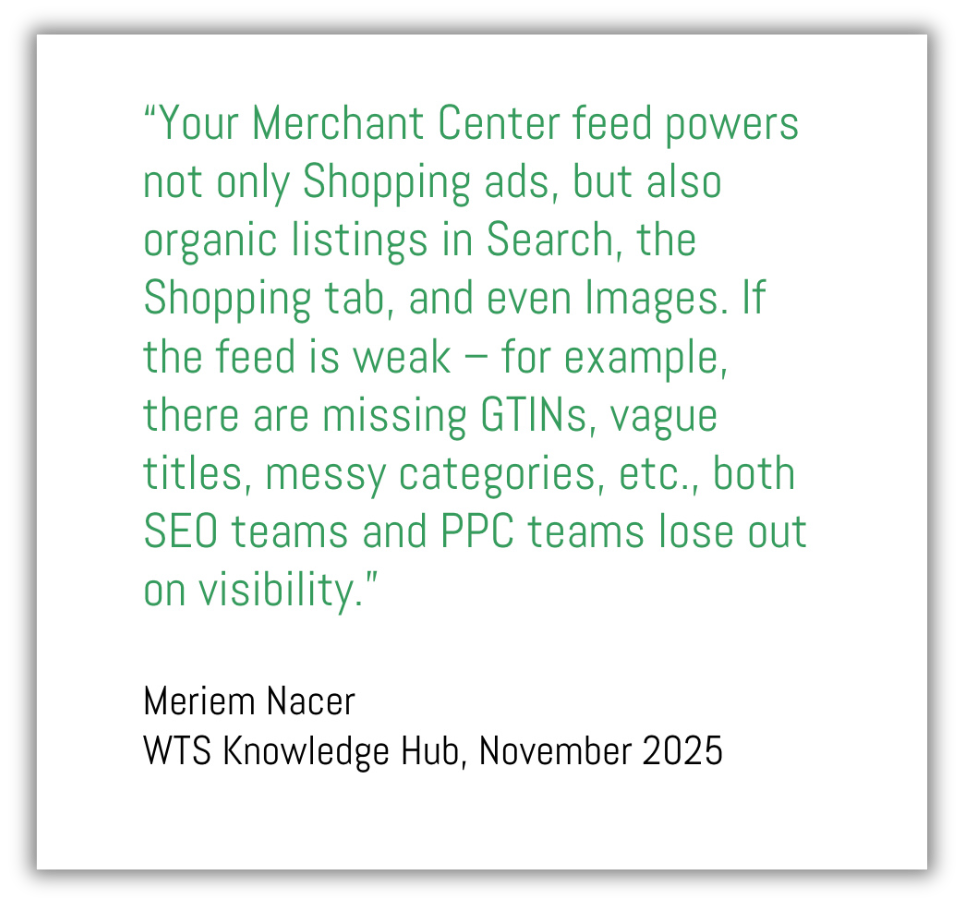
Did you know that major search engines will reference product feeds, even if you aren’t actively buying ads that feature them? Meriem Nacer shared an excellent WTS Knowledge piece on product feeds for SEO in November 2025, but the gist is this: the robots that fuel search engine discovery generally want the path of least resistance, and product feeds neatly package information for them. Search engines will reference both product feeds and crawled pages on your website to form a full picture of products, and serve them in a variety of places. The Shopping tab on Google isn’t just for ads; most of the products users browse in that experience are organic, and products with well-maintained product feeds are significantly more likely to surface and perform well in that space.
And those feeds? They’ve historically existed to be read. The search engines ingest the feed and apply their algorithmic reasoning to them, weighing them for relevance, placement, and rank. However, they don’t really understand the contents of a product feed beyond their context as data points.
Now there’s AI, and it processes feeds in vastly different ways than the relatively “simple” way traditional search engines have. Whether it’s AI Mode or Lens in Google, Copilot-augmented searches in Microsoft, Bing, and Yahoo, or searching directly in an LLM like ChatGPT or Perplexity, product feeds take on a new complexity.
When a user asks AI to help it research and choose products, the AI attempts to think like a human. The AI uses product feeds (among other sources) to shop.
To understand the benefits of product feeds, we must first understand how AI platforms obtain the information they use. When users input a prompt into an LLM, they may wait for a few moments while the AI platform “thinks,” but a lot is happening in that brief period.
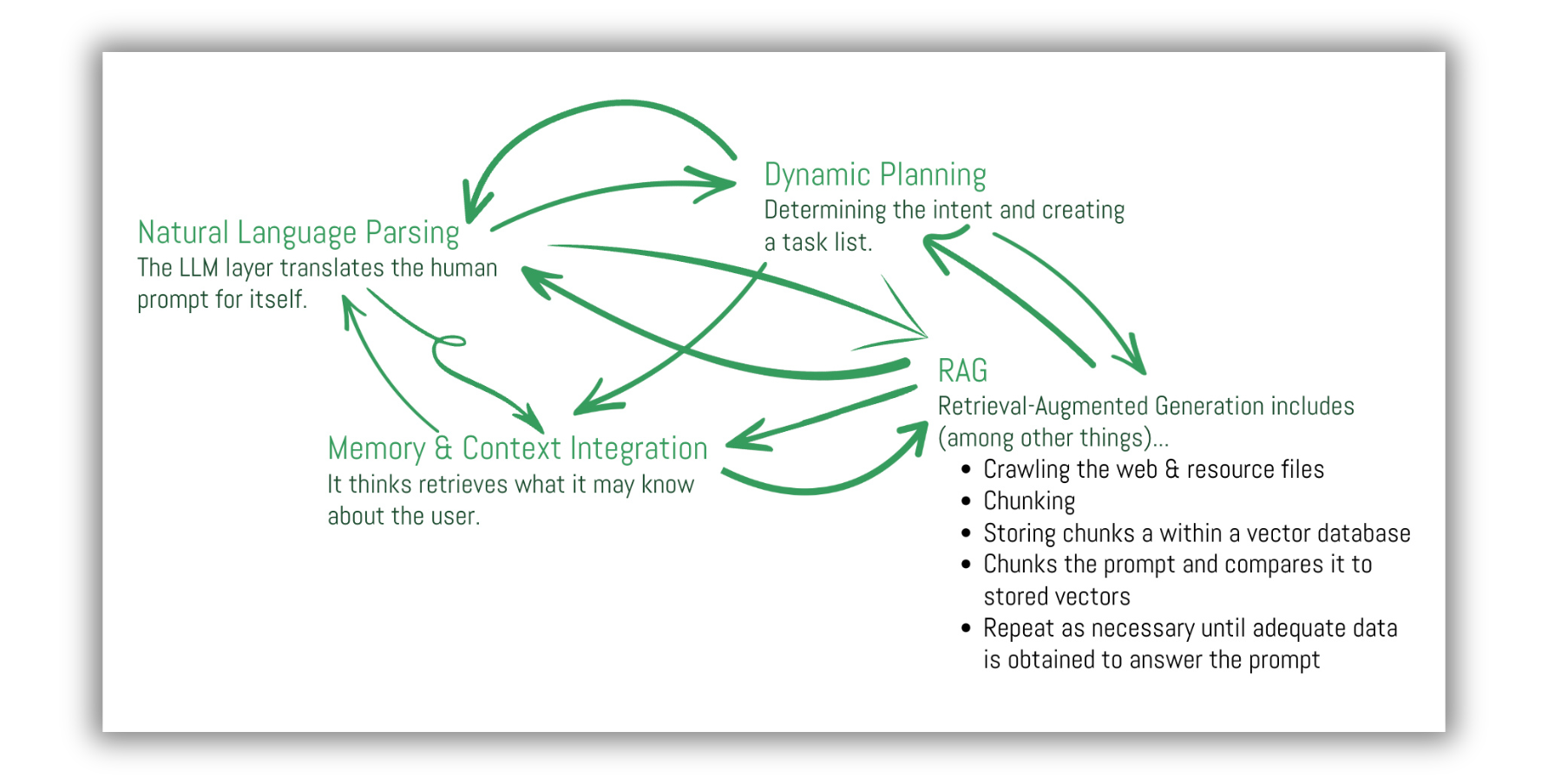
Step 1: Natural Language Parsing refers to the LLM’s work translating the human prompt into the “language” and format that LLMs use.
Step 2: Dynamic Planning is the step where the LLM determines the intent of the prompt (whether the user is shopping, just seeking information, etc.) and creates a list of tasks it can execute to fulfill the need.
Step 3: Memory & Context Integration is factored in; basically, if the LLM knows anything about the user, it considers this in relation to the information it is ingesting, reviewing, and preparing for output.
Step 4: RAG itself is a complex process that can occur in a loop until the LLM has adequate information for its response. Some of the components of RAG include:
While I have documented these as linear steps in a clean process, in reality, these things happen in a loop, in tandem, and/or in whatever order makes sense. Straightforward prompts may be processed exactly as per the steps above, but the processing of some prompts may look more like a chaotic spiderweb:
I briefly mentioned product feeds as a potential contributor to the RAG step. Making RAG easier for search engines is an important element to GEO / AEO / AIO – or whatever you want to call AI search optimization. Your product feeds are an “easy button” for getting accurate, quality information to AI search platforms. Control the things you can.
There’s often an ownership question with product feeds: some businesses are never quite sure who should own them. While it’s less complicated in small organizations where collaboration between teams is common, in larger organizations it can feel like a gray area. Should the feed belong to the merchandising and catalog teams who own the products’ digital source of truth? Or the paid media team who buys the ads where the products are served? And now that we’ve decided it’s an SEO tactic, how does the SEO team fit in?
I can’t solve that for your specific organization, but I can encourage you to explore product feed ownership within it. When I was the in-house Search Strategist for Hallmark, I accidentally became owner of the product feeds because no one else seemed positioned to do it. If you believe there may be an ownership gap for product feeds in your business (or your client’s business), start asking how you can help.
The strategic takeaway is simple, regardless of who actually owns the work: whether your visibility is organic or paid, it draws on the same product feed. Search engine and AI shopping’s source of truth doesn’t change significantly between paid and organic.
There are a LOT of potential fields in a shopping feed, and what’s required can change dramatically between different product categories. What matters for apparel is different than what matters for food products. That said, the fundamentals of good “data hygiene” apply across all product types.
The list of considerations is long, but there’s a silver lining: while there ARE some variances in product feeds between different platforms, some of them CAN use the same feeds, with the same fields. Most ecommerce platforms have some native functionality for mapping feeds to match the endpoints (i.e. using the Sales Channels features in Shopify), and if you find these insufficient there are SaaS solutions to take it across the finish line.
Now that you’ve read through a lot of theory and history, let’s talk about practical execution. Here’s what you should bake into your routine for product feed maintenance:
The online shopping journey will continue to evolve – quickly. One of my favorite metaphors about our industry is that we are all just boats riding the waves of oceans built by tech companies. While we can’t prevent every possible risk, we can control the variables within our power.
Product feeds are one of the most powerful variables at our disposal, and they’ve often been underutilized in the organic side of search engines and AI.
While it may be tempting to brush product feeds off as a consideration for paid media, treating it as an SEO and GEO input can reduce barriers between your business and its visibility in the emerging channel of agentic shopping.

Kelly Stanze - Consultant, Kelly Stanze Consulting & Creative
Kelly Stanze’s 15-year digital strategy career has spanned all business sizes, and a variety of interesting verticals. She serves clients both independently, and as Organic Search Director for Robot Logic Marketing, a full-service freelancer co-op.
WTSFest London is a place to learn, ask questions, meet new people & feel part of the room.
Whether it's your first WTSFest or you've joined us before, you'll be welcomed by a kind community that wants to see each other succeed.